Hermann Hesse - The Glass Bead Game
Здесь есть возможность читать онлайн «Hermann Hesse - The Glass Bead Game» весь текст электронной книги совершенно бесплатно (целиком полную версию без сокращений). В некоторых случаях можно слушать аудио, скачать через торрент в формате fb2 и присутствует краткое содержание. Год выпуска: 1969, Жанр: Современная проза, Социально-психологическая фантастика, на английском языке. Описание произведения, (предисловие) а так же отзывы посетителей доступны на портале библиотеки ЛибКат.
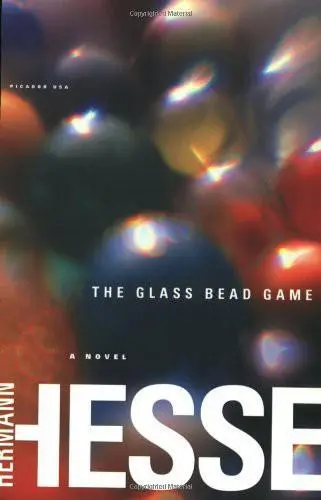
- Название:The Glass Bead Game
- Автор:
- Жанр:
- Год:1969
- ISBN:нет данных
- Рейтинг книги:4 / 5. Голосов: 2
-
Избранное:Добавить в избранное
- Отзывы:
-
Ваша оценка:
The Glass Bead Game: краткое содержание, описание и аннотация
Предлагаем к чтению аннотацию, описание, краткое содержание или предисловие (зависит от того, что написал сам автор книги «The Glass Bead Game»). Если вы не нашли необходимую информацию о книге — напишите в комментариях, мы постараемся отыскать её.
Something like chess but far more intricate, the game of Magister Ludi known as the Glass Bead Game is thought in its purest form, a synthesis through which philosophy, art, music and scientific law are appreciated simultaneously. The scholar-players are isolated within Castalia, an autonomous elite institution devoted wholly to the mind and the imagination…
The Glass Bead Game — читать онлайн бесплатно полную книгу (весь текст) целиком
Ниже представлен текст книги, разбитый по страницам. Система сохранения места последней прочитанной страницы, позволяет с удобством читать онлайн бесплатно книгу «The Glass Bead Game», без необходимости каждый раз заново искать на чём Вы остановились. Поставьте закладку, и сможете в любой момент перейти на страницу, на которой закончили чтение.
Интервал:
Закладка:
“I don’t know whether my life has been useless and merely a misunderstanding, or whether it has a meaning. If it does have a meaning, I should say it would be this: that one single specific person in our time has recognized plainly and experienced in the most painful way how far Castalia has moved away from its motherland. Or for my part it might be put the other way around: how alien our country has become from her noblest Province and how unfaithful to that Province’s spirit; how far body and soul, ideal and reality have moved apart in our country; how little they know about each other, or want to know. If I had any one task and ideal in life, it was to make myself a synthesis of the two principles, to be mediator, interpreter, and arbitrator between the two. I have tried and failed. And since after all I cannot tell you my whole life, and you would not be able to understand it all anyhow, I will describe only one of the situations in which my failure was revealed.
“The difficulty after I began attending the university consisted not so much in my being unable to deal with the teasing or hostility that came my way as a Castalian, a show-off. Those few among my new associates who regarded my coming from the elite schools as a glory gave me more trouble, in fact, and caused me greater embarrassment. No, the hard part, perhaps the impossible task I set myself, was to continue a life in the Castalian sense in the midst of worldliness. At first I scarcely noticed; I abided by the rules I had learned among you, and for some time they seemed to prove their validity in the world. They seemed to strengthen and shield me, seemed to preserve my gaiety and inner soundness and to increase my resolve to pass my student years in the Castalian way as far as possible, following the paths that my craving for knowledge indicated and not letting anything coerce me into a course of studies designed to prepare the student as thoroughly as possible in the shortest possible time for a speciality in which he could earn his livelihood, and to stamp out whatever sense of freedom and universality he may have had.
“But the protection that Castalia had given me proved dangerous and dubious, for I did not want to be like a hermit, cultivating my peace of soul and preserving a calm, meditative state of mind. I wanted to conquer the world, you see, to understand it, to force it to understand me. I wanted to affirm it and if possible renew and reform it. In my own person I wanted to bring Castalia and the world together, to reconcile them. When after some disappointment, some clash or disturbance, I retired to meditate, I derived great benefit at first; each time, meditation was like relaxation, deep breathing, a return to good, friendly powers. But in time I realized that this very practice of meditation, the cultivation and exercising of the psyche, was what isolated me, made me seem so unpleasantly strange to others, and actually rendered me incapable of really understanding them. I saw that I could really understand those others, those people in the world and of it, if I once again became like them, if I had no advantages over them, including this recourse to meditation.
“Of course it may be that I am putting it in a better light when I describe it in this way. Perhaps it was simply that without associates trained to the same practices, without supervision by teachers, without the bracing atmosphere of Waldzell, I gradually lost the discipline, that I grew sluggish and inattentive and succumbed to carelessness, and that in moments of guilty conscience I then excused myself on the ground that carelessness was one of the attributes of this world, and that by giving way to it I was coming closer to an understanding of my environment. I’m not trying to make things out better than they are for your sake, but neither do I want to deny or conceal the fact that I went to considerable lengths, that I strove and fought, even where I was mistaken. I was serious about the whole problem. But whether or not my attempt to find a meaningful place for myself was mere conceit on my part — in any case, it ended as it was bound to end. The world was stronger than I was; it slowly overwhelmed and devoured me. It was exactly as if life took me at my word and molded me wholly to the world whose rightness, naive strength, and ontological superiority I so highly praised and defended against your logic in our Waldzell disputations. You remember.
“And now I must remind you of something else which you probably forgot long ago, since it meant nothing to you. But it meant a great deal to me; it was important, important and terrible. My student years had come to an end; I had adapted, had been defeated, but not entirely. Inwardly I still thought of myself as your equal and imagined that I had made certain adjustments, shed certain customs, more out of prudence and free choice than as the consequence of defeat. And so I also clung to a good many of the habits and needs of my earlier years. Among them was the Glass Bead Game, which probably had little point, since without constant practice and constant association with equal and especially with better players, it’s impossible to learn anything, of course. Playing alone can at best replace such practice the way talking to oneself replaces real, serious dialogue. So without really understanding how I stood, what had happened to my player’s skill, my culture, my status as an elite pupil, I struggled to save at least some of these values. In those days, whenever I sketched a Game pattern or analyzed a Game movement for one of my friends who knew something about the Game but had no notion of its spirit, it probably seemed akin to magic to these total ignoramuses. Then, in my third or fourth year at the university, I took part in a Game course in Waldzell. Seeing the countryside and the town again, visiting our old school and the Players’ Village, gave me melancholy pleasure; but you were not here; you were studying somewhere in Monteport or Keuperheim at the time, and were considered an ambitious eccentric. My Game course was only a series of summer classes for pitiable worldlings and dilettantes like myself. Nevertheless, I worked hard at it and was proud at the end of the course to receive the usual C , that passing mark which qualifies the holder for future vacation courses of the same sort.
“Well, then, a few years later I once again summoned up the energy and signed up for a vacation course under your predecessor. I tried to prepare myself for Waldzell. I read through my old exercise books, made some stabs at the technique of concentration — in short, within my modest limits I composed myself, gathered my energies, and put myself in the mood for the course rather the way a real Glass Bead Game player readies himself for the great annual Game. And so I arrived in Waldzell, where after this longer interval I found myself a good deal more alienated, but at the same time enchanted, as if I were returning to a lovely land I had lost, in whose language I was no longer very fluent. And this time my fervent wish to see you again was granted. Do you by any chance recall, Joseph?”
Knecht looked earnestly into his eyes, nodded and smiled slightly, but said not a word.
“Good,” Designori continued. “So you remember. But just what do you remember? A casual reunion with a schoolmate, a brief encounter and disappointment, after which one goes on and thinks no more about it, unless the other fellow tactlessly reminds one about it decades later. Isn’t that it? Was it anything else, was it more than that for you?”
Although he was obviously trying very hard to hold himself in check, it was apparent that emotions accumulated over many years, and never mastered, were on the brink of eruption.
“You are anticipating,” Knecht said carefully. “We will speak of my impressions when it is my turn to render an accounting. You have the floor now, Plinio. I see that the meeting was not pleasant for you. It was not for me either, at the time. And now go on and tell me what it was like. Speak bluntly.”
Читать дальшеИнтервал:
Закладка:
Похожие книги на «The Glass Bead Game»
Представляем Вашему вниманию похожие книги на «The Glass Bead Game» списком для выбора. Мы отобрали схожую по названию и смыслу литературу в надежде предоставить читателям больше вариантов отыскать новые, интересные, ещё непрочитанные произведения.







Обсуждение, отзывы о книге «The Glass Bead Game» и просто собственные мнения читателей. Оставьте ваши комментарии, напишите, что Вы думаете о произведении, его смысле или главных героях. Укажите что конкретно понравилось, а что нет, и почему Вы так считаете.