Hermann Hesse - The Glass Bead Game
Здесь есть возможность читать онлайн «Hermann Hesse - The Glass Bead Game» весь текст электронной книги совершенно бесплатно (целиком полную версию без сокращений). В некоторых случаях можно слушать аудио, скачать через торрент в формате fb2 и присутствует краткое содержание. Год выпуска: 1969, Жанр: Современная проза, Социально-психологическая фантастика, на английском языке. Описание произведения, (предисловие) а так же отзывы посетителей доступны на портале библиотеки ЛибКат.
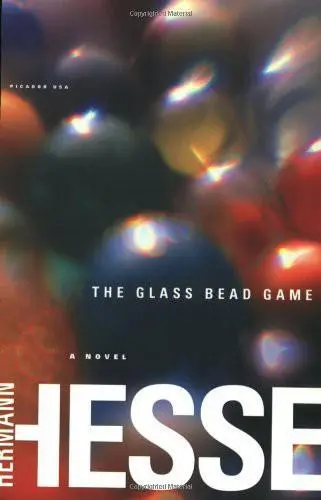
- Название:The Glass Bead Game
- Автор:
- Жанр:
- Год:1969
- ISBN:нет данных
- Рейтинг книги:4 / 5. Голосов: 2
-
Избранное:Добавить в избранное
- Отзывы:
-
Ваша оценка:
The Glass Bead Game: краткое содержание, описание и аннотация
Предлагаем к чтению аннотацию, описание, краткое содержание или предисловие (зависит от того, что написал сам автор книги «The Glass Bead Game»). Если вы не нашли необходимую информацию о книге — напишите в комментариях, мы постараемся отыскать её.
Something like chess but far more intricate, the game of Magister Ludi known as the Glass Bead Game is thought in its purest form, a synthesis through which philosophy, art, music and scientific law are appreciated simultaneously. The scholar-players are isolated within Castalia, an autonomous elite institution devoted wholly to the mind and the imagination…
The Glass Bead Game — читать онлайн бесплатно полную книгу (весь текст) целиком
Ниже представлен текст книги, разбитый по страницам. Система сохранения места последней прочитанной страницы, позволяет с удобством читать онлайн бесплатно книгу «The Glass Bead Game», без необходимости каждый раз заново искать на чём Вы остановились. Поставьте закладку, и сможете в любой момент перейти на страницу, на которой закончили чтение.
Интервал:
Закладка:
It was an exalted festival. Even the envoys from the outside world sensed this, and proclaimed it; and in the course of those days a good many new converts were won over to the Glass Bead Game forever. In the light of this triumph, however, Joseph Knecht, at the end of the ten-day festival, made some highly curious remarks in summing up the experience to his friend Tegularius. “We may be content,” he said. “Yes, Castalia and the Glass Bead Game are wonderful things; they come close to being perfect. Only perhaps they are too much so, too beautiful. They are so beautiful that one can scarcely contemplate them without fearing for them. It is not pleasant to think that some day they are bound to pass away as everything else does. And yet one must think of that.”
With this historic statement, the biographer is forced to approach the most delicate and mysterious part of his task. Indeed, he would have preferred to postpone it for a while longer and continue — with that placidity which clear and unambiguous conditions afford to the narrator of them — to depict Knecht’s successes, his exemplary conduct of his office, the brilliant peak of his life. But it would seem to us misleading, and out of keeping with our subject, if we failed to take account of the duality, or call it polarity, in the revered Master’s life and character, even though it was so far known to no one but Tegularius. From now on our task, in fact, will be to accept this dichotomy in Knecht’s soul, or rather this ever-alternating polarity, as the central feature of his nature, and to affirm it as such. As a matter of fact, a biographer who thought it proper to deal with the life of a Castalian Magister entirely in the spirit of hagiography, ad maiorem gloriam Castaliae, would not find it at all difficult to describe Joseph Knecht’s years as Magister, with the sole exception of the last moments, entirely as a glorious list of achievements, duties performed, and successes. To the eye of the historian who holds solely to the documented facts, Magister Knecht’s conduct in office appears as blameless and praiseworthy as that of any Glass Bead Game Master in history, not even excepting that of Magister Ludwig Wassermaler who reigned during the era of Waldzell’s most exuberant passion for the Game. Nevertheless, Knecht’s period in office came to a most unusual, sensational, and to the minds of many judges scandalous end, and this end was not mere chance or misfortune but a wholly logical outcome of what went before. It is part of our task to show that it by no means contradicts the reverend Master’s brilliant and laudable achievements. Knecht was a great, an exemplary administrator, an honor to his high office, an irreproachable Glass Bead Game Master. But he saw and felt the glory of Castalia, even as he devoted himself to it, as an imperiled greatness that was on the wane. He did not participate in its life thoughtlessly and unsuspectingly, as did the great majority of his fellow Castalians, for he knew about its origins and history, was conscious of it as a historical entity, subject to time, washed and undermined by time’s pitiless surges. This sensitivity to the pulse of historical process and this feeling for his own self and activities as a cell carried along in the stream of growth and transformation, had ripened within him in the course of his historical studies. Much was due to the influence of the great Benedictine Father Jacobus, but the germs of such consciousness had been present within him long before. Anyone who honestly tries to explore the meaning of that life, to analyze its idiosyncrasy, will easily discover these germs.
The man who could say, on one of the finest days of his life, at the end of his first festival Game and after a singularly successful and impressive demonstration of the Castalian spirit, “It is not pleasant to think that some day Castalia and the Glass Bead Game are bound to pass away — and yet one must think of that” — this man had early on, long before he had acquired insight into history, borne within himself a metaphysical sense of the transitoriness of all that has evolved and the problematical nature of everything created by the human mind. If we go back to his boyhood we will remember his depression and uneasiness whenever a fellow pupil disappeared from Eschholz because he had disappointed his teachers and been demoted from the elite to the ordinary schools. There is no record that a single one of those expelled had been a close friend of young Joseph; what disturbed him was not personal loss, not the absence of this or that individual. Rather, his grief was caused by the mild shock to his child’s faith in the permanence of Castalian order and Castalian perfection. He himself took his vocation so seriously as something sacred, and yet there were boys and youths who had been granted the happiness of acceptance into the elite schools of the Province and had squandered this boon, thrown it away. This was shocking, and a sign of the power of the world outside Castalia. Perhaps also — though here we can only speculate — such incidents aroused the boy’s first doubts of the Board of Educators’ infallibility, since this Board now and then brought to Castalia pupils whom it subsequently had to dismiss again. There is no saying whether these earliest stirrings of criticism of authority also affected his thinking.
In any case, the boy felt every dismissal of an elite pupil not only as a misfortune, but also as an impropriety, an ugly glaring stain, whose presence was in itself a reproach involving all of Castalia. This, we think, is the basis for that feeling of shock and distraction which Knecht as a schoolboy experienced on such occasions. Outside, beyond the boundaries of the Province, was a way of life which ran counter to Castalia and its laws, which did not abide by the Castalian system and could not be tamed and sublimated by it. And of course he was aware of the presence of this world in his own heart also. He too had impulses, fantasies, and desires which ran counter to the laws that governed him, impulses which he had only gradually managed to subdue by hard effort.
These impulses, he concluded, could be so strong in a good many pupils that they erupted despite all restraints and led those who yielded to them away from the elite world of Castalia and into that other world which was dominated not by discipline and cultivation of the mind, but by instincts. To one striving for Castalian virtue that world seemed sometimes a wicked underworld, sometimes a tempting playground and arena. For generations many young consciences have experienced the concept of sin in this Castalian form. And many years later, as an adult student of history, Knecht was to perceive more distinctly that history cannot come into being without the substance and the dynamism of this sinful world of egoism and instinctuality, and that even such sublime creations as the Order were born in this cloudy torrent and sooner or later will be swallowed up by it again. This is what underlay all the powerful movements, aspirations, and upheavals in Knecht’s life. Nor was this ever merely an intellectual problem for him. Rather, it engaged his innermost self more than any other problem, and he felt it as partly his responsibility. His was one of those natures which can sicken, languish, and die when they see an ideal they have believed in, or the country and community they love, afflicted with ills.
Tracing this same thread further, we come to Knecht’s first period in Waldzell, his final years as a schoolboy, and his significant meeting with the guest pupil Designori, which we have described in detail in its proper place. This encounter between the ardent adherent of the Castalian ideals and the worldling Plinio was not only intense and long-lasting in its effects, but also had a deeply symbolic significance for young Knecht. For the strenuous and important role imposed upon him at that time, seemingly sent his way by sheer chance, in fact so closely corresponded with his whole nature that we are tempted to say his later life was nothing but a reiteration of this role, an ever more perfect adaptation to it. The role, of course, was that of champion and representer of Castalia. He had to play it once more some ten years later against Father Jacobus, and as Master of the Glass Bead Game he played it to the end: champion and representative of the Order and its laws, but one who was constantly endeavoring to learn from his antagonist and to promote not the rigid isolation of Castalia, but its vital collaboration and confrontation with the outside world. The oratorical contest with Designori had been partly a game. With his far more substantial friendly antagonist, Father Jacobus, it was altogether serious. He had proved himself against both opponents, had matured in his encounter with them, had learned from them, had given as much as he had taken in the course of their disputes and exchanges of views. In neither case had he defeated his antagonist; from the start that had not, after all, been the goal of the disputations. But he had succeeded in making each of them respect him as a person, and the principles and ideal he advocated. Even if the disputation with the learned Benedictine had not led directly to its practical result, the establishment of a semiofficial Castalian envoy at the Holy See, it would have been of greater value than the majority of Castalians could have guessed.
Читать дальшеИнтервал:
Закладка:
Похожие книги на «The Glass Bead Game»
Представляем Вашему вниманию похожие книги на «The Glass Bead Game» списком для выбора. Мы отобрали схожую по названию и смыслу литературу в надежде предоставить читателям больше вариантов отыскать новые, интересные, ещё непрочитанные произведения.









Обсуждение, отзывы о книге «The Glass Bead Game» и просто собственные мнения читателей. Оставьте ваши комментарии, напишите, что Вы думаете о произведении, его смысле или главных героях. Укажите что конкретно понравилось, а что нет, и почему Вы так считаете.