Hermann Hesse - The Glass Bead Game
Здесь есть возможность читать онлайн «Hermann Hesse - The Glass Bead Game» весь текст электронной книги совершенно бесплатно (целиком полную версию без сокращений). В некоторых случаях можно слушать аудио, скачать через торрент в формате fb2 и присутствует краткое содержание. Год выпуска: 1969, Жанр: Современная проза, Социально-психологическая фантастика, на английском языке. Описание произведения, (предисловие) а так же отзывы посетителей доступны на портале библиотеки ЛибКат.
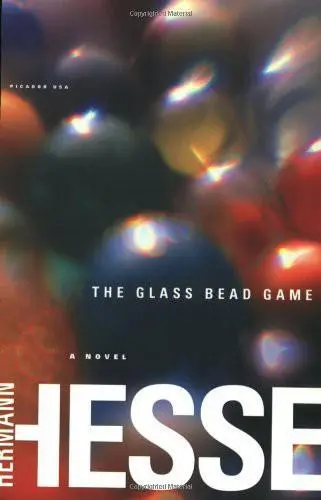
- Название:The Glass Bead Game
- Автор:
- Жанр:
- Год:1969
- ISBN:нет данных
- Рейтинг книги:4 / 5. Голосов: 2
-
Избранное:Добавить в избранное
- Отзывы:
-
Ваша оценка:
The Glass Bead Game: краткое содержание, описание и аннотация
Предлагаем к чтению аннотацию, описание, краткое содержание или предисловие (зависит от того, что написал сам автор книги «The Glass Bead Game»). Если вы не нашли необходимую информацию о книге — напишите в комментариях, мы постараемся отыскать её.
Something like chess but far more intricate, the game of Magister Ludi known as the Glass Bead Game is thought in its purest form, a synthesis through which philosophy, art, music and scientific law are appreciated simultaneously. The scholar-players are isolated within Castalia, an autonomous elite institution devoted wholly to the mind and the imagination…
The Glass Bead Game — читать онлайн бесплатно полную книгу (весь текст) целиком
Ниже представлен текст книги, разбитый по страницам. Система сохранения места последней прочитанной страницы, позволяет с удобством читать онлайн бесплатно книгу «The Glass Bead Game», без необходимости каждый раз заново искать на чём Вы остановились. Поставьте закладку, и сможете в любой момент перейти на страницу, на которой закончили чтение.
Интервал:
Закладка:
Knecht laughed. “That was quite a roundabout way for you to discover your own dislike for poor Petrus,” he said. “But what now? Am I also a mystic and enthusiast? Am I too indulging in the forbidden cult of personality and hagiolatry? Or are you admitting to me what you won’t admit to the student, that we have seen and experienced something real, objective, not mere dreams and fancies?”
“Of course I admit it to you,” Carlo replied slowly and thoughtfully. “No one is going to deny your experience or doubt the beauty and serenity of the Magister who can smile at us in that incredible way. The question is only: Where do we classify this phenomenon? What do we call it, how explain it? That sounds like the pedantic schoolmaster, but we Castalians are schoolmasters, after all; and if I want to classify and find a term for your and our experience, it is not because I wish to destroy its beauty by generalizing it, but because I want to describe and preserve it as distinctly as possible. If on a journey I hear a peasant or child humming a melody I have never heard before, that is likewise an important experience for me, and if I immediately try to transcribe this melody as precisely as I can, I am not dismissing and filing it away, but paying due honor to my experience, and taking care that it is not lost.”
Knecht gave him a friendly nod. “Carlo,” he said, “it is a great pity we can so rarely see each other any more. Not all friendships of youth survive reunions. I came to you with my story about the old Magister because you are the only person here whose knowing and sharing it matters to me. Now I must leave it to you to do with my story whatever you like, and to assign whatever term you will to our Master’s transfigured state. It would make me happy if you would call on him and stay in his aura for a little while. His state of grace, perfection, wisdom of age, bliss, or whatever we want to call it, may belong to religious life. But although we Castalians have neither denominations nor churches, piety is not altogether unknown to us. And our former Music Master in particular was always a thoroughly pious person. Since there are accounts of blessed, perfected, radiant, transfigured souls in many religions, why should not our Castalian piety occasionally have this kind of blossoming?… It is late by now — I ought to go to sleep — I must leave early tomorrow morning. But I hope to come back soon. Let me just briefly tell you the end of my story. After he had said to me, ‘You are tiring yourself,’ I was at last able to stop straining at conversation; I managed not only to be still, but to turn my will away from the foolish goal of using words in the effort to probe this man of silence and draw profit from him. And the moment I gave up that effort and left everything to him, it all went of its own accord. You may want to substitute terms of your own for mine, but please listen to me, even if I seem vague or confound categories. I stayed about an hour or an hour and a half with the old man, and I cannot communicate to you what went on between us or what was exchanged; certainly no words were spoken. I felt, after my resistance was broken, only that he received me into his peace and his brightness; cheerful serenity and a wonderful peace enclosed the two of us. Without my having deliberately and consciously meditated, it somewhat resembled an unusually successful and gladdening meditation whose subject might have been the Magister’s life. I saw or felt him and the course of his growth from the time he first entered my life, when I was a boy, up to this present moment. His was a life of devotion and work, but free of obstructions, free of ambition, and full of music. It was as if by becoming a musician and Music Master he had chosen music as one of the ways toward man’s highest goal, inner freedom, purity, perfection, and as though ever since making that choice he had done nothing but let himself be more and more permeated, transformed, purified by music — his entire self from his nimble, clever pianist’s hands and his vast, well-stocked musician’s memory to all the parts and organs of body and soul, to his pulses and breathing, to his sleep and dreaming — so that he was now only a symbol, or rather a manifestation, a personification of music. At any rate, I experienced what radiated from him, or what surged back and forth between him and me like rhythmic breathing, entirely as music, as an altogether immaterial esoteric music which absorbs everyone who enters its magic circle as a song for many voices absorbs an entering voice. Perhaps a non-musician would have perceived this grace in different images: an astronomer might have seen it as a moon circling around a planet, or a philologist heard it as some magical primal language containing all meanings. But enough for now, I must be going. It’s been a great pleasure, Carlo.”
We have reported this episode in some detail, since the Music Master held so important a place in Knecht’s life and heart. We have also been drawn into prolixity by the chance circumstance that Knecht’s talk with Ferromonte has come down to us in the latter’s own record of it in a letter. This is certainly the earliest and most reliable account of the Music Master’s “transfiguration”; later, of course, there was a swarm of legends and embroideries.
EIGHT
THE TWO POLES
THE ANNUAL GAME, remembered to this day as the Chinese House Game, and often quoted, was for Knecht and his friend Tegularius a happy outcome to their labors, and for Castalia and the Boards proof that they had done well to summon Knecht to the highest office. Once more Waldzell, the Players’ Village, and the elite had the satisfaction of a splendid and exultant festival. Not for many years had the annual Game been such an event as it was this time, with the youngest and most-discussed Magister in Castalian history making his first public appearance and showing what he could do. Moreover, Waldzell was determined to make up for the failure and disgrace of the previous year. This time no one lay ill, no cowed deputy awaited the great ceremony with apprehension, coldly ringed by the malevolent distrust of the elite, faithfully but listessly supported by nervous officials. Quiet, inaccessible, entirely the high priest, white-and-gold-clad major piece on the solemn chessboard of symbols, the Magister celebrated his and his friend’s work. Radiating calm, strength, and dignity, beyond the reach of any profane summons, he appeared in the festival hall in the midst of his many acolytes, conducting step after step of his Game with the ritual gestures. With a luminous golden stylus he delicately inscribed character after character on the small tablet before him, and the same characters promptly appeared in the script of the Game, enlarged a hundredfold, upon the gigantic board on the rear wall of the hall, to be spelled out by a thousand whispering voices, called out by the Speakers, broadcast to the country and the world. And when at the end of the first act he wrote the summary formula for that act upon his tablet, with graceful and impressive poise gave instructions for the meditation, laid down the stylus and, taking his seat, assumed the perfect meditation posture, in the hall, in the Players’ Village, throughout Castalia and beyond, in many countries of the globe, the faithful devotees of the Glass Bead Game reverently sat down for the selfsame meditation and sustained it until the moment the Magister in the hall rose to his feet once again. It was all as it had been many times before, and yet it was all stirring and new. The abstract and seemingly timeless world of the Game was flexible enough to respond, in a hundred nuances, to the mind, voice, temperament, and handwriting of a given personality, and the personality in this case was great and cultivated enough to subordinate his own inspirations to the inviolable inner laws of the Game itself. The assistants and fellow players, the elite, obeyed like well-drilled soldiers, yet each one of them, even though he might be executing only the bows or helping to draw the curtain around the meditating Master, seemed to be performing his own Game, inspired by his own ideas. But it was the crowd, the great congregation filling the hall and all of Waldzell, the thousands of souls who followed the Master down the hieratic and labyrinthine ways through the endless, multidimensional imagery of the Game, who furnished the fundamental chord for the ceremony, the low, throbbing base bellnote, which for the more simple-hearted members of the community is the best and almost the only experience the festival yields, but which also awakens awe in the subtle virtuosi and critics of the elite, in the acolytes and officials all the way up to the leader and Master.
Читать дальшеИнтервал:
Закладка:
Похожие книги на «The Glass Bead Game»
Представляем Вашему вниманию похожие книги на «The Glass Bead Game» списком для выбора. Мы отобрали схожую по названию и смыслу литературу в надежде предоставить читателям больше вариантов отыскать новые, интересные, ещё непрочитанные произведения.






Обсуждение, отзывы о книге «The Glass Bead Game» и просто собственные мнения читателей. Оставьте ваши комментарии, напишите, что Вы думаете о произведении, его смысле или главных героях. Укажите что конкретно понравилось, а что нет, и почему Вы так считаете.