Hermann Hesse - The Glass Bead Game
Здесь есть возможность читать онлайн «Hermann Hesse - The Glass Bead Game» весь текст электронной книги совершенно бесплатно (целиком полную версию без сокращений). В некоторых случаях можно слушать аудио, скачать через торрент в формате fb2 и присутствует краткое содержание. Год выпуска: 1969, Жанр: Современная проза, Социально-психологическая фантастика, на английском языке. Описание произведения, (предисловие) а так же отзывы посетителей доступны на портале библиотеки ЛибКат.
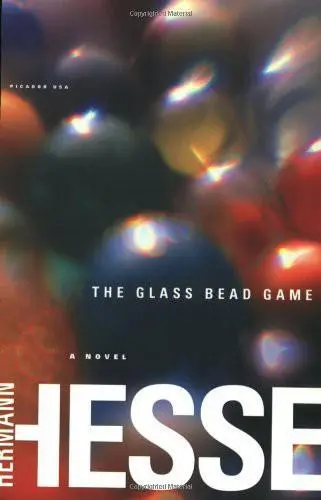
- Название:The Glass Bead Game
- Автор:
- Жанр:
- Год:1969
- ISBN:нет данных
- Рейтинг книги:4 / 5. Голосов: 2
-
Избранное:Добавить в избранное
- Отзывы:
-
Ваша оценка:
The Glass Bead Game: краткое содержание, описание и аннотация
Предлагаем к чтению аннотацию, описание, краткое содержание или предисловие (зависит от того, что написал сам автор книги «The Glass Bead Game»). Если вы не нашли необходимую информацию о книге — напишите в комментариях, мы постараемся отыскать её.
Something like chess but far more intricate, the game of Magister Ludi known as the Glass Bead Game is thought in its purest form, a synthesis through which philosophy, art, music and scientific law are appreciated simultaneously. The scholar-players are isolated within Castalia, an autonomous elite institution devoted wholly to the mind and the imagination…
The Glass Bead Game — читать онлайн бесплатно полную книгу (весь текст) целиком
Ниже представлен текст книги, разбитый по страницам. Система сохранения места последней прочитанной страницы, позволяет с удобством читать онлайн бесплатно книгу «The Glass Bead Game», без необходимости каждый раз заново искать на чём Вы остановились. Поставьте закладку, и сможете в любой момент перейти на страницу, на которой закончили чтение.
Интервал:
Закладка:
Knecht had had scant difficulty obtaining the consent of both the monks and his home authorities for his decision. He could not quite determine the nature of his position after his reassignment to the little republic of the Vicus Lusorum, but he suspected that he would not long be left unoccupied and would soon be burdened and honored with some new office or mission. For the present he looked forward happily to returning home, to seeing his friends and participating in the approaching festival. He enjoyed his last days with Father Jacobus, and accepted with dignity and good humor the rather demonstrative kindnesses of the Abbot and monks when the time came for farewells. Then he left, feeling some sadness at parting from a place he had grown fond of and from a stage in his life he was now leaving behind, but also in a mood of festive anticipation, for although he lacked guidance and companions, he had, on his own initiative, scrupulously undertaken the whole series of meditation exercises prescribed as preparations for the festival Game. He had not been able to prevail on Father Jacobus to accept the Magister Ludi’s formal invitation to attend the annual Game and accompany him, but this had not affected his good spirits; he understood the old anti-Castalian’s reserved attitude, and he himself for the moment felt entirely relieved of all duties and restrictions and ready to surrender his whole mind to the impending ceremonies.
Festivities have their own peculiar nature. A genuine festival cannot go entirely wrong, unless it is spoiled by the unfortunate intervention of higher powers. For the devout soul, even in a downpour a procession retains its sacral quality, and a burned feast does not depress him. For the Glass Bead Game player every annual Game is festive and in a sense hallowed. Nevertheless, as every one of us knows, there are some festivals and games in which everything goes right, and every element lifts up, animates, and exalts every other, just as there are theatrical and musical performances which without any clearly discernible cause seem to ascend miraculously to glorious climaxes and intensely felt experiences, whereas others, just as well prepared, remain no more than decent tries. Insofar as the achievement of intense experiences depends on the emotional state of the spectator, Joseph Knecht had the best imaginable preparation: he was troubled by no cares, returning from abroad loaded with honors, and looking forward with joyous anticipation to the coming event.
Nevertheless, this time the Ludus sollemnis was not destined to be touched by that aura of the miraculous and so rise to a special degree of consecration and radiance. It turned out, in fact, a cheerless, distinctly unhappy, and something very close to an unsuccessful Game. Although many of the participants may have felt edified and exalted all the same, the real actors and organizers of the Game, as always in such cases, felt all the more inexorably that atmosphere of apathy, lack of grace and failure, of inhibition and bad luck which overshadowed this festival. Knecht, although he of course sensed it and found his high expectations somewhat dashed, was by no means among those who felt the fiasco most keenly. Even though the solemn act failed to reach the true peak of perfection and blessing, he was able, because he was not playing and bore no responsibility for it, to follow the ingeniously constructed Game appreciatively, as a devout spectator, to let the meditations quiver to a halt undisturbed, and with grateful devotion to share that experience so familiar to all guests at these Games: the sense of ceremony and sacrifice, of mystic union of the congregation at the feet of the divine, which could be conveyed even by a ceremony that, for the narrow circle of initiates, was regarded as a “failure.” Nevertheless, he too was not altogether unaffected by the unlucky star that seemed to preside over this festival. The Game itself, to be sure, was irreproachable in plan and construction, like every one of Master Thomas’s Games; in fact it was one of his cleanest, most direct, and impressive achievements. But its performance was specially ill-starred and has not yet been forgotten in the history of Waldzell.
When Knecht arrived, a week before the opening of the great Game, he was received not by the Magister Ludi himself, but by his deputy Bertram, who welcomed him courteously but informed him rather curtly and distractedly that the venerable Master had recently fallen ill and that he, Bertram, was not sufficiently informed about Knecht’s mission to receive his report. Would he therefore go to Hirsland to report his return to the directorate of the Order and await its commands.
As he took his leave Knecht involuntarily betrayed, by tone or gesture, his surprise at the coolness and shortness of his reception. Bertram apologized. “Do forgive me if I have disappointed you, and please understand my situation,” he said. “The Magister is ill, the annual Game is upon us, and everything is up in the air. I don’t know whether the Magister will be able to conduct the Game or whether I shall have to leap into the breach.” The revered Master’s illness could not have come at a more difficult moment, he went on to say. He was ready as always to assume the Magister’s official duties, but if in addition he had to prepare himself at such short notice to conduct the great Game, he was afraid it would prove a task beyond his powers.
Knecht felt sorry for the man, who was so obviously depressed and thrown off balance; he was also sorry that the responsibility for the festival might now lie in the deputy’s hands. Joseph had been away from Waldzell too long to know how well founded Bertram’s anxiety was. The worst thing that can happen to a deputy had already befallen the man: some time past he had forfeited the trust of the elite, so that he was truly in a very difficult position.
With considerable concern, Knecht thought of the Magister Ludi, that great exponent of classical form and irony, the perfect Master and Castalian. He had looked forward eagerly to the Magister’s receiving him, listening to his report, and reinstalling him in the small community of players, perhaps in some confidential post. It had been his desire to see the festival Game presided over by Master Thomas, to continue working under him and courting his recognition. Now it was painful and disappointing to find the Magister withdrawn into illness, and to be directed to other authorities. There was, however, some compensation in the respectful good will with which the secretary of the Order and Monsieur Dubois received him and heard him out. They treated him, in fact, as a colleague. During their first talk he discovered that for the present at any rate they had no intention of using him to promote the Roman project. They were going to respect his desire for a permanent return to the Game. For the moment they extended a friendly invitation to him to stay in the guesthouse of the Vicus Lusorum, attend the annual Game, and survey the situation. Together with his friend Tegularius, he devoted the days before the public ceremonies to the exercises in fasting and meditation. That was one of the reasons he was able to witness in so devout and grateful a spirit the strange Game which has left an unpleasant aftertaste in the memories of some.
The position of the deputy Masters, also called “Shadows,” is a very peculiar one — especially the deputies to the Music Master and the Glass Bead Game Master. Every Magister has a deputy who is not provided for him by the authorities. Rather, he himself chooses his deputy from the narrow circle of his own candidates. The Master himself bears the full responsibility for all the actions and decisions of his deputy. For a candidate it is therefore a great distinction and a sign of the highest trust when he is appointed deputy by his Magister. He is thereby recognized as the intimate associate and right hand of the all-powerful Magister. Whenever the Magister is prevented from performing his official duties, he sends the deputy in his stead. The deputy, however, is not entitled to act in all capacities. For example, when the Supreme Board votes, he may transmit only a yea or nay in the Master’s name and is never permitted to deliver an address or present motions on his own. There are a variety of other precautionary restrictions on the deputies.
Читать дальшеИнтервал:
Закладка:
Похожие книги на «The Glass Bead Game»
Представляем Вашему вниманию похожие книги на «The Glass Bead Game» списком для выбора. Мы отобрали схожую по названию и смыслу литературу в надежде предоставить читателям больше вариантов отыскать новые, интересные, ещё непрочитанные произведения.









Обсуждение, отзывы о книге «The Glass Bead Game» и просто собственные мнения читателей. Оставьте ваши комментарии, напишите, что Вы думаете о произведении, его смысле или главных героях. Укажите что конкретно понравилось, а что нет, и почему Вы так считаете.