J.M. le Clézio - Desert
Здесь есть возможность читать онлайн «J.M. le Clézio - Desert» весь текст электронной книги совершенно бесплатно (целиком полную версию без сокращений). В некоторых случаях можно слушать аудио, скачать через торрент в формате fb2 и присутствует краткое содержание. Город: Jaffrey, Год выпуска: 2009, ISBN: 2009, Издательство: Verba Mundi Books, Жанр: Современная проза, на английском языке. Описание произведения, (предисловие) а так же отзывы посетителей доступны на портале библиотеки ЛибКат.
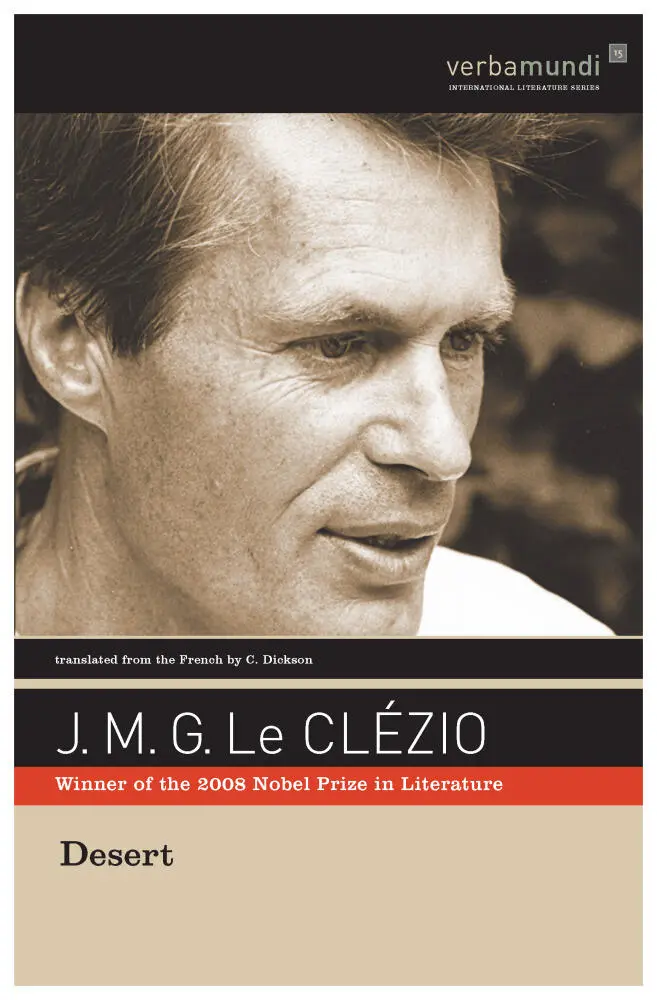
- Название:Desert
- Автор:
- Издательство:Verba Mundi Books
- Жанр:
- Год:2009
- Город:Jaffrey
- ISBN:978-1-56792-386-5
- Рейтинг книги:5 / 5. Голосов: 1
-
Избранное:Добавить в избранное
- Отзывы:
-
Ваша оценка:
Desert: краткое содержание, описание и аннотация
Предлагаем к чтению аннотацию, описание, краткое содержание или предисловие (зависит от того, что написал сам автор книги «Desert»). Если вы не нашли необходимую информацию о книге — напишите в комментариях, мы постараемся отыскать её.
Available for the first time in English translation, Desert is a novel composed of two alternating narratives, set in counterpoint. The first takes place in the desert between 1909 and 1912 and evokes the migration of a young adolescent boy, Nour, and his people, the Blue Men, notorious warriors of the desert. Driven from their lands by French colonial soldiers, Nour's tribe has come to the valley of the Saguiet El Hamra to seek the aid of the great spiritual leader known as Water of the Eyes. The religious chief sends them out from the holy city of Smara into the desert to travel still further. Spurred on by thirst, hunger, and suffering, Nour's tribe and others flee northward in the hopes of finding a land that can harbor them at last.
The second narrative relates the contemporary story of Lalla, a descendant of the Blue Men. Though she is an orphan living in a shantytown known as the Project near a coastal city in Morocco, the blood of her proud, obstinate tribe runs in her veins. All too soon, Lalla must flee to escape a forced marriage with an older, wealthy man. She travels to France, undergoing many trials there, from working as a hotel maid to becoming a highly-paid fashion model, and yet she never betrays the blood of her ancestors.
Desert — читать онлайн бесплатно полную книгу (весь текст) целиком
Ниже представлен текст книги, разбитый по страницам. Система сохранения места последней прочитанной страницы, позволяет с удобством читать онлайн бесплатно книгу «Desert», без необходимости каждый раз заново искать на чём Вы остановились. Поставьте закладку, и сможете в любой момент перейти на страницу, на которой закончили чтение.
Интервал:
Закладка:
At mealtime, when he went to have some bread and millet porridge with the blue men, Nour watched the star-filled night covering the earth. Weariness burned his skin, fever too, throwing its long shivers down his body.
In their makeshift campsite, under the shelters of branches and leaves, the blue men no longer spoke, no longer told the legend of Ma al-Aïnine, no longer sang. Wrapped in their ragged cloaks, they stared into the burning coals, blinking when the wind swept the smoke back. Maybe they weren’t waiting for anything anymore, eyes blurred, hearts beating very slowly.
One after the other, the fires went out, and darkness flooded through the wide valley. In the distance, jutting into the black sea, the city of Agadir blinked weakly. Then Nour lay down on the ground, his head turned toward the lights, and as he did every evening, he thought of the great sheik Ma al-Aïnine, who had been buried in front of the ruined house in Tiznit. They had laid him in the grave, face turned toward the east; in his hands they had placed his only possessions, his holy book, his calamus, his ebony prayer beads. The loose earth tumbled over his body, the red dust of the desert, then they had put down large stones so the jackals wouldn’t dig up the body; and the men had stamped on the earth with their bare feet until it became smooth and hard as a slab of stone. Near the tomb stood a young acacia with white thorns, like the one in front of the house of prayer in Smara.
Then, one after the other, the blue men of the desert, the Berik Allah, the last companions of the Goudfia had knelt on the grave, and had run their hands slowly over the smooth earth, then over their faces, as if to receive one last blessing from the great sheik.
Nour thought of that night, when all of the men had left the plain of Tiznit, and he had remained alone with Lalla Meymuna near the tomb. In the cold night, he had listened to the voice of the old woman crying interminably inside the ruined house, like a song. He had fallen asleep on the ground, lying next to the tomb, and his body had remained motionless, dreamless, as if he too were dead. The next morning, and the following days, he had hardly left the tomb, sitting on the burning earth, enveloped in his woolen cloak, his eyes and throat burning with fever. Already, the wind was blowing dust onto the smooth earth of the tomb, gently obliterating it. Then the fever had seized his whole body, and he had lost consciousness. Some women from Tiznit had taken him home and cared for him while he was delirious, on the verge of death. When he recovered, after several weeks, he walked back to the ruined house where Ma al-Aïnine had died. But no one was there; Lalla Meymuna had gone back to her tribe, and the wind had blown so hard, carrying so much sand, he wasn’t able to find the grave.
Perhaps that was the way things were meant to be, thought Nour; perhaps the great sheik had gone back to his true domain, lost in the desert sands, swept away in the wind. Now Nour looked out on the vast stretch of the Souss River, in the night, barely lit by the haze of the galaxy, the great glow that is the mark of blood left by the angel Gabriel’s lamb, according to what people say. It was the same silent land as that around Tiznit, and Nour sometimes thought he was hearing the long weeping chant of Lalla Meymuna, but it was probably the sound of a jackal yapping in the night. The spirit of Ma al-Aïnine was still alive there; it was covering the entire earth, mingling with the sand and the dust, hiding in the crevices or glimmering faintly on each sharp stone.
Nour could feel his gaze, out there in the sky, in the dark spots on the earth. He could feel his gaze upon him, as he had once before, in the square in Smara, and a shudder ran over his body. The gaze entered him, hollowing out its dizziness. What did he want to say? Maybe he was asking something, just like that, mutely, out on that plain, encompassing the men in his light. Maybe he was asking the men to come join him, where he was, mixed in with the gray earth, scattered in the wind, turned to dust… Nour fell into a motionless, dreamless sleep, buoyed by the immortal gaze.
When they heard the sound of the cannons for the first time, the blue men and the warriors started running toward the hills, to look out on the sea. The noise shook the sky like thunder. Alone, off the coast of Agadir, a large battleship, like a monstrous slow animal, was spitting out flashes. The noise came a long time afterward, a long rumble, followed by the crashing sound of shells exploding inside the city. In a few minutes, the high walls of red stone were no more than a pile of rubble from which black smoke rose. Then the inhabitants spilled out of the broken walls, men, women, children, bloody and screaming. They filled the river valley, running away from the sea as fast as they could, in the throes of panic.
The short flame flashed several times from the cannons of the cruiser Cosmao, and the ripping sound of the shells exploding in the Kasbah of Agadir rolled out over the entire valley of the Souss River. The black smoke of the burning city rose high into the blue sky, covering the camp of nomads with its shadow.
Then the mounted warriors of Moulay Sebaa, the Lion, appeared. They crossed the riverbed, falling back toward the hills in front of the inhabitants of the city. In the distance, the cruiser Cosmao was immobile on the metal-colored sea, and its cannons turned slowly toward the valley where the people of the desert were fleeing. But the flame didn’t flare again at the end of the cannons. There was a long silence, with only the sound of the people running and the cries of the animals, while the black smoke continued to rise into the sky.
When the soldiers of the Christians appeared before the crumbled ramparts of the city, no one understood at first who they were. Perhaps for a second even Moulay Sebaa and his men believed they were the warriors from the North that Moulay Hafid, the Leader of the Faithful, had sent for the holy war.
But it was Colonel Mangin’s four battalions, having come on a forced march to the rebel city of Agadir — four thousand men wearing the uniforms of African infantrymen, Senegalese, Sudanese, Saharans, armed with Lebel rifles and a score of Nordenfeldt machine guns. The soldiers advanced slowly toward the bank of the river, fanning out in a half-circle, while on the other side of the river, at the foot of the rocky hills, Moulay Sebaa’s cavalry of three thousand began turning in a circle, churning up a large whirling cloud, raising the red dust up into the sky. Moulay Sebaa, wearing his white cloak, standing at a distance from the cloud, anxiously watched the long line of enemy soldiers, like a column of insects marching over the dried earth. He knew that the battle was already lost, as in the past at Bou Denib, when the bullets of the black infantrymen had cut down more than a thousand of his mounted warriors from the South. Sitting still on his horse, which was quivering with impatience, he watched the foreigners advancing slowly toward the river, as if on maneuver. Several times, Moulay Sebaa tried to give the order to retreat, but the warriors from the mountains weren’t listening to his orders. They were spurring their horses on to gallop in that frantic circle, drunk with dust and the smell of gunpowder, letting out cries in their savage language, invoking the names of their saints. When the circling was over, they would jump into the trap which had been laid for them; they were all going to die.
Moulay Sebaa could do nothing more then, and tears of pain were already filling his eyes. On the other side of the dried riverbed, Colonel Mangin had prepared the machine guns on either flank of his army, atop the rocky hills. When the Moorish cavalry charged toward the center, just when they were crossing the riverbed, the crossfire of the machine guns would decimate them, and then it would simply be a matter of finishing them off with bayonets.
Читать дальшеИнтервал:
Закладка:
Похожие книги на «Desert»
Представляем Вашему вниманию похожие книги на «Desert» списком для выбора. Мы отобрали схожую по названию и смыслу литературу в надежде предоставить читателям больше вариантов отыскать новые, интересные, ещё непрочитанные произведения.












Обсуждение, отзывы о книге «Desert» и просто собственные мнения читателей. Оставьте ваши комментарии, напишите, что Вы думаете о произведении, его смысле или главных героях. Укажите что конкретно понравилось, а что нет, и почему Вы так считаете.