J.M. le Clézio - Desert
Здесь есть возможность читать онлайн «J.M. le Clézio - Desert» весь текст электронной книги совершенно бесплатно (целиком полную версию без сокращений). В некоторых случаях можно слушать аудио, скачать через торрент в формате fb2 и присутствует краткое содержание. Город: Jaffrey, Год выпуска: 2009, ISBN: 2009, Издательство: Verba Mundi Books, Жанр: Современная проза, на английском языке. Описание произведения, (предисловие) а так же отзывы посетителей доступны на портале библиотеки ЛибКат.
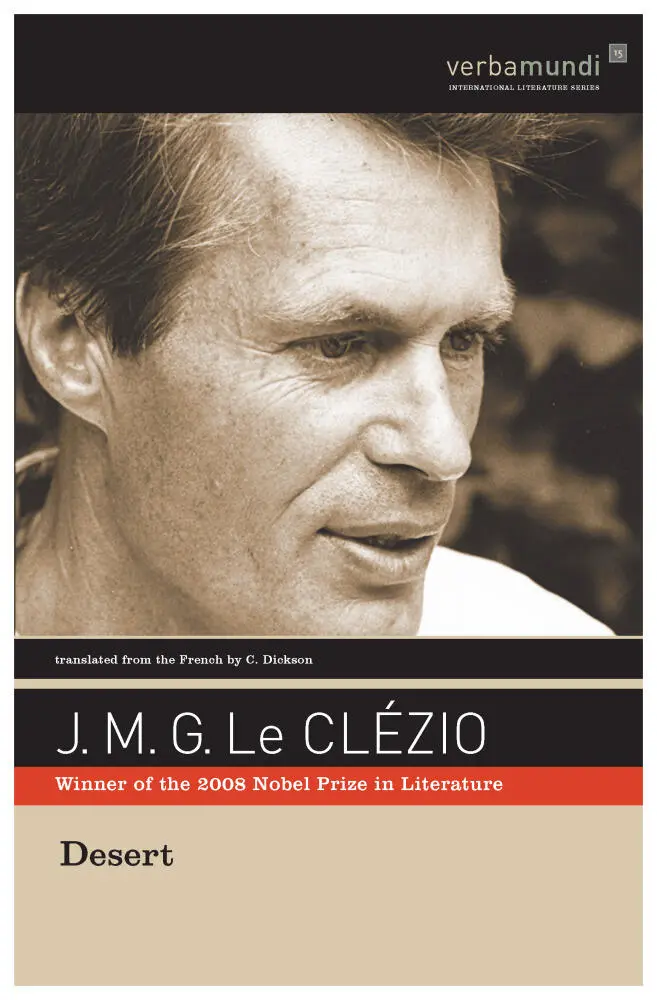
- Название:Desert
- Автор:
- Издательство:Verba Mundi Books
- Жанр:
- Год:2009
- Город:Jaffrey
- ISBN:978-1-56792-386-5
- Рейтинг книги:5 / 5. Голосов: 1
-
Избранное:Добавить в избранное
- Отзывы:
-
Ваша оценка:
Desert: краткое содержание, описание и аннотация
Предлагаем к чтению аннотацию, описание, краткое содержание или предисловие (зависит от того, что написал сам автор книги «Desert»). Если вы не нашли необходимую информацию о книге — напишите в комментариях, мы постараемся отыскать её.
Available for the first time in English translation, Desert is a novel composed of two alternating narratives, set in counterpoint. The first takes place in the desert between 1909 and 1912 and evokes the migration of a young adolescent boy, Nour, and his people, the Blue Men, notorious warriors of the desert. Driven from their lands by French colonial soldiers, Nour's tribe has come to the valley of the Saguiet El Hamra to seek the aid of the great spiritual leader known as Water of the Eyes. The religious chief sends them out from the holy city of Smara into the desert to travel still further. Spurred on by thirst, hunger, and suffering, Nour's tribe and others flee northward in the hopes of finding a land that can harbor them at last.
The second narrative relates the contemporary story of Lalla, a descendant of the Blue Men. Though she is an orphan living in a shantytown known as the Project near a coastal city in Morocco, the blood of her proud, obstinate tribe runs in her veins. All too soon, Lalla must flee to escape a forced marriage with an older, wealthy man. She travels to France, undergoing many trials there, from working as a hotel maid to becoming a highly-paid fashion model, and yet she never betrays the blood of her ancestors.
Desert — читать онлайн бесплатно полную книгу (весь текст) целиком
Ниже представлен текст книги, разбитый по страницам. Система сохранения места последней прочитанной страницы, позволяет с удобством читать онлайн бесплатно книгу «Desert», без необходимости каждый раз заново искать на чём Вы остановились. Поставьте закладку, и сможете в любой момент перейти на страницу, на которой закончили чтение.
Интервал:
Закладка:
A little farther ahead, on the opposite bank, the path leading to the Project begins. Then the mud and plank houses, one, another one. Lalla doesn’t recognize the houses anymore. There are new ones everywhere, even near the riverbank, where it floods when the water is high. The alleyways of tamped earth are poorly lit with electric lamps, and the plank and sheet metal houses look abandoned. As she walks down the streets, Lalla hears the sound of voices whispering, of babies crying. Somewhere, out beyond the town, the eerie yapping of a wild dog. Lalla’s feet are treading upon ancient traces, and she takes off her canvas sandals to better feel the coolness and the grain of the earth.
The same gaze is still guiding her, here, in the streets of the Project; it’s a very long and very gentle gaze, coming from all sides at once, from the depths of the sky, swaying in the wind. Lalla walks past the houses she’s familiar with; she smells the odor of coal fires going out; she recognizes the sound of the wind in the tarpaper, on the sheet metal. It all comes back to her at once, as if she’d never left, as if she’d only fallen asleep for an hour or two.
So, instead of going toward Ikikr’s house, over by the fountain, Lalla takes the path to the dunes. Weariness is making her body heavy, triggering a pain in her lower back, but it is the unknown gaze that is guiding her, and she knows she must go out of the village. Barefoot, she walks as quickly as she can between the thorn bushes and the dwarf palms, till she reaches the dunes.
Here, nothing has changed. She walks along the gray dunes, just as she used to. From time to time, she stops, looks around, picks a sprig of a succulent plant and squishes it between her fingers to smell the peppery odor she used to love. She recognizes all the hollows, all the paths, those that lead up to the rocky hills, those that go to the salt marsh, those that don’t go anywhere. The night is deep and mild, and above her the stars are bright. How much time has gone by for them? They haven’t changed places, their flame — like that of magic lamps — has not burned out. Perhaps the dunes have moved, but how could you tell? The old carcass that used to bare its claws and lift its horns and scare her so much has disappeared now. There are no more abandoned tin cans, and certain shrubs have burned; their branches have been broken to pieces for the brazier fires.
Lalla can’t find her spot up on top of the dunes anymore. The passageway that led to the beach has filled with sand. Laboriously, Lalla scales the cold sand of the dunes till she reaches the crest. Her breath is wheezing in her throat, and the pain in her back is so sharp she’s moaning, in spite of herself. In clenching her teeth, she changes the moaning into a song. She thinks of the song she used to love to sing, in the old days, when she was afraid:
“Méditerra-né-é-e…”
She tries to sing, but her voice is too weak.
Now she’s walking over the hard sand of the beach, right along the sea foam. The wind isn’t blowing very hard, and the waves are purling softly in the night, and Lalla feels the giddy thrill once again, just as she had on the ship and in the bus, as if it had all been waiting for her, expecting her. Maybe it’s the gaze of al-Ser, the one she calls the Secret, that is on the beach, mixed in with the starlight, with the sound of the sea, with the whiteness of the foam. It is a night without fear, a remote night, the likes of which Lalla has never known.
Now she’s nearing the place where Old Naman used to like to haul his boat up, to heat the pitch or mend his nets. But the place is empty, and the beach stretches on into the night, deserted. There is only the old fig tree, standing against the dune, with its thick branches thrown back from being accustomed to the wind. Lalla recognizes its heavy bland odor with delight; she watches the movement of its leaves. She sits down at the foot of the dune, not far from the tree, and looks at it for a long time, as if the old fisherman were going to appear any second.
Weariness weighs upon Lalla’s body, pain has numbed her arms and legs. She lets herself fall slowly backward into the cold sand, and goes immediately to sleep, lulled by the sound of the sea and the smell of the fig tree.
The moon rises in the east, climbs into the night over the rocky hills. Its pale light shines on the sea and the dunes, bathes Lalla’s face. Later in the night, the wind rises too, the warm wind that blows in from the sea. It passes over Lalla’s face, over her hair, sprinkles sand on her body. The sky is so vast, and the earth absent. Below the constellations, things have changed, evolved. Cities have enlarged their rings, like mold stains in the valley bottoms, in the shelter of bays and estuaries. People have died, houses have fallen to ruin, in a cloud of dust and scattering cockroaches. And yet, on the beach, near the fig tree, in the place where Old Naman used to come, it’s as if nothing had happened. It’s as if the young woman had just gone on sleeping.
The moon moves slowly upward till it reaches its zenith. Then it descends in the west, out in the high seas. The sky is pure, without a cloud. In the desert, beyond the plains and the rocky hills, the cold wells up from the sand, spreads out like water. It’s as if the whole earth, here, and even the sky, the moon, and the stars, had been holding their breath, had suspended their time.
Now they are all stopped, as the fijar, the first dawn, begins.
In the desert, the fox, the jackal, no longer chase after the jerboa or the hare. The horned viper, the scorpion, the scolopendra, are stopped on the cold earth, under the black sky. The fijar has seized them, has turned them to stone, to powdered stone, to mist, because this is the hour when the heavens spread celestial time over the earth, chilling bodies, and sometimes interrupting life and breath. In the dip of the dune, Lalla isn’t moving. Her skin is shivering, in long shivers that shake her limbs and make her teeth chatter, but she doesn’t wake up.
Then comes the second dawn, the white. The light begins to mix with the darkness of the air. Instantly, it sparkles in the sea foam, on patches of dried salt on the rocks, on the sharp stones at the foot of the old fig tree. The pale gray glimmer shines on the peaks of the rocky hills, gradually fading out the stars: the Goat, the Dog, the Snake, the Scorpion, and the three sister stars, Mintaka, Alnilam, Alnitak. Then the sky seems to invert, a large pearly veil covers it, snuffing out the last stars. In the dips of the dunes, the small prickly plants tremble slightly, while dewdrops form pearls in their down.
On Lalla’s cheeks, the drops roll a little, like tears. The young woman awakens and moans quietly. She doesn’t open her eyes yet, but her plaint rises, mingles with the unbroken sound of the sea, which is now in her ears again. The pain comes and goes
in her belly, sending out signals which are closer and closer together, rhythmical like the sound of the waves.
Lalla raises herself up slightly on the bed of sand, but the pain is so sharp it takes her breath away. Then suddenly she realizes the time has come for the baby to be born, right now, here, on this beach, and a wave of fear runs through her, overwhelms her, because she knows she’s alone, that no one will come to help her, no one. She wants to get up; she takes a few steps in the cold sand, staggering, but falls back down, and her moaning turns to a scream. Out here, there is nothing but the gray beach, and the dunes, which are still plunged in darkness, and before her, the heavy sea, gray and green, dark, still mingling with the black of night.
Lying on her side in the sand, knees curled up, Lalla is moaning again in rhythm with the sea. The pain comes in waves, in long regular rollers, whose highest crest moves over the dark surface of the water, catching a brief glint of pale light from time to time, until it breaks. Lalla follows the progress of her pain on the sea, each shudder stemming from far out on the horizon, from the dark area, where the night is still thick, and radiating slowly out till it reaches the shore on the eastern side, spreading slantwise, casting out layers of foam, while the swish of the water over the hard sand creeps up, engulfs her. Sometimes the pain is just too strong, as if her belly were tearing open, were emptying, and the moaning increases in her throat, covering over the crashing of the waves breaking on the sand.
Читать дальшеИнтервал:
Закладка:
Похожие книги на «Desert»
Представляем Вашему вниманию похожие книги на «Desert» списком для выбора. Мы отобрали схожую по названию и смыслу литературу в надежде предоставить читателям больше вариантов отыскать новые, интересные, ещё непрочитанные произведения.











Обсуждение, отзывы о книге «Desert» и просто собственные мнения читателей. Оставьте ваши комментарии, напишите, что Вы думаете о произведении, его смысле или главных героях. Укажите что конкретно понравилось, а что нет, и почему Вы так считаете.