J.M. le Clézio - Desert
Здесь есть возможность читать онлайн «J.M. le Clézio - Desert» весь текст электронной книги совершенно бесплатно (целиком полную версию без сокращений). В некоторых случаях можно слушать аудио, скачать через торрент в формате fb2 и присутствует краткое содержание. Город: Jaffrey, Год выпуска: 2009, ISBN: 2009, Издательство: Verba Mundi Books, Жанр: Современная проза, на английском языке. Описание произведения, (предисловие) а так же отзывы посетителей доступны на портале библиотеки ЛибКат.
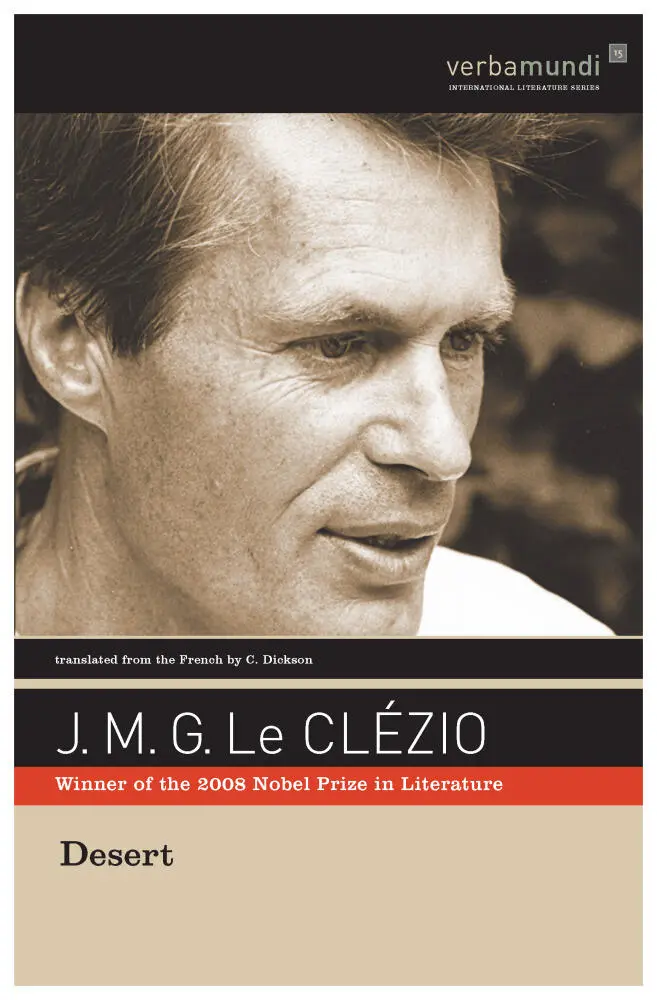
- Название:Desert
- Автор:
- Издательство:Verba Mundi Books
- Жанр:
- Год:2009
- Город:Jaffrey
- ISBN:978-1-56792-386-5
- Рейтинг книги:5 / 5. Голосов: 1
-
Избранное:Добавить в избранное
- Отзывы:
-
Ваша оценка:
Desert: краткое содержание, описание и аннотация
Предлагаем к чтению аннотацию, описание, краткое содержание или предисловие (зависит от того, что написал сам автор книги «Desert»). Если вы не нашли необходимую информацию о книге — напишите в комментариях, мы постараемся отыскать её.
Available for the first time in English translation, Desert is a novel composed of two alternating narratives, set in counterpoint. The first takes place in the desert between 1909 and 1912 and evokes the migration of a young adolescent boy, Nour, and his people, the Blue Men, notorious warriors of the desert. Driven from their lands by French colonial soldiers, Nour's tribe has come to the valley of the Saguiet El Hamra to seek the aid of the great spiritual leader known as Water of the Eyes. The religious chief sends them out from the holy city of Smara into the desert to travel still further. Spurred on by thirst, hunger, and suffering, Nour's tribe and others flee northward in the hopes of finding a land that can harbor them at last.
The second narrative relates the contemporary story of Lalla, a descendant of the Blue Men. Though she is an orphan living in a shantytown known as the Project near a coastal city in Morocco, the blood of her proud, obstinate tribe runs in her veins. All too soon, Lalla must flee to escape a forced marriage with an older, wealthy man. She travels to France, undergoing many trials there, from working as a hotel maid to becoming a highly-paid fashion model, and yet she never betrays the blood of her ancestors.
Desert — читать онлайн бесплатно полную книгу (весь текст) целиком
Ниже представлен текст книги, разбитый по страницам. Система сохранения места последней прочитанной страницы, позволяет с удобством читать онлайн бесплатно книгу «Desert», без необходимости каждый раз заново искать на чём Вы остановились. Поставьте закладку, и сможете в любой момент перейти на страницу, на которой закончили чтение.
Интервал:
Закладка:
Then the ship sails slowly out over the smooth sea away from Algeciras; it’s heading for Tangiers. On the deck, the sun and the salt burn, and the people are all crowded into the shade, men, women, children, sitting beside their boxes and suitcases.
Some sing from time to time, to ward off anxiety, a sad nasal song, then the song stops, and all that can be heard is the chugging of the engine.
Over the railing, Lalla is looking at the smooth, dark blue sea, out where the rollers curl slowly over the swell. Dolphins are leaping in the ship’s white wake, chasing after one another, swimming away. Lalla thinks of the white bird, the one that was a true prince of the sea, the one that flew over the beach back in the days of Old Naman. Her heart quickens, and she looks up ecstatically, as if she were really going to see him, arms outstretched over the sea. She can feel the burn of the sun on her skin, the old burn, and she can see the light of the sky which is so lovely and so cruel.
Suddenly the voice of some men singing their nasal song troubles her, and she feels tears running from her eyes, without really understanding why. It’s been such a long time since she’s heard that song, as if in an old dream, half faded away. They are men with black skin, dressed only in camouflage shirts and cotton pants that are too short, barefoot in Japanese sandals. One after the other, they sing the sad nasal song, which no one else can understand, just like that, rocking themselves with their eyes half shut.
And when she hears their song, Lalla feels — deep down inside of herself, very secretly — the desire to see that white land again, the tall palm trees in the red valleys, the expanses of stones and sand, the wide lonely beaches, and even the villages of mud and planks, with sheet metal and tarpaper roofs. She squints her eyes a little and sees it before her, as if she hadn’t left, as if she’d only fallen asleep for an hour or two.
Deep inside of her, inside her swollen belly, there is also that movement, those painful thrusts that are hitting the inside of her skin. Now she thinks of the child who wants to be born, who is already living, who is already dreaming. She shivers a little and pushes her hands against her dilated stomach, lets her body fall in with the heavy rocking of the boat, her back leaning against the vibrating iron bulkhead. She even sings a little to herself, between her teeth, a little to the child who stops hitting her and listens, the old song, the one Aamma used to sing, that came from her mother:
“One day, the crow will be white, the sea will go dry, there will be honey in the desert flower, we will make up a bed of acacia sprays, one day, oh, one day, the snake will spit no more poison, and rifle bullets will bring no more death, for that will be the day I will leave my love…”
The chugging of the engines drowns out the sound of her voice, but inside her belly, the unknown child listens closely to the words, and falls asleep. So to make more noise, and to muster her courage, Lalla sings the words to her favorite song louder:
“Méditerra-né-é-e…”
The boat glides slowly over the smooth sea, under the heavy sky. Now there is an ugly gray splotch on the horizon, like a cloud snagging on the sea: Tangiers. All the faces are turned toward the spot, and the people have stopped talking: even the black men are no longer singing. Africa comes slowly into view — irresolute, deserted — in front of the stem of the ship. The seawater turns gray, shallower. In the sky, the first gulls are flying, gray as well, scrawny and fearful.
Has everything changed then? Lalla thinks of her first journey, to Marseille, when everything was still new, the streets, the houses, the people. She thinks of Aamma’s apartment, of the Hotel Sainte-Blanche, of the vacant lots near the storage tanks, of everything that she left behind in the big deadly city. She thinks of Radicz the beggar, of the photographer, of the reporters, of all the people who have turned into shadows. She’s got nothing left but her clothes now, and the brown coat that Aamma gave her when she arrived. The money too, the bundle of new banknotes held together with a pin that she took from the photographer’s jacket pocket before leaving. But it’s as if nothing had ever happened, as if she’d never left the Project of planks and tarpaper, or the plateau of stones and the hills where the Hartani lives, as if she’d simply fallen asleep for an hour or two.
She looks out at the empty horizon, off the stern of the ship, then at the spot of gray earth and the mountain where the houses, like smudges, in the Arab city are growing larger. She winces, because inside her abdomen, the child has started making rough movements.
In the bus, driving down the dust road, stopping to let on peasants, women, children, Lalla gets that strange, ecstatic feeling again. The light is enveloping her, so is the fine dust rising like a fog on either side of the bus, entering the passenger compartment, sticking in her throat, and gritting under her fingers, the light, the dryness, the dust: Lalla can feel their presence, and it’s like a new skin covering her, like a new breath.
Is it possible that something else once existed? Is there another world, other faces, another light? The lie of memories cannot survive the noise of the coughing bus, or the heat, or the dust. The light cleanses everything, abrades everything, as it used to, out on the plateau of stones. Lalla feels the weight of the secret gaze upon her again, around her; no longer the gaze of men, filled with desire and yearning, but the gaze filled with mystery that belongs to the one who knows Lalla and who reigns over her like a god.
The bus drives along the dust track, lumbers up hills. Everywhere, there is nothing but dry burned earth, like an old snakeskin. Above the roof of the bus, the sky and the light burn fervently, and the passenger compartment grows as hot as the inside of an oven. Lalla feels the drops of sweat rolling down her forehead, along her neck, down her back. In the bus, the people are immobile, impassive. The men are wrapped in their woolen cloaks; the women are squatting on the floor, between the seats, covered with their blue-black veils. Only the driver is moving, grimacing, looking in the rearview mirror. Several times his eyes meet Lalla’s, and she turns her face away. The plump man with a flat face adjusts the mirror to see her better, then, with an angry gesture, puts it back in place. The radio, volume turned all the way up, screeches and spits and, when passing near an electricity pylon, lets out a long trail of nasal music.
All day long, the bus drives along the tarred roads and dust tracks, crosses dried rivers, stops in front of mud villages where naked children are waiting. Skeletal dogs run along beside the bus, trying to nip at the wheels. At times, the bus stops in the middle of a deserted plain because the motor stalls. While the driver with a flat nose leans into the open hood to clean the idling jet, the men and women get off, sit down in the shade of the bus or go to urinate, squatting amid the euphorbia bushes. Some take small lemons out of their pockets to suck on, clacking their tongues.
Then the bus starts out again, bumping over the roads, climbing up hills, like that, interminably, in the direction of the setting sun. Night falls quickly on the stretch of deserted plains; it covers over the stones and turns the dust to ashes. Then, suddenly, the bus stops in the night, and Lalla can see lights in the distance, on the far side of the river. Outside, the night is hot, filled with the whirring of insects, the croaking of toads. But it seems like silence after the hours spent on the bus.
Lalla gets off, walks slowly along the river. She recognizes the building of the public bathhouse, then the ford. The river is black; the tide has pushed back the freshwater stream. Lalla crosses the ford with the water at mid-thigh, but the cool river soothes her. In the dusk light, Lalla sees the figure of a woman carrying a bundle on her head, her long cloak hitched up to her waist.
Читать дальшеИнтервал:
Закладка:
Похожие книги на «Desert»
Представляем Вашему вниманию похожие книги на «Desert» списком для выбора. Мы отобрали схожую по названию и смыслу литературу в надежде предоставить читателям больше вариантов отыскать новые, интересные, ещё непрочитанные произведения.









Обсуждение, отзывы о книге «Desert» и просто собственные мнения читателей. Оставьте ваши комментарии, напишите, что Вы думаете о произведении, его смысле или главных героях. Укажите что конкретно понравилось, а что нет, и почему Вы так считаете.