J.M. le Clézio - Desert
Здесь есть возможность читать онлайн «J.M. le Clézio - Desert» весь текст электронной книги совершенно бесплатно (целиком полную версию без сокращений). В некоторых случаях можно слушать аудио, скачать через торрент в формате fb2 и присутствует краткое содержание. Город: Jaffrey, Год выпуска: 2009, ISBN: 2009, Издательство: Verba Mundi Books, Жанр: Современная проза, на английском языке. Описание произведения, (предисловие) а так же отзывы посетителей доступны на портале библиотеки ЛибКат.
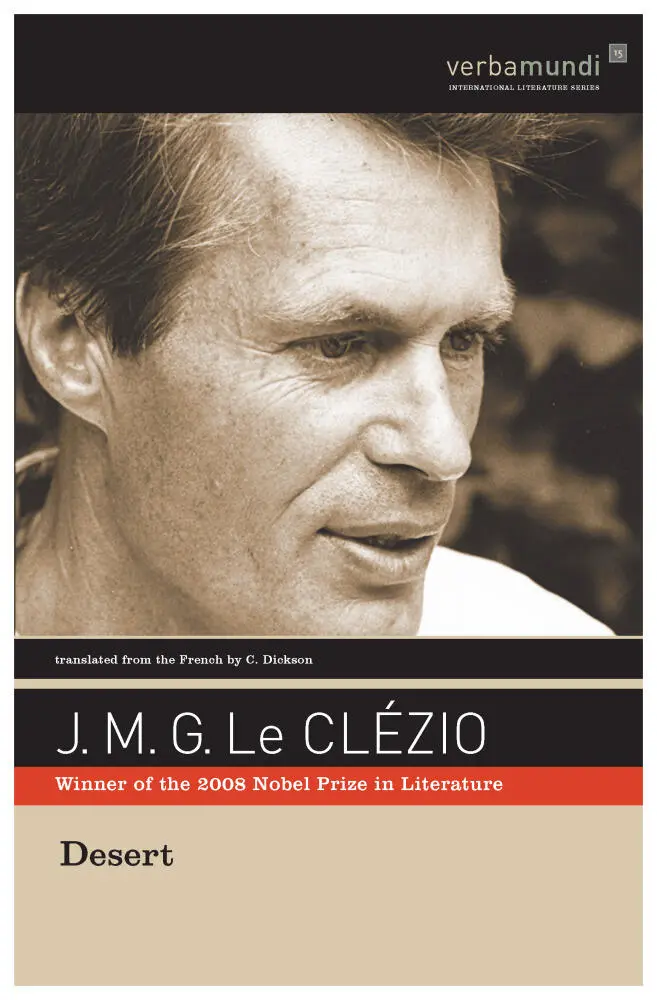
- Название:Desert
- Автор:
- Издательство:Verba Mundi Books
- Жанр:
- Год:2009
- Город:Jaffrey
- ISBN:978-1-56792-386-5
- Рейтинг книги:5 / 5. Голосов: 1
-
Избранное:Добавить в избранное
- Отзывы:
-
Ваша оценка:
Desert: краткое содержание, описание и аннотация
Предлагаем к чтению аннотацию, описание, краткое содержание или предисловие (зависит от того, что написал сам автор книги «Desert»). Если вы не нашли необходимую информацию о книге — напишите в комментариях, мы постараемся отыскать её.
Available for the first time in English translation, Desert is a novel composed of two alternating narratives, set in counterpoint. The first takes place in the desert between 1909 and 1912 and evokes the migration of a young adolescent boy, Nour, and his people, the Blue Men, notorious warriors of the desert. Driven from their lands by French colonial soldiers, Nour's tribe has come to the valley of the Saguiet El Hamra to seek the aid of the great spiritual leader known as Water of the Eyes. The religious chief sends them out from the holy city of Smara into the desert to travel still further. Spurred on by thirst, hunger, and suffering, Nour's tribe and others flee northward in the hopes of finding a land that can harbor them at last.
The second narrative relates the contemporary story of Lalla, a descendant of the Blue Men. Though she is an orphan living in a shantytown known as the Project near a coastal city in Morocco, the blood of her proud, obstinate tribe runs in her veins. All too soon, Lalla must flee to escape a forced marriage with an older, wealthy man. She travels to France, undergoing many trials there, from working as a hotel maid to becoming a highly-paid fashion model, and yet she never betrays the blood of her ancestors.
Desert — читать онлайн бесплатно полную книгу (весь текст) целиком
Ниже представлен текст книги, разбитый по страницам. Система сохранения места последней прочитанной страницы, позволяет с удобством читать онлайн бесплатно книгу «Desert», без необходимости каждый раз заново искать на чём Вы остановились. Поставьте закладку, и сможете в любой момент перейти на страницу, на которой закончили чтение.
Интервал:
Закладка:
Just a few more leaps, keep going, legs, a few more beats, heart, keep going, for the sea isn’t very far now, the sea and the sky mingling together, where there are no more houses, or people, or cars. So in the same instant that the body of the young man bounds onto the pavement of the coastal road, heading straight for the sea and the sky mingling together, like a deer the pack hounds are catching up with, at that very instant, a large blue city bus with its headlights still lit arrives, and the rising sun hits its curved windshield like a flash of lightning when Radicz’s body smashes up against the hood and the headlights with a terrific crash of metal and screeching brakes. Not far from there, on the edge of the palm tree park, stands a very somber young woman, still as a shadow, watching intently. She doesn’t move, she just watches as people approach from all sides, gathering on the road around the bus, around the black car, around the blanket covering the thief’s broken body.
Tiznit, October 23, 1910
OUT WHERE THE city melts in with the red earth of the desert, old drystone walls, ruins of houses made of adobe in amongst acacias, some of which have burned, out where the dusty winds blow freely, far from the wells, from the shade of the palm trees, that is where the old sheik is in the process of dying.
He arrived here, in the city of Tiznit, at the end of his long pointless march. To the north, in the land of the defeated king, the foreign soldiers are advancing, from city to city, destroying everything that resists them. To the south, the soldiers of the Christians have entered the holy valley of the Saguiet al-Hamra, they are even going to occupy Ma al-Aïnine’s empty palace. The wind of ill-fortune has begun to blow on the stone walls, through the narrow loopholes, the wind that wears everything away, that empties everything out.
It’s blowing here now, the malevolent wind, the warm wind that comes from the north, that brings the mist in from the sea. Scattered around Tiznit like lost animals, the blue men are waiting, sheltered by their huts of branches.
Throughout the entire camp, no other sound can be heard but that of the wind clicking in the acacia branches, and from time to time the complaint of a hobbled animal. There is a vast silence, a terrible silence that hasn’t let up since the attack of the Senegalese soldiers, in the valley of the Oued Tadla. The voices of the warriors have been stilled now; the chants have fallen silent. No one speaks about what will happen anymore, maybe because nothing else will happen.
It’s the wind of death that is blowing over the dried earth, the malevolent wind coming from the lands occupied by the foreigners, in Mogador, in Rabat, in Fez, in Tangiers. The warm wind, bearing with it the murmur of the sea, and even beyond, the humming of the big white cities where the bankers, the merchants rule.
In the mud house with the half-caved-in roof, the old sheik is lying on his cloak on the bare mud floor. The heat is stifling; the sound of flies and wasps fills the air. Does he know that all is lost, that it’s all over now? Yesterday, day before yesterday, the messengers from the South came to bring him news, but he didn’t want to listen to them. The messengers had kept their news of the South to themselves, the surrender of Smara, the flight of Hassena and Larhdaf, Ma al-Aïnine’s youngest sons, in the direction of the plateau of Tagant, the flight of Moulay Hiba in the direction of the Atlas Mountains. But now they are taking away with them the news they will give to those who are awaiting them down there: “The great sheik Ma al-Aïnine will soon be dead. Already, his eyes can see no more, and his lips can speak no more.” They will say that the great sheik is dying in the poorest house in Tiznit, like a beggar, far from his sons, far from his people.
A few men are sitting around the ruined house. They are the last blue warriors of the Berik Allah tribe. They fled across the plain of the Tadla River, without looking back, without trying to understand. The others turned back southward, back to their trails, because they realized there was no hope left, that the lands they had been promised would never be given to them. But it wasn’t land they had wanted. They loved the great sheik, they venerated him as they would a saint. He had given them his divine blessing, and that had bound them to him, like the words of an oath.
Nour is with them today. Sitting on the dusty earth, sheltered by a roof of branches, he is staring steadily at the mud house with the half-caved-in roof, where the great sheik is closed up. He doesn’t know yet that Ma al-Aïnine is dying. It’s been several days since he’s seen him come out, wearing his soiled white cloak, leaning on the shoulder of his servant, followed by Meymuna Laliyi, his first wife, the mother of Moulay Sebaa, the Lion. When he first arrived in Tiznit, Ma al-Aïnine sent messengers out for his sons to come and get him. But the messengers did not come back. Every evening, before the prayer, Ma al-Aïnine came out of the house to gaze northward at the trail upon which Moulay Hiba should have come. Now it is too late, and it is obvious his sons won’t come.
He lost his sight two days ago, as if death had taken his eyes first. Even when he used to come out to look northward, it was no longer his eyes that were searching for his son, it was his whole face, his hands, his body that desired the presence of Moulay Hiba. Nour watched him, frail figure, almost ghostly, surrounded by his servants, followed by the black shadow of Lalla Meymuna. And he could feel the chill of death darkening the landscape, as if a cloud had hidden the sun.
Nour thought about the blind warrior lying in the ravine, on the bed of the Tadla River. He thought about the dead face of his friend who might have already been eaten by jackals, and he also thought about all the people who had died on the journey, left at the mercy of the sun and the night.
Later, he had met up again with the rest of the caravan that had escaped the massacre, and they had walked for days, dying of hunger and weariness. They had fled like outlaws along the most difficult trails, avoiding the cities, barely daring to taste the well water. Then the great sheik had fallen sick, and they had had to stop here, at the gates of Tiznit, on this dusty land over which the malevolent wind was blowing.
Most of the blue men had continued their aimless endless journey, toward the plateaus of the Drâa, to pick up the trails where they’d left off. Nour’s mother and father had gone back to the desert. But he couldn’t bring himself to follow them. Maybe he was still hoping for a miracle, the land that the sheik had promised them, where there would be peace and abundance, which the foreign soldiers could never enter. The blue men had left, one after the other, taking their rags with them. But so many had died on the way! Never would they find the peace they had known before, never would the wind of ill-fortune leave them in peace.
At times, the rumor would crop up: “Moulay Hiba is coming, Moulay Sebaa, the Lion, our king!” But it was only a mirage, which faded away in the torrid silence.
Now it is all too late, because the sheik Ma al-Aïnine is dying. Suddenly the wind stops blowing; the heaviness in the air causes the men to stand. They all heave to their feet, look westward, where the sun is descending toward the low horizon. The dusty earth, strewn with razor-sharp stones, is bathed in a glaring hue, bright as molten metal. The sky is veiled with a thin haze, through which the sun resembles an enormously dilated red disk.
No one understands why the wind has suddenly stopped, or why there is that strange, burnt color out on the horizon. But once again, Nour feels the chill enter him, like a fever, and he starts to tremble. He turns toward the ruins of the old house, where Ma al-Aïnine is. He walks slowly toward the house, drawn to it in spite of himself, his eyes trained on the black door.
Читать дальшеИнтервал:
Закладка:
Похожие книги на «Desert»
Представляем Вашему вниманию похожие книги на «Desert» списком для выбора. Мы отобрали схожую по названию и смыслу литературу в надежде предоставить читателям больше вариантов отыскать новые, интересные, ещё непрочитанные произведения.











Обсуждение, отзывы о книге «Desert» и просто собственные мнения читателей. Оставьте ваши комментарии, напишите, что Вы думаете о произведении, его смысле или главных героях. Укажите что конкретно понравилось, а что нет, и почему Вы так считаете.