J.M. le Clézio - Desert
Здесь есть возможность читать онлайн «J.M. le Clézio - Desert» весь текст электронной книги совершенно бесплатно (целиком полную версию без сокращений). В некоторых случаях можно слушать аудио, скачать через торрент в формате fb2 и присутствует краткое содержание. Город: Jaffrey, Год выпуска: 2009, ISBN: 2009, Издательство: Verba Mundi Books, Жанр: Современная проза, на английском языке. Описание произведения, (предисловие) а так же отзывы посетителей доступны на портале библиотеки ЛибКат.
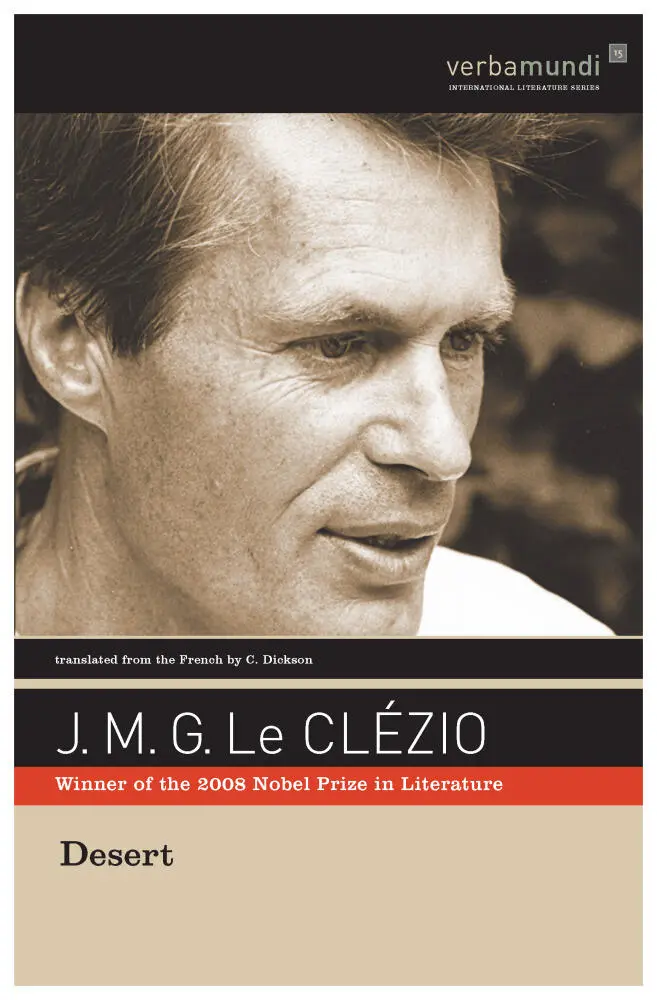
- Название:Desert
- Автор:
- Издательство:Verba Mundi Books
- Жанр:
- Год:2009
- Город:Jaffrey
- ISBN:978-1-56792-386-5
- Рейтинг книги:5 / 5. Голосов: 1
-
Избранное:Добавить в избранное
- Отзывы:
-
Ваша оценка:
Desert: краткое содержание, описание и аннотация
Предлагаем к чтению аннотацию, описание, краткое содержание или предисловие (зависит от того, что написал сам автор книги «Desert»). Если вы не нашли необходимую информацию о книге — напишите в комментариях, мы постараемся отыскать её.
Available for the first time in English translation, Desert is a novel composed of two alternating narratives, set in counterpoint. The first takes place in the desert between 1909 and 1912 and evokes the migration of a young adolescent boy, Nour, and his people, the Blue Men, notorious warriors of the desert. Driven from their lands by French colonial soldiers, Nour's tribe has come to the valley of the Saguiet El Hamra to seek the aid of the great spiritual leader known as Water of the Eyes. The religious chief sends them out from the holy city of Smara into the desert to travel still further. Spurred on by thirst, hunger, and suffering, Nour's tribe and others flee northward in the hopes of finding a land that can harbor them at last.
The second narrative relates the contemporary story of Lalla, a descendant of the Blue Men. Though she is an orphan living in a shantytown known as the Project near a coastal city in Morocco, the blood of her proud, obstinate tribe runs in her veins. All too soon, Lalla must flee to escape a forced marriage with an older, wealthy man. She travels to France, undergoing many trials there, from working as a hotel maid to becoming a highly-paid fashion model, and yet she never betrays the blood of her ancestors.
Desert — читать онлайн бесплатно полную книгу (весь текст) целиком
Ниже представлен текст книги, разбитый по страницам. Система сохранения места последней прочитанной страницы, позволяет с удобством читать онлайн бесплатно книгу «Desert», без необходимости каждый раз заново искать на чём Вы остановились. Поставьте закладку, и сможете в любой момент перейти на страницу, на которой закончили чтение.
Интервал:
Закладка:
Ma al-Aïnine’s warriors, the Berik Allah, watch the boy walking toward the house with dark faces, but none of them step forward to bar his way. Their eyes are blank and weary, as if they were living a dream. Perhaps they too have lost their sight during the pointless march, eyes burned by the desert sun and sand?
Slowly, Nour walks forward over the rocky earth, toward the house with mud walls. The setting sun is lighting up the old walls, deepening the dark shadow of the door.
It is through that door that Nour is now passing, just as he once had with his father, into the tomb of the saint. For an instant, he remains immobile, blinded by the darkness, feeling the damp coolness inside the house. When his eyes have adjusted, he sees the large, empty room, the mud floor. At one end of the room, the old sheik is lying on his cloak, his head resting on a stone. Lalla Meymuna is sitting next to him, wrapped in her black mantle, face veiled.
Nour doesn’t make a sound, he holds his breath. After a long time Lalla Meymuna turns her face toward the boy, because she can feel his eyes upon her. The black veil pulls aside, uncovering her handsome, copper-colored face. Her eyes are shining in the half-light; tears are running down her cheeks. Nour’s heart starts pounding very hard, and he feels a sharp pain in the center of his body. He is going to back away toward the door, leave, when the old woman tells him to come in. He walks slowly toward the center of the room, doubled over slightly because of the pain in the middle of his body. When he is before the sheik, his legs buckle under him, and he falls heavily to the floor, arms stretched out in front. His hands are touching Ma al-Aïnine’s white cloak, and he remains lying with his face against the damp earth. He doesn’t cry, doesn’t say anything, doesn’t think of anything, but his hands are clutching the woolen cloak and holding it so tightly that it hurts. Next to him, Lalla Meymuna is sitting still beside the man she loves, wrapped in her black mantle, and she can no longer see anything, no longer hear anything.
Ma al-Aïnine is breathing slowly, painfully. His breath lifts his chest with difficulty, making a hoarse sound that fills the entire house. In the half-light, his emaciated face seems even whiter, almost transparent.
Nour stares very hard at the old man, as if his eyes could slow down the march of death. Ma al-Aïnine’s parted lips pronounce snatches of words that are quickly drowned out by the rales. Maybe he is chanting the names of his sons again, Mohammed Rebbo, Mohammed Larhdaf, Taaleb, Hassena, Saadbou, Ahmed al-Shems, he who is called the Sun, and above all the name of the one he searched for every evening on the northern trail, the one he is still waiting for, Ahmed Dehiba, he who is called Moulay Sebaa, the Lion.
With a corner of her cloak, Lalla Meymuna dries the sweat beading on Ma al-Aïnine’s face, but he doesn’t even feel the contact of the cloth on his forehead and cheeks.
At times his arms go stiff, and his torso strains, because he wants to sit up. His lips tremble, his eyes roll around in their sockets. Nour draws nearer, and helps Meymuna raise Ma al-Aïnine; they hold him in a sitting position. With incredible energy for such a frail body, the old sheik remains sitting upright for a few seconds, arms outstretched, as if he were going to stand. His thin face betrays intense anxiety, and Nour feels terrified because of that empty look, those pale eyes. Nour remembers the blind warrior, Ma al-Aïnine’s hand that touched his eyes, his breath on the wounded man’s face. Now Ma al-Aïnine is feeling that same kind of solitude, the kind from which there is no escape, and no one can appease the utter emptiness in his eyes.
The pain Nour feels is so great that he would like to get away, leave this house of shadows and death, go running out over the dusty plain, out toward the golden light of the setting sun.
But suddenly, he feels the power in his hands, in his breath. Slowly, as if he were trying to remember forgotten gestures, Nour runs the palm of his hand over Ma al-Aïnine’s forehead, without saying a word. He wets his fingertips with his saliva, and touches the eyelids that are fluttering with anxiety. He blows softly on the old man’s face, his lips, his eyes. He wraps his arm around his torso and slowly, the frail body lets go, reclines.
Now Ma al-Aïnine’s face seems appeased, freed of its suffering. Eyes closed, the old man is breathing softly, noiselessly, as if he were going to fall asleep. Nour too feels peaceful inside, the pain in his body has relaxed. He moves back a little without taking his eyes off the sheik. Then he goes out of the house, as the dark shadow of Lalla Meymuna stretches out on the floor to sleep.
Outside, night is slowly falling. You can hear the cries of birds flying over the bed of the stream, toward the palm grove. The warm wind from the sea starts blowing again, in fits and starts, rustling in the leaves of the collapsed roof. Meymuna lights the oil lamp, she gives the sheik some water. In front of the door to the house, Nour’s throat feels tight, burning; he can’t sleep. Several times during the night, following a sign from Meymuna, he goes up to the old man, runs his hand over his forehead, blows on his lips and eyelids. But weakness and despair have destroyed his power, and he is no longer able to erase the anxiety that is making Ma al-Aïnine’s lips tremble. Perhaps it is the pain inside his own body that is crippling his breath.
Just before the first dawn, when the air outside is completely still and silent, when there is not a sound, not a single insect call, Ma al-Aïnine dies. Meymuna, who is holding his hand, feels it, and she lies down on the floor next to the man she loves, and begins to cry, no longer holding back the sobs. Nour, standing by the door, looks once more at the frail figure of the great sheik, lying on his white cloak, so light that he seems to be floating above the ground. Then, backing away, he leaves, finds himself alone in the night, on the ash-colored plain lit with the full moon. Grief and fatigue prevent him from walking very far. He stumbles to the ground near some thorn bushes and falls immediately asleep, not hearing the voice of Lalla Meymuna weeping as if in song.
THAT’S HOW SHE LEFT one day, without telling anyone. She got up one morning, just before dawn, as she used to do, back in her country, to go down to the sea, or out to the gates of the desert. She listened to the breathing of the photographer who was sleeping in his big bed, overwhelmed with the summer heat. Outside, the swifts were already letting out their high-pitched cries, and off in the distance, maybe the soft sound of the street cleaner’s water hose. Lalla had hesitated, because she wanted to leave something for the photographer, a sign, a message, to say good-bye to him. Since she didn’t have anything, she took a piece of soap and drew the well-known sign of her tribe, the one she used to sign her photographs with in the streets of Paris:

because it’s the oldest drawing she knows and because it looks like a heart. Then she walked away, through the streets of the city, never to return.
She traveled by train for days and nights, from city to city, from country to country. She waited for trains in the stations for such a long time that her legs grew stiff and her back and buttocks ached.
People came and went, talked, looked. But they didn’t pay any attention to the silhouette of the young woman with a weary face who, despite the heat, was wrapped up in a funny old brown coat that reached down to her feet. Maybe they thought she was poor, or sick. Sometimes people talked to her in the passenger cars, but she didn’t understand their language, and simply smiled.
Читать дальшеИнтервал:
Закладка:
Похожие книги на «Desert»
Представляем Вашему вниманию похожие книги на «Desert» списком для выбора. Мы отобрали схожую по названию и смыслу литературу в надежде предоставить читателям больше вариантов отыскать новые, интересные, ещё непрочитанные произведения.











Обсуждение, отзывы о книге «Desert» и просто собственные мнения читателей. Оставьте ваши комментарии, напишите, что Вы думаете о произведении, его смысле или главных героях. Укажите что конкретно понравилось, а что нет, и почему Вы так считаете.