Selma Dabbagh - Out of It
Здесь есть возможность читать онлайн «Selma Dabbagh - Out of It» весь текст электронной книги совершенно бесплатно (целиком полную версию без сокращений). В некоторых случаях можно слушать аудио, скачать через торрент в формате fb2 и присутствует краткое содержание. Город: London, Год выпуска: 2011, ISBN: 2011, Издательство: Bloomsbury Publishing, Жанр: Современная проза, на английском языке. Описание произведения, (предисловие) а так же отзывы посетителей доступны на портале библиотеки ЛибКат.
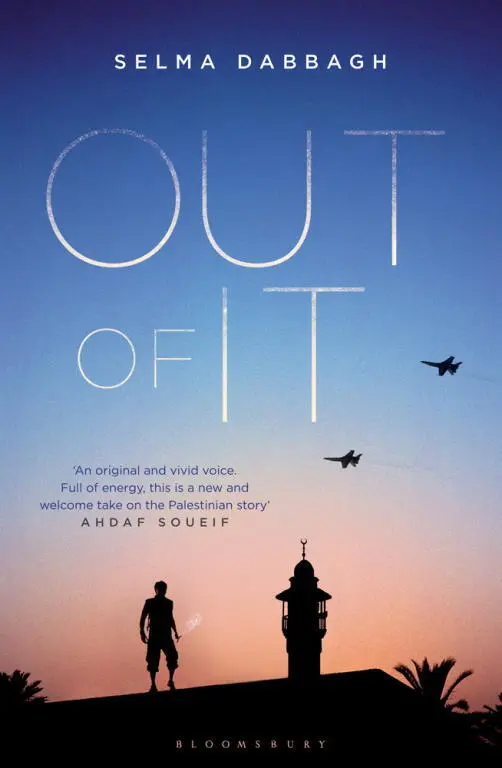
- Название:Out of It
- Автор:
- Издательство:Bloomsbury Publishing
- Жанр:
- Год:2011
- Город:London
- ISBN:978-1-4088-2430-6
- Рейтинг книги:5 / 5. Голосов: 1
-
Избранное:Добавить в избранное
- Отзывы:
-
Ваша оценка:
Out of It: краткое содержание, описание и аннотация
Предлагаем к чтению аннотацию, описание, краткое содержание или предисловие (зависит от того, что написал сам автор книги «Out of It»). Если вы не нашли необходимую информацию о книге — напишите в комментариях, мы постараемся отыскать её.
Meanwhile Sabri, the oldest brother of this disparate Palestinian family works on a history of Palestine from his wheelchair as their mother pickles vegetables and feuds with their neighbours.
Written with extraordinary humanity and humour, and moving between Gaza London and the Gulf, Out of It is a tale that redefines Palestine and its people. It follows the lives of Rashid and Iman as they try to forge paths for themselves in the midst of occupation, religious fundamentalism and the divisions between Palestinian factions. It tells of family secrets, unlikely love stories and unburied tragedies as it captures the frustrations and energies of the modern Arab world.
Out of It — читать онлайн бесплатно полную книгу (весь текст) целиком
Ниже представлен текст книги, разбитый по страницам. Система сохранения места последней прочитанной страницы, позволяет с удобством читать онлайн бесплатно книгу «Out of It», без необходимости каждый раз заново искать на чём Вы остановились. Поставьте закладку, и сможете в любой момент перейти на страницу, на которой закончили чтение.
Интервал:
Закладка:
The cramps had started just when it seemed like it was all over, after they had carted her outside to sit in a bus shelter with all her things on a trolley, guarded by one of the uniformed recruits. It felt as though a lizard was trapped inside her. She felt its teeth and claws as though it was convinced there was a way out at the base of her lower back and it bit and scratched and pushed with a thick tail flaying out at the contents of her stomach. She bent over. Please. No. No. Not my period now.
And the bastards had not let her get to her bag for a pad, a tissue, a painkiller, or to visit the bathroom, and when she finally got to the Egyptian side, they had decided to give her their special treatment, which was a room – God, that room! No, she did not even want to go there in her head – and a military escort (and it was not as though they could not have spent the money on something else). It was not until Cairo Airport where a cleaning lady had asked if she was OK, ‘ Malik ya habibti? Salamtik ya habibti , and given her a stack of tissues, that she had been able to sort herself out a bit in the bathroom.
A shower. I just need a shower.
Chapter 24
Iman’s plane had landed over an hour before, but Jibril was counting on his daughter being the last one out. Sensing the prod of Suzi’s phantom finger in his gut, he had ordered a skinny latte but it was tasteless, pointless, so he had got the chap to add a vanilla shot and then a touch of cream.
A woman with lilac combs in her hair and matching nail varnish had smiled up at him at the sound of his ringtone: toot-a-toot, toot-a-toot toot . A recognisable tune by a nubile Egyptian singer Jibril rather fancied. Charming. He raised his eyebrows at the lilac woman – a look, he believed, that combined a sense of intelligent irony with nonchalant seduction. She smiled back. Ah, maybe he had not reached the end of it all, the end of women. Perhaps there was still time. He did have Suzi, and Suzi was Suzi and there was no trying to undermine that. He was a lucky man. But to know that the door to others was closed for ever? Was, quite simply, terrifying.
It was Jibril’s fixer ringing. Telling him that Iman had been held back for questioning. Well, of course she had. What did the stupid man expect?
He ordered another coffee before returning the lilac woman’s smile, but she got up and walked off before he was able to take it any further.
It did not take long for the newspaper to upset him. He had read the Sheikh A bin B meets Sheikh B bin A to discuss bilateral relations bit, skimmed the runaway housemaids and discontented manual labourers section, sought and found some hidden nuggets of adultery charges and rogue sexual activity and (oh joy!) he even found a piece about further evidence of lesbian activity in school bathrooms. Jibril chuckled happily. Un-Islamic behaviour tickled him to the core.
He braced himself as he turned over the page to the international section, his eye automatically finding the news from home. The same images seemed to have been repeating themselves for years now, the perpetual cycle of violence and diplomatic grins, dead child, stone-throwing youths, exploded car, crying woman outside a demolished house, grinning Leadership, dead child again.
‘The worse the loss, the more we grin,’ Jibril said staring at a particularly despicable picture of the Leaders standing on a golf course in Texas.
‘They treat their dogs better than us,’ said the young man behind the counter, gazing at the sprightly Labrador at the President’s feet. ‘A dog’s life would be a blessing compared to what some of us have to live through.’ He nodded, this time to the picture of a mother crying over her dead child.
‘Where are you from?’ Jibril had been having problems reconciling the boy’s face and Arabic with his badge. ‘Hi!’ it said. ‘I am ERNESTO. Welcome to Starbright®. I am happy to serve you.’ If he had to guess, he would have said the boy was the same as he was, only brought up in Jordan. ‘Mr Ernesto?’
‘Oh no, that’s only my work name,’ the boy said turning to Jibril from the milk steamer that was hawking and spitting behind him. ‘HQ designates our names and market research has found that Spanish names are more amenable to the clientele. My true name is Salem Abu Wazir.’
‘Abu Wazir? You are from…? You are from my village?’ Jibril named his village, to which the manager raised his eyebrows.
‘You know the Abu Wazirs? You know my family?’
The café was filling out. A woman with prawn skin was leaning down close to Jibril’s legs tapping over a chocolate cake with a fingernail, her cleavage a gathering of creases and sunspots.
‘ Know your family? Know your family?’ Jibril exclaimed. ‘I practically am your family! I am Jibril Mujahed, the Mujaheds and the Abu Wazirs have married each other for years. Centuries, in fact, since the time of the Crusades.’
The boy laid out a piece of cake on a plate for his customer and looked up, bemused.
‘I’ve heard of you, Ammo, Uncle. You were with the Outside Leadership, were you not?’
The boy was a bit spotty. His pimples had white tips and clustered together around his nostrils. Other than that, he would be a fairly good-looking chap if he calmed down on the hair cream a bit.
‘I was with the Organisation. Yes. Not any more though. Left it years ago. And you’re…? A manager here?’
‘I manage all the airport branches. We had two outlets when I started; now we have fourteen. It’s a growth industry.’
‘A franchise, I suppose?’
‘Of course.’ The boy, Salem Abu Wazir (Abu Wazir, eh?), turned back to his staff. A queue was forming of servicemen, businessmen and backpackers. All pushed up behind Jibril to see into the counter. Jibril thought of trying to recreate their village using the salt and pepper pots to show this boy where the Abu Wazir house had been compared to the Mujahed’s, but it would be difficult as the village had been built on the slopes of two hills and the houses had been like cubes stacked up the sides.
Jibril could quite clearly see and feel himself as a child in Palestine. When he was there he wore shorts and a dangly belt, always (the outfit had been frozen in a photograph). Behind him, the village was a series of blocks and arches, rough stone straddling from one building to another in semicircles, arched windows, domes smoothed over with sand and outdoor staircases. There were days when the smell of his village would come and sit on his nose like a flirtatious djinn . He would wake from a dream and feel himself boyish, a spirit running through alleyways, over roofs, in the olive groves, leaping in the sun, a sun that was always bright but never harsh. And then at other times (it was there in him), when he had maybe drunk a bit too much, or been talking to someone who knew his village or a similar village, he would suddenly feel like saying, ‘Yes, that place! How about it? How about we go back and see how that place is doing?’ as though he had just gone around a corner and if he were to turn back quickly enough it would be there. But it would take less time than the words took to get to his mouth for him to realise that it was absurd. He could never go back to that place, it had been sealed off to him for ever, blown to the sky with explosives then flattened to the ground with bulldozers, built over with tarmac, lived on top of by other people.
People of a faith he didn’t have.
He tried to go back to his newspaper, but Abu Wazir, eh? He wished it would stop affecting him. He wished he didn’t care. He wished that he were free of it all. It was now almost eight years since he left the Organisation and all political involvement with it, but it still got to him. When Jibril announced that he was leaving, their Leader had looked him hard in the eye. ‘You can leave the Organisation, Jibril,’ he had said. ‘Of course, Jibril, we do not want you to leave, for you to leave is your choice. But, Jibril, you must understand that you can leave the Organisation but the Organisation will never leave you .’ Jibril did not know what that meant, but to be safe he had decided to treat it as a threat.
Читать дальшеИнтервал:
Закладка:
Похожие книги на «Out of It»
Представляем Вашему вниманию похожие книги на «Out of It» списком для выбора. Мы отобрали схожую по названию и смыслу литературу в надежде предоставить читателям больше вариантов отыскать новые, интересные, ещё непрочитанные произведения.










Обсуждение, отзывы о книге «Out of It» и просто собственные мнения читателей. Оставьте ваши комментарии, напишите, что Вы думаете о произведении, его смысле или главных героях. Укажите что конкретно понравилось, а что нет, и почему Вы так считаете.