Selma Dabbagh - Out of It
Здесь есть возможность читать онлайн «Selma Dabbagh - Out of It» весь текст электронной книги совершенно бесплатно (целиком полную версию без сокращений). В некоторых случаях можно слушать аудио, скачать через торрент в формате fb2 и присутствует краткое содержание. Город: London, Год выпуска: 2011, ISBN: 2011, Издательство: Bloomsbury Publishing, Жанр: Современная проза, на английском языке. Описание произведения, (предисловие) а так же отзывы посетителей доступны на портале библиотеки ЛибКат.
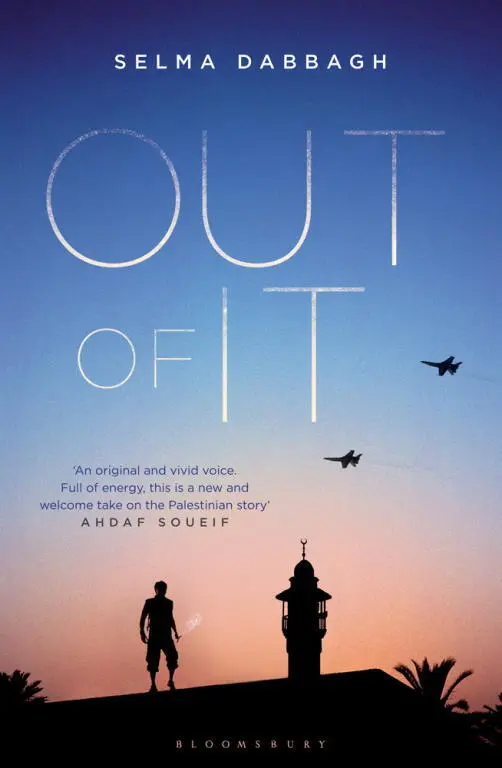
- Название:Out of It
- Автор:
- Издательство:Bloomsbury Publishing
- Жанр:
- Год:2011
- Город:London
- ISBN:978-1-4088-2430-6
- Рейтинг книги:5 / 5. Голосов: 1
-
Избранное:Добавить в избранное
- Отзывы:
-
Ваша оценка:
Out of It: краткое содержание, описание и аннотация
Предлагаем к чтению аннотацию, описание, краткое содержание или предисловие (зависит от того, что написал сам автор книги «Out of It»). Если вы не нашли необходимую информацию о книге — напишите в комментариях, мы постараемся отыскать её.
Meanwhile Sabri, the oldest brother of this disparate Palestinian family works on a history of Palestine from his wheelchair as their mother pickles vegetables and feuds with their neighbours.
Written with extraordinary humanity and humour, and moving between Gaza London and the Gulf, Out of It is a tale that redefines Palestine and its people. It follows the lives of Rashid and Iman as they try to forge paths for themselves in the midst of occupation, religious fundamentalism and the divisions between Palestinian factions. It tells of family secrets, unlikely love stories and unburied tragedies as it captures the frustrations and energies of the modern Arab world.
Out of It — читать онлайн бесплатно полную книгу (весь текст) целиком
Ниже представлен текст книги, разбитый по страницам. Система сохранения места последней прочитанной страницы, позволяет с удобством читать онлайн бесплатно книгу «Out of It», без необходимости каждый раз заново искать на чём Вы остановились. Поставьте закладку, и сможете в любой момент перейти на страницу, на которой закончили чтение.
Интервал:
Закладка:
In the middle distance, somewhere close to where the heels of one of the old men in the flat caps were perched on to the rung of a bar stool, Rashid could see Jamal crouching in a prison camp. The heels moved. A stripper stood next to Rashid and waited. ‘Got a light I can borrow?’ She leant over him with her all of her excitable bulbousness. Her body’s desire for attention was exhausting. The pub had almost completely emptied. The barmaid put two large scooped glasses filled with a beige drink and ice on to the counter. The stripper took one and strutted back to Rashid, who was stuffing Khalil’s message back into his jacket pocket.
‘Mind if I…?’ She indicated the chair. Rashid nodded, although he found her knickerlessness somewhat perturbing.
‘Not your kind of thing, then?’
‘No, not really. I just needed somewhere to go.’
‘Aww. All alone are we?’
‘I just had a letter I wanted to read. I didn’t feel like going home.’
‘Trouble with the wife?’
‘I’m not married.’
‘So, where are you from, anyway?’
‘Palestine.’ Was there even any point in saying that?
‘Oh, right. My mate. Her man’s from there. Always joking about how he needs to walk around with see-through plastic bags and a couple of cans of lager to stop himself getting arrested.’
‘Are you sure he’s not from Pakistan?’
‘Pakistan. Yeah, that’s it. Would not carry around a bag like yours anyway. What you got in there?’
‘Books.’
‘You a student then?’ Rashid nodded. ‘Like her behind the bar. She’s a student. Studies women’s issues. Not even a dyke or anything.’ Dyke? Some words still threw Rashid.
A second lurid-coloured-cotton-clad woman came over to them. She stroked down the other dancer’s hair and kissed her mouth. Dyke? OK, he got it. The other woman turned to face him, ‘Who’s this then?’
‘Show’s not his kind of thing. We were just having a chat.’ Rashid was holding the canvas straps of his bag. They were still watching him.
The bouncer moved in from the front door. ‘Ladies,’ the bouncer said. ‘All right?’
‘I need to be going.’ Rashid got up. The bouncer was standing behind him, blocking his way out.
‘All right, ladies?’ he asked.
‘All right. All right, love, see you,’ the ladies replied, one of them stirring the ice around her glass with her finger. Rashid wondered whether it was a trap, whether the door, like in the films, although appearing close, was actually going to be impossible to reach. Whether he would be grabbed back into the bar. He tried to walk close to the wall, away from the bar to where the bouncer stood, but found himself banging into chairs (‘All right?’). It could be a trap and if it was a trap then the barmaid in the glasses would save him, but, when he looked around one more time ( ‘All right?’ ), he realised that she had already gone.
PART III
GULF INTERIORS
The same week
Chapter 23
Iman flew over the Gulf in the dark and below her the tankers bobbed around in its water like fireflies in oil. The coast was elaborate; it had been dredged into loops, pearl drops and crowns, pinpricked a million times over with electricity, but Iman could think of nothing except the state that she was in.
They had questioned her for over ten hours at the Gaza border. Rotating the young soldiers with the old, the men with the women, the clean-shaven with the bearded, the plain-clothed with the uniformed, the hugely muscular with the puny and bespectacled, until the only thing they had in common with each other was their guns: hand guns, dinky pocket revolvers for the women, Uzis for the men.
‘Why were you in Switzerland?’
‘For school.’
‘You went to school in Switzerland?’
‘For a while.’
‘How many others, like you, in Switzerland?’
‘You mean Palestinians?’
‘Yes. Like you.’
‘I don’t know, say, three or maybe five?’ Iman was not sure what answer they wanted.
‘What are their names?’
‘I don’t know.’
‘How do you not know?’
‘I did not know them.’
‘I don’t believe you.’ The good-looking one had gone off to talk about her with a small man in plain clothes with metal-framed glasses.
‘Do you belong to a political party?’ It was a woman with cropped hair now.
‘No.’
‘Do you belong to a political party?’
‘No.’ Look them in the eye.
‘Why are you leaving?’
‘To see my father.’
‘Who is your father?’
‘Jibril Ali Mujahed.’
‘We know your father.’ Then why ask? ‘He’s in the Organisation.’
‘He left.’
‘When? Why?’
‘He wanted to get out of politics.’
‘I said, when?’
‘About eight years ago.’
‘Do you belong to a political party?’
‘No.’
They went through everything: every seam, every tube of antiseptic, face cream and toothpaste, every scrap of paper. Then they stuffed it all in see-through plastic bags and threw them back in her case. The charade of personalities and questioning techniques seemed unrelenting, the questions being asked from behind her and in front, from the side, from ones, twos and threes, while she watched the others who were trying to enter or leave having their belongings thrown across the long white tables and on to the floor in the fluorescently lit room. Old women in embroidered thoubs being screamed at by girls a third of their age in uniform. The abuse shrieked through the room like jets flying low. Everyone was being yelled at, except Iman who got questions, and more questions, and more changes of personnel. She was moved from chair to chair from one side of the room to the other and back again. Iman thought to herself that it was fine, that she had been through it all so many times before. It was all fine, but still one of her hands kept trying to soothe the loose skin of her bent elbow as she sat, her fingers looking for consolation or to console.
‘What year are you in at school?’ a girl with a puppet sitting next to Iman had asked her, and for a moment Iman had felt younger than the girl and had wanted her mother too, and then the Uzi woman returned and they went back to the questions and the anger rose up again, until she no longer had any idea of who was in charge, what she had told whom, and why she wanted to leave anyway. I just need to get away from them. Screw it all. I just need to be away from these people, away from their nastiness, their hate.
And there really was nowhere she could mentally escape to now either. The textured surroundings and tender feel of the place where she used to mentally go to be with Raed, or at least an idea of him, was no more than a burnt-out shell of a room, with nothing to show for it except for his bare, dead feet hanging off a table on a stifling day, and after that the madness of the chase through the streets, being pulled back, falling. The man with the jacket and the gun, Ziyyad Ayyoubi, whose presence there was mortifying to her. That he had seen her run after that man, even though he, Ayyoubi, was really just another one of their heavies, paid to drag men like Abu Omar out of their houses, in front of their families, on dubious second-hand information to further some grudge or another, a feud between families, a political rift at most. Of course, no one liked their neighbour – there was something pathetic and ineffectual about him – but a collaborator? He had lived there for years. They’d known him for years, as long as they had been in that apartment, even back when Sabri had had his legs.
Sitting here like this. Being made to wait, and wait, and wait. Move here. Sit there. No, there. Get up. Sit down. No purpose to it except for the humiliation. What enemies they had, these masters of humiliation. They prided themselves on it. Well, she could sit it out. They were getting nothing from her.
Читать дальшеИнтервал:
Закладка:
Похожие книги на «Out of It»
Представляем Вашему вниманию похожие книги на «Out of It» списком для выбора. Мы отобрали схожую по названию и смыслу литературу в надежде предоставить читателям больше вариантов отыскать новые, интересные, ещё непрочитанные произведения.










Обсуждение, отзывы о книге «Out of It» и просто собственные мнения читателей. Оставьте ваши комментарии, напишите, что Вы думаете о произведении, его смысле или главных героях. Укажите что конкретно понравилось, а что нет, и почему Вы так считаете.