Selma Dabbagh - Out of It
Здесь есть возможность читать онлайн «Selma Dabbagh - Out of It» весь текст электронной книги совершенно бесплатно (целиком полную версию без сокращений). В некоторых случаях можно слушать аудио, скачать через торрент в формате fb2 и присутствует краткое содержание. Город: London, Год выпуска: 2011, ISBN: 2011, Издательство: Bloomsbury Publishing, Жанр: Современная проза, на английском языке. Описание произведения, (предисловие) а так же отзывы посетителей доступны на портале библиотеки ЛибКат.
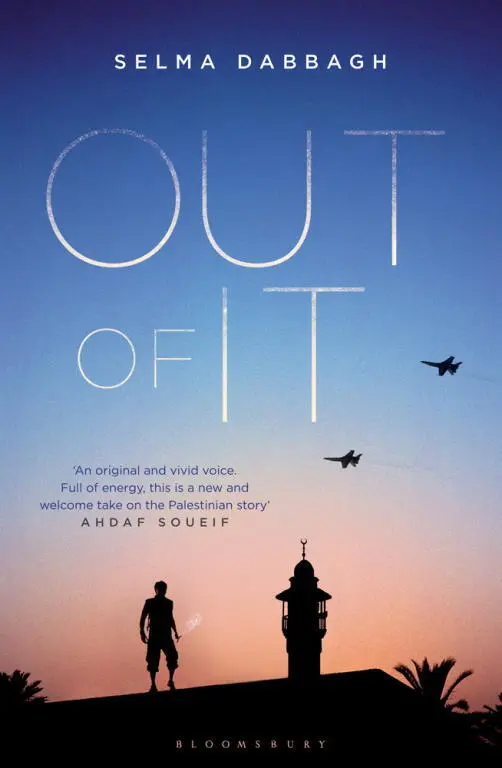
- Название:Out of It
- Автор:
- Издательство:Bloomsbury Publishing
- Жанр:
- Год:2011
- Город:London
- ISBN:978-1-4088-2430-6
- Рейтинг книги:5 / 5. Голосов: 1
-
Избранное:Добавить в избранное
- Отзывы:
-
Ваша оценка:
Out of It: краткое содержание, описание и аннотация
Предлагаем к чтению аннотацию, описание, краткое содержание или предисловие (зависит от того, что написал сам автор книги «Out of It»). Если вы не нашли необходимую информацию о книге — напишите в комментариях, мы постараемся отыскать её.
Meanwhile Sabri, the oldest brother of this disparate Palestinian family works on a history of Palestine from his wheelchair as their mother pickles vegetables and feuds with their neighbours.
Written with extraordinary humanity and humour, and moving between Gaza London and the Gulf, Out of It is a tale that redefines Palestine and its people. It follows the lives of Rashid and Iman as they try to forge paths for themselves in the midst of occupation, religious fundamentalism and the divisions between Palestinian factions. It tells of family secrets, unlikely love stories and unburied tragedies as it captures the frustrations and energies of the modern Arab world.
Out of It — читать онлайн бесплатно полную книгу (весь текст) целиком
Ниже представлен текст книги, разбитый по страницам. Система сохранения места последней прочитанной страницы, позволяет с удобством читать онлайн бесплатно книгу «Out of It», без необходимости каждый раз заново искать на чём Вы остановились. Поставьте закладку, и сможете в любой момент перейти на страницу, на которой закончили чтение.
Интервал:
Закладка:
The crowd held up the Mercedes for as long they could, trapping it behind them as they walked slowly, slapping at each other’s backs before they allowed the car to push forward, leaving them with just the vision of its large, shiny bottom bouncing over the potholes ahead of them.
As the crowd thinned out, the people appeared from within it, the craned neck of the suitcase owner pushed into an opening, his arm pulling at the case behind him as though dragging an errant child. It was a flat suitcase with buckles hanging off its straps. Rashid recognised the back of a head in front of him, the dyed hair and pocked dome of Abu Omar. His neighbour was not in his usual tracksuit bottoms and vest but dressed in an ironed short-sleeved shirt and trousers with creases running up from the elbows and down from the knees. And it was into the backs of those knees that the suitcase collided, sending Abu Omar reeling forwards to the edge of a puddle, his hands catching at a wheelbarrow on his way down. Rashid, whose emails had enhanced his sense of goodwill to the rest of humanity, moved ahead to help. Abu Omar’s hand had fallen on to a torn bag of cement in the wheelbarrow and a cloud had lifted up around him. His face was covered in a cloying film. He brushed down the dust covering him, and smoothed back his hair with two palms.
‘Are you all right now, Ammo ?’ Rashid wanted to convey his empathy with the man’s land squabbles with his mother, addressing him respectfully. He tried to do this with a look, but on seeing Rashid’s face, his neighbour tore away from him and pushed through the crowd.
Chapter 8
The woman, Raed and Taghreed’s aunt, had brought Iman to a house with two small rooms where the bodies were. The sun had moved up from the smoky horizon and pitched itself high in the sky by then, and the walk had been hot, the rooms they entered even hotter. They had gone through alleyways and areas where Iman had never been before, where camp and town became indecipherable from one another, where alleys became streets, streets became alleys. There were no other women like Iman walking bareheaded in the area where the house was.
There were two bodies in the house: Taghreed’s and her cousin Raed’s. The corpses were lined up next to each other in cotton sheets. Taghreed’s sheet had been wrapped double and formed a bulbous shape around her. But on Raed, the sheet was not enough, his feet protruded at its end, as though he had hastily decided upon a siesta and not a death.
‘She was visiting her cousin when they struck the hospital,’ Raed’s aunt had told Iman on the way to the house. ‘Her mother said that Taghreed would want you to be here. She said she loved you more than her own mother.’ She paused. ‘Raed also spoke of you. He used to ask Taghreed about you,’ she made it sound like a secret, ‘in a special way, I felt, and it is for that that I came to find you.’
The room was overburdened with a sense of duty and disbelief. Iman cleared her throat against the antiseptic air. Outside the sun was bright, but distant and the sounds of children teasing and fighting each other along the alleyway made their way into the room as though transmitted down a pipe.
Taghreed’s school bag had been left in the hallway. On the outside zip pocket a pink and blonde princess smiled two white bands of teeth into the room. Iman saw the bag bobbing through the schoolyard on Taghreed’s back, under plaits that jumped.
Taghreed’s mother was wading around in her grief trying to find her bearings with social niceties.
The bodies were burnt mostly; we had to hide those bits.
Last week I tried to tuck her shirt in for school but she was screaming and moving and the nail on my little finger caught her skin and scratched her back…
Would you like coffee?
God let them rest in peace.
The faces are not so bad.
May their lives live on in yours.
All day I felt that skin being scratched under my fingernail…
I knew, as soon as I heard the strike I knew it had taken them.
Your mother is well?
The room swelled out with women and Taghreed’s bag in the corridor, and Raed’s feet under the sheet, were lost from sight for a while and Iman found it a little easier to converse.
Something just under my navel went very tight, like a baby turning when it is too big and a sick, sharp feeling and I knew with the blast, I knew.
I keep thinking she will come in now, shouting, showing me one of the pictures she drew. Always drawing, Miss Iman, especially for you.
Your brothers are well?
We thought they might not find the bodies but they did. It was so hot, so much smoke…
Iman had never seen Raed’s feet before, only felt them close to her. Now the foot that had pressed against hers was bare and hanging like a clodden thing off the side of the table. She had thought of him as a body and done so with an ache that was so alive that it was embarrassing to remember in this setting, in any setting. She could not bring herself to look at his feet.
She turned in the other direction and found herself focussing on the hem of a woman’s skirt that had come unstitched. It is harder to cry with your mouth open. Somewhere in her inner ear she heard that laugh that came up out of him, so rich and fat that everyone around would turn to smile at it. It could lift the whole room.
She had even talked to him about poetry and he recited some back to her. Ya mualima , he called her. Oh teacher.
The loss went to her chest and her ribs felt yawned apart by it. The dark bodies of the women moved in and out of the room. Iman became focussed on where she was now, on the precise nature of the attack, on the details of the burns on the bodies, and the sense of loss made way for something greater, more directed, that forced her to breathe more and faster.
Manar was waiting for Iman in the alley outside the house. Iman felt no surprise. It was right that she should be there. Manar looked exactly as she always did, just a little prouder this time. She had been expecting Iman to be there and greeted her as though she was escorting her to a groom. Her hands reached forwards to take Iman’s.
“You know your role now Iman, don’t you?” Manar asked.
‘Yes,’ said Iman. ‘Yes.’ Because it had to stop. Immediately. It had to end.
‘You will know him. The contact. He knows you already.’
Manar left by way of a small alley between the houses, leaving Iman who did not know where she was. The road Iman was left on was sloped, sandy and populated only by children. She walked towards something pale and fluttering on the ground ahead of her. It was the head of a pink carnation. The road was scattered with them: heads, stems and small clusters of flowers in the colours of toilet paper.
There was a farmer with some boys and the farmer had bunches of flowers in his hand, a gathering of people around him and he was shouting. About the closure. About the flowers rotting. About the flowers being a high security risk. About it being an end to him. He would feed the flowers to his cows. He would shoot them (the crowd like this). No, he would give them to the women. Then the boys were running around with the flowers and Iman found herself cradling a wet bouquet in her arm as though it was a baby. She could see all this, but distantly as though it was all going on on the other side of a thick wall of dirty Perspex of the type that their guards sat behind and she stood in the street motionless waiting for nothing more than for the wall to lift.
Chapter 9
Sindibad’s appeared packed, although once inside Rashid could see that it was only one table that was occupied. A long banqueting set-up had been assembled through the café’s centre. At it a group of fighters, half in half out of fatigues, hunched over plastic bowls spread across a newspaper surface.
Читать дальшеИнтервал:
Закладка:
Похожие книги на «Out of It»
Представляем Вашему вниманию похожие книги на «Out of It» списком для выбора. Мы отобрали схожую по названию и смыслу литературу в надежде предоставить читателям больше вариантов отыскать новые, интересные, ещё непрочитанные произведения.









Обсуждение, отзывы о книге «Out of It» и просто собственные мнения читателей. Оставьте ваши комментарии, напишите, что Вы думаете о произведении, его смысле или главных героях. Укажите что конкретно понравилось, а что нет, и почему Вы так считаете.