Maggie Helwig - Girls Fall Down
Здесь есть возможность читать онлайн «Maggie Helwig - Girls Fall Down» весь текст электронной книги совершенно бесплатно (целиком полную версию без сокращений). В некоторых случаях можно слушать аудио, скачать через торрент в формате fb2 и присутствует краткое содержание. Город: Toronto, Год выпуска: 2008, ISBN: 2008, Издательство: Coach House Books, Жанр: Современная проза, Триллер, на английском языке. Описание произведения, (предисловие) а так же отзывы посетителей доступны на портале библиотеки ЛибКат.
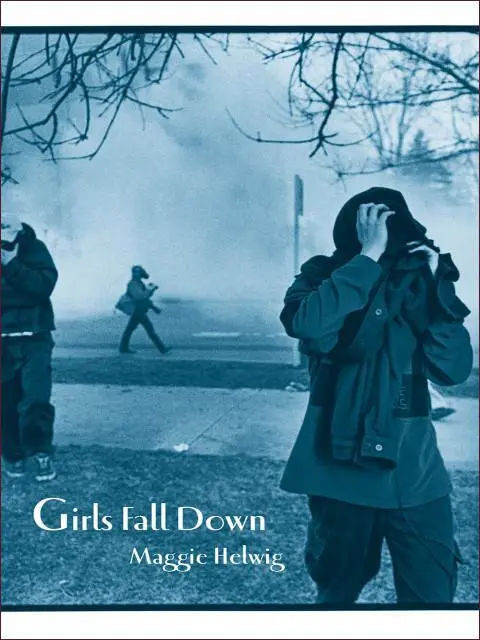
- Название:Girls Fall Down
- Автор:
- Издательство:Coach House Books
- Жанр:
- Год:2008
- Город:Toronto
- ISBN:978-1-55245-196-0
- Рейтинг книги:3 / 5. Голосов: 1
-
Избранное:Добавить в избранное
- Отзывы:
-
Ваша оценка:
Girls Fall Down: краткое содержание, описание и аннотация
Предлагаем к чтению аннотацию, описание, краткое содержание или предисловие (зависит от того, что написал сам автор книги «Girls Fall Down»). Если вы не нашли необходимую информацию о книге — напишите в комментариях, мы постараемся отыскать её.
Alex was witness to this first episode. He’s a photographer: of injuries and deaths, for his job at the hospital, and of life, in his evening explorations of every nook and cranny of the city. Alex is a diabetic, now facing the very real possibility of losing his sight, and he’s determined to create a permanent vision of his city through his camera lens. As he rushes to take advantage of his dying sight, he encounters an old girlfriend – the one who shattered his heart in the eighties, while she was fighting for abortion rights and social justice and he was battling his body’s chemical demons. But now Susie-Paul is fighting her own crisis: her schizophrenic brother has been missing for months, and the streets of Toronto are more hostile than ever.
Maggie Helwig, author of the critically lauded
, has fashioned a novel not of bold actions but of small gestures, showing how easy and gentle is the slide into paranoia, and how enormous and terrifying is the slide into love. This is a remarkable novel: romantically and politically charged, utterly convincing in its portrait of our individual and societal instability, and steadfast in its faith in redemption.
Girls Fall Down — читать онлайн бесплатно полную книгу (весь текст) целиком
Ниже представлен текст книги, разбитый по страницам. Система сохранения места последней прочитанной страницы, позволяет с удобством читать онлайн бесплатно книгу «Girls Fall Down», без необходимости каждый раз заново искать на чём Вы остановились. Поставьте закладку, и сможете в любой момент перейти на страницу, на которой закончили чтение.
Интервал:
Закладка:
In the hospital, the specialists held their vigil over the burned man. They supervised the debridement of the dead meat from his body, watched the progress of the skin grafts. The man woke and slept again, and saw always the fire as it came towards him.
He knew that he had not been a good man, not really, that he had failed in work and in love and talked to himself sometimes out loud. Speak to the bones , he would say to himself, thinking of her disappointed face and the carton of expired milk. Things happened badly. But no one could tell him why – how it was he had been burned like this, why he was the person that young men had chosen to hurt.
The burned man could not remember their faces, those angry young men equipped with fire. When he saw them in dreams, coming towards him, he could not picture them clearly. These things he knew, that they had lighters in their pockets, alcohol on their breath, that they had tense, implacable muscle. That they were full of lack and desire, and they hated him because he was weak. Because he was no one.
They were angry before these troubles started, these young men, and they would be angry afterwards, formlessly angry, and only rarely would they cross the path of the public world. They were not the city’s only threat, and not the worst, but in the burned man’s dreams they came to him, and he woke to pain and purple infection and the constant drip of liquid in his arm.
Pray for us now and at the hour of our death , he whispered.
Alex went down the winding slope of Grace Street and walked for a while in Trinity-Bellwoods Park, kicking at snow, throwing a badly formed snowball at a tree. Then the pain got to be too much for him and he went home and took a Tylenol and sat with his eyes closed, listening to the radio.
‘And phone in those pledges right now, people,’ the announcer on the campus radio station was saying, ‘because we are $15,000 behind on our rent, and if you don’t get on those phones, we’re going off the air at midnight!’
He would have to remember to check the station tomorrow and find out whether they were still around.
This is what it would be like, he thought, an aimless little life of walks and radios and pointless diversions. Because he couldn’t really believe that it would work out well, that they would arrest the disease with a few treatments and cause no major damage to his sight. His ophthalmologist, he suspected, didn’t really believe it either. It happened that way for some people, but it wouldn’t happen for him.
The girl watched the late afternoon light move across her desk, deep yellow, the sun glowing orange behind the dark mass of trees beyond the window. Her notebook was open in front of her, a purple pen with gold sparkles lying across it. The English teacher reached for a dictionary and set it down on Zoe’s desk. ‘Okay. Definition and derivation,’ he said. ‘Read that part?’
Zoe glanced at the page. ‘What? The whole letter B?’ she said teasingly. The teacher pointed at a line.
‘Beel… no way. You’re trying to make me look dumb.’
‘Oh, come on,’ said the teacher.
‘You read it.’
The teacher shrugged and picked up the dictionary. ‘Beelzebub,’ he said. ‘Definition 1: the prince of demons; the devil. Now you read the derivation.’ He passed the book to Lauren, who ran her finger down the page and found the line.
‘Hebrew – oh, wow! Hebrew for Lord of the Flies! Awesome!’
‘Oh my GOD!’ exclaimed Zoe, putting her hands up to her face. ‘How did you even know that? Were you just, like, reading through the dictionary one day and you found it?’
‘Um, it’s just more like – general knowledge,’ said the teacher, who was a very young man, though he didn’t seem so to the girls in his class. ‘It’s a thing people know.’
The girl drew a flower in the corner of a page, watching the rest of the class from the corner of her eye. Looked outside at the woods.
‘That is so awesome ,’ said Lauren.
The girl played with her pen for a moment, and then closed her exercise book and carefully inked the word FEAR onto the cover, in tiny, precise, very dark letters.
‘You know, if William Golding had kids, his kids would be totally upset reading this book,’ said Tasha.
At the St. Patrick station, on the stairway leading to the street, a woman collapsed and fell down half a flight, breaking two bones in her hand. A dead smell, she said it had been, a dead, sweet smell that pulled her down.
How could she be expected to do proper blood tests, asked the doctor in the toxicology lab, when no one could tell her what to look for, when all they could tell her was what they supposed it was not, not sarin, not cyanide, probably not a virus? Was she meant to search down to infinite degrees of abnormality? There could never be an end to that.
In the storage rooms and passageways below the subway lines the hazmat workers moved, breathing through heavy masks, slowly searching each room, each corner, for traces of powder or chemical marks, for doors opened that should not have been, cigarette butts in forbidden areas, for any sign that someone had hidden here, waiting, contaminants in open hands.
Other things happened that were innocuous and fairly ordinary, the little troubles of winter. A common enterovirus infiltrated several playschools and caused a large number of toddlers to start vomiting. Many adults exhibited upper respiratory tract infections. Some of them, remembering the men who had lost their breath at the King station, understood their symptoms to mean that they had been poisoned. Hospital emergency departments began to overflow.
A man was admitted to one of the hospitals with a high fever, the transaction that had passed between himself and a dead girl breaking violently to the surface. This man got to a doctor in time; he was treated effectively with intravenous antibiotics. Public Health was notified, and began once again the process of tracing contacts, discovering those he had been close to, those he had lived with, those he had touched. Meningitis is fast, faster than organized plans, and the dead girl, the vector, with her weak immune system and her coded, hidden world, she was moving the authorities now in a way that her life could never have done.
Alex went out again in the early evening with his camera, and tried dismally, experimentally, to take some pictures. That everything felt wrong was surely a function of his mood as much as the state of his eyes.
Anyway, some of the photos might turn out all right. There was a quality of light and movement that he liked, outside the windows of the Diplomatico, a girl in the doorway of the Bar Italia, these might be okay after all. He had to believe that.
When he got back to his apartment, there was a message on his voice mail from Susie. Asking how he was. He didn’t want anyone asking how he was. Telling him that she was going to see Derek that night, that she’d be leaving around ten, he could come to her house anytime before that.
In theory, he could simply not turn up. She had left him that choice. She might even have been suggesting it.
He could do other things. He could phone his sister, his pleasantly normal, dissatisfied sister, and listen to her stories of the folly of her co-workers. He could call in a pledge to that poor campus radio station. He sat on his couch stroking Jane and thinking about the things he could do if he didn’t answer Susie’s message, and then it was quarter to ten. He stood up and got his coat, put the photographs of her in a new manila envelope, and packed his insulin kit in his camera bag. He was halfway out the door when he turned back, grabbed the string of the balloon and brought it along with him.
He would come when she called. Watch when she left. Lose her, lose his eyes. Lose the winter light, and end up with nothing.
Читать дальшеИнтервал:
Закладка:
Похожие книги на «Girls Fall Down»
Представляем Вашему вниманию похожие книги на «Girls Fall Down» списком для выбора. Мы отобрали схожую по названию и смыслу литературу в надежде предоставить читателям больше вариантов отыскать новые, интересные, ещё непрочитанные произведения.










Обсуждение, отзывы о книге «Girls Fall Down» и просто собственные мнения читателей. Оставьте ваши комментарии, напишите, что Вы думаете о произведении, его смысле или главных героях. Укажите что конкретно понравилось, а что нет, и почему Вы так считаете.