Maggie Helwig - Girls Fall Down
Здесь есть возможность читать онлайн «Maggie Helwig - Girls Fall Down» весь текст электронной книги совершенно бесплатно (целиком полную версию без сокращений). В некоторых случаях можно слушать аудио, скачать через торрент в формате fb2 и присутствует краткое содержание. Город: Toronto, Год выпуска: 2008, ISBN: 2008, Издательство: Coach House Books, Жанр: Современная проза, Триллер, на английском языке. Описание произведения, (предисловие) а так же отзывы посетителей доступны на портале библиотеки ЛибКат.
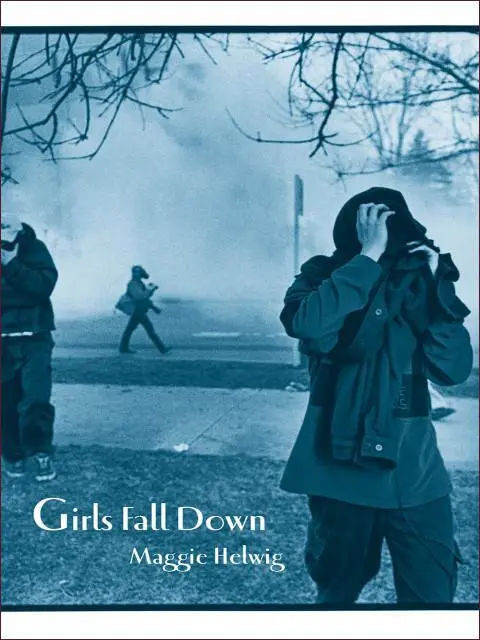
- Название:Girls Fall Down
- Автор:
- Издательство:Coach House Books
- Жанр:
- Год:2008
- Город:Toronto
- ISBN:978-1-55245-196-0
- Рейтинг книги:3 / 5. Голосов: 1
-
Избранное:Добавить в избранное
- Отзывы:
-
Ваша оценка:
Girls Fall Down: краткое содержание, описание и аннотация
Предлагаем к чтению аннотацию, описание, краткое содержание или предисловие (зависит от того, что написал сам автор книги «Girls Fall Down»). Если вы не нашли необходимую информацию о книге — напишите в комментариях, мы постараемся отыскать её.
Alex was witness to this first episode. He’s a photographer: of injuries and deaths, for his job at the hospital, and of life, in his evening explorations of every nook and cranny of the city. Alex is a diabetic, now facing the very real possibility of losing his sight, and he’s determined to create a permanent vision of his city through his camera lens. As he rushes to take advantage of his dying sight, he encounters an old girlfriend – the one who shattered his heart in the eighties, while she was fighting for abortion rights and social justice and he was battling his body’s chemical demons. But now Susie-Paul is fighting her own crisis: her schizophrenic brother has been missing for months, and the streets of Toronto are more hostile than ever.
Maggie Helwig, author of the critically lauded
, has fashioned a novel not of bold actions but of small gestures, showing how easy and gentle is the slide into paranoia, and how enormous and terrifying is the slide into love. This is a remarkable novel: romantically and politically charged, utterly convincing in its portrait of our individual and societal instability, and steadfast in its faith in redemption.
Girls Fall Down — читать онлайн бесплатно полную книгу (весь текст) целиком
Ниже представлен текст книги, разбитый по страницам. Система сохранения места последней прочитанной страницы, позволяет с удобством читать онлайн бесплатно книгу «Girls Fall Down», без необходимости каждый раз заново искать на чём Вы остановились. Поставьте закладку, и сможете в любой момент перейти на страницу, на которой закончили чтение.
Интервал:
Закладка:
‘I can’t see where the railway track is,’ he said.
Susie didn’t speak. He would not have been wholly surprised if she had left him there. He heard her moving in the darkness, the soft friction of boots in snow. Then her gloved fingers closed around his wrist.
‘This way,’ she murmured, and led him forward. ‘Now.’
He stepped out carefully and felt the track under his feet, stumbled across and stopped sharply at the other side, remembering that the steep downslope was very close. Susie let go of his wrist, and he shuffled downwards in a crouch, clinging to dry branches, until he saw a dull light to the left. Derek’s lantern. He could make out the shape of the tent by the concrete wall now, pick his way to level ground. Susie went ahead of him. ‘Derek?’ she called.
There was no answer from the tent.
‘Derek?’ She moved closer to the front flap. ‘It’s Susie-Paul. Are you there?’ Then frowned, tipped her head as if she heard something faint. ‘Hello? Derek, are you okay? Talk to me, Derek.’
Alex wasn’t aware of any sound except the distant traffic, but Susie leaned closer to the flap. ‘Hello? Please, Derek, answer me. Hello?’
Her hand moved out, and Alex caught his breath as she unzipped the tent flap. In the light that spilled from the opening, he could see her put a hand to her mouth, her eyes widening. ‘Derek, Jesus Christ, talk to me!’ She disappeared into the tent, and he was crouching and heading towards the entrance when she looked out.
‘Alex, come here,’ she said shakily. ‘He’s really sick. Physically sick.’
He got down on his hands and knees and crept into the tent, the cold nearly as bad inside, the wind crawling through small rips in the fabric. The rotting sweet smell of unwashed human, sticky acrid male smells of urine and semen and sweat, and something else, the swampy scent of illness. Derek was lying on the ground on his side, unmoving, and Alex realized now what Susie had heard, the rasp of hard breath. He had heard this before in the hospital. Not agonal, not the last breaths, not quite, but very bad.
She had moved to the side of the tent, deferring to his quasi-professional status. The lantern was inside, and he could see well enough. He didn’t want to touch this man, but there was a duty here, some elusive transfer of the medical oath to Alex, the next best thing.
He put a hand on Derek’s dirty forehead, and there was a trace of response, a twitch and a moan, consciousness.
‘He’s burning up.’ He tried to think what to do about fever. Derek’s mouth was open, the lips dry and puckered. ‘He’s extremely dehydrated.’ He looked around the tent, piles of ragged clothing, old books with foxed pages, rat droppings. There was a bottle of water in one corner. ‘He’s kind of semi-conscious. It’s possible I can get him to take some fluids.’
Susie handed him the bottle, and he took hold of Derek’s shoulder, thinking of fleas and mites, and pulled him over. He would have to hold on to him. He put one arm around the other man – realizing for the first time he was a fairly small man, of course he was, he was Susie’s brother – and lifted him partway up. Bodies in space . Derek muttered, and his legs flexed up spasmodically; then his whole body moved, and a thin stream of stringy vomit ran from his lips down the side of his face. Alex put down the water bottle, reached for a rag and wiped the vomit away, then picked the bottle up again and tried to pour the liquid into Derek’s mouth.
He should have noticed it earlier, but maybe he hadn’t been at the right angle. Derek’s shirt was partly unbuttoned and hung open over his skinny chest, ribs like sticks, and Alex saw the rash, the dark purple explosive spots scattered across the skin. He froze where he was.
‘Do you have your cellphone?’ he asked, trying to control his voice. Susie nodded. ‘Call an ambulance now. Right now,’ said Alex. ‘This is meningitis.’
She took the small phone from her pocket, but she couldn’t get a good signal under the tracks, had to crawl outside the tent and stand on the hillside in the open air, leaving Alex alone counting how many days it had been since he’d shaken Derek’s mucusy wet hand, trying to remember whether he had touched his own mouth or nose afterwards. How many days it had been since, oh God, Derek had kissed his sister.
Susie crept back into the tent. ‘They’re on their way. You should take the lantern up to the top of the hill so they can see you. I’ll stay with Derek.’ She was unnaturally calm, her face stiff. Alex was still holding Derek, the heat of the fever close against him. ‘Susie, honey, he’s very contagious. I’ve had more exposure than you up to this point, maybe I should… ’
‘Don’t be an idiot. Leave me with him.’
She was right. Of course she was right. He lay Derek gently down on the floor of the tent and moved out, his eyes on Susie as she knelt beside her brother, and as he backed out of the entrance he saw her bend down, and put her lips once more to Derek’s.
He pulled himself up the slope of the hill in the circle of light from the lantern, hearing her voice behind him, a soft continuous sound. He couldn’t make out the words. He passed over the tracks and stood at the highest point of the hill, holding the lantern up, level with his head.
Outside its pale circle there was nothing but blackness, a chaotic punctuation of lights moving in meaningless patterns. Dry seed-heads broke through the snow at his feet, and the invisible city stretched out on every side. In front of him, the Don River, the slope upwards to the east side, the plane trees and small brick houses, and behind him the wetlands, and the landscaped sloping enclaves of Rosedale. To the south and west somewhere was most of his life, his apartment at College and Grace, the osprey on the wall in Kensington Market, the little brick church, the woman in the rooming house on Bathurst and the man being held hostage by terrorists, the new Sneaky Dee’s on College that would always be the new Sneaky Dee’s although it had been there for more than a decade; to the north, his office in the hospital, the operating rooms where he moved quietly among the surgical teams, the burned man in the isolation ward. The girls falling down in the subway, the Don River running past him and away into landfill, where the shore of the lake used to be. All dark. He closed his eyes and listened to the traffic on Bayview, the hum of the engines, the wires connecting in networks above his head, like the hiss and thud of his defective blood.
And here, on the edge of this valley, half-blind and tainted with disease, he felt the city inside him with a kind of completeness, all the tangled systems. Money and death, knowledge and care, moving constantly from hand to hand; our absolute dependence on the actions of bodies around us, smog and light and electric charge.
There was a sound like music at the bottom of the city’s noise, far distant. And it grew louder, and closer, and he knew it now, the wail of the siren, the ambulance come to them in this strange retreat, this place at the heart of everything.
IV
At the corner of College and Spadina, a man with a torn bit of blanket around his shoulders and a bottle of Chinese cooking wine in his hand stood in the radiance of a neon sign and watched the show. A streetcar stalled in the middle of the intersection, the sound of car horns surging around it at all four corners, as the traffic lights spread smears of green and red on the wet asphalt, and a woman lay in the road, flat on her back, her arms and legs spread, her hair fanned out, eyes open and white, the pupils rolled up. A fire engine pulling out from the station a block away. The streetcar driver climbed down onto the tracks and knelt by the woman, and the lights of the vehicles seized them there, etching them in high relief, a frozen sculpture on a city street.
Читать дальшеИнтервал:
Закладка:
Похожие книги на «Girls Fall Down»
Представляем Вашему вниманию похожие книги на «Girls Fall Down» списком для выбора. Мы отобрали схожую по названию и смыслу литературу в надежде предоставить читателям больше вариантов отыскать новые, интересные, ещё непрочитанные произведения.












Обсуждение, отзывы о книге «Girls Fall Down» и просто собственные мнения читателей. Оставьте ваши комментарии, напишите, что Вы думаете о произведении, его смысле или главных героях. Укажите что конкретно понравилось, а что нет, и почему Вы так считаете.