Maggie Helwig - Girls Fall Down
Здесь есть возможность читать онлайн «Maggie Helwig - Girls Fall Down» весь текст электронной книги совершенно бесплатно (целиком полную версию без сокращений). В некоторых случаях можно слушать аудио, скачать через торрент в формате fb2 и присутствует краткое содержание. Город: Toronto, Год выпуска: 2008, ISBN: 2008, Издательство: Coach House Books, Жанр: Современная проза, Триллер, на английском языке. Описание произведения, (предисловие) а так же отзывы посетителей доступны на портале библиотеки ЛибКат.
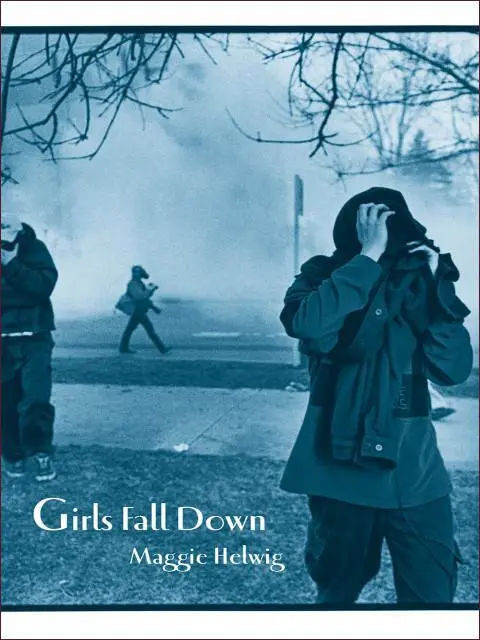
- Название:Girls Fall Down
- Автор:
- Издательство:Coach House Books
- Жанр:
- Год:2008
- Город:Toronto
- ISBN:978-1-55245-196-0
- Рейтинг книги:3 / 5. Голосов: 1
-
Избранное:Добавить в избранное
- Отзывы:
-
Ваша оценка:
Girls Fall Down: краткое содержание, описание и аннотация
Предлагаем к чтению аннотацию, описание, краткое содержание или предисловие (зависит от того, что написал сам автор книги «Girls Fall Down»). Если вы не нашли необходимую информацию о книге — напишите в комментариях, мы постараемся отыскать её.
Alex was witness to this first episode. He’s a photographer: of injuries and deaths, for his job at the hospital, and of life, in his evening explorations of every nook and cranny of the city. Alex is a diabetic, now facing the very real possibility of losing his sight, and he’s determined to create a permanent vision of his city through his camera lens. As he rushes to take advantage of his dying sight, he encounters an old girlfriend – the one who shattered his heart in the eighties, while she was fighting for abortion rights and social justice and he was battling his body’s chemical demons. But now Susie-Paul is fighting her own crisis: her schizophrenic brother has been missing for months, and the streets of Toronto are more hostile than ever.
Maggie Helwig, author of the critically lauded
, has fashioned a novel not of bold actions but of small gestures, showing how easy and gentle is the slide into paranoia, and how enormous and terrifying is the slide into love. This is a remarkable novel: romantically and politically charged, utterly convincing in its portrait of our individual and societal instability, and steadfast in its faith in redemption.
Girls Fall Down — читать онлайн бесплатно полную книгу (весь текст) целиком
Ниже представлен текст книги, разбитый по страницам. Система сохранения места последней прочитанной страницы, позволяет с удобством читать онлайн бесплатно книгу «Girls Fall Down», без необходимости каждый раз заново искать на чём Вы остановились. Поставьте закладку, и сможете в любой момент перейти на страницу, на которой закончили чтение.
Интервал:
Закладка:
Alex sipped the coffee, which tasted of little except a certain artificial bitterness. ‘I was listening to one of your old tapes the other night,’ he said.
‘Huh. That’s something I don’t hear very often.’ Adrian looked down at his mug. ‘I put too much sugar in this. Anyway, infection. It’s all about people touching each other, isn’t it? Proximity. Half the congregation won’t drink out of the common cup any more. I’ve been counting.’
‘Susie, Suzanne, she’s planning to write an academic paper about it. But she thinks she has to talk to the girls from that first incident. Which I doubt she’s going to be allowed to do.’
‘Proximity’s a difficult issue for people,’ said Adrian. He pushed his glasses up on his nose, and then spoke quickly. ‘You should have kept in touch, Alex.’
Alex leaned back against the other counter. ‘I thought I did,’ he said softly.
‘When you moved? You never told me, remember that? I tried to call you and your number was disconnected, you didn’t even have a message with the new one. So you can see, you know… yeah, I could’ve looked up Deveney in the phone book, but it seemed like you were sending a kind of signal there.’
‘I didn’t mean to. I just forgot.’
‘Well. I guess that’s kind of true.’
‘It is true. I mean, I don’t even remember now, honestly. But I’d know if I’d done it on purpose.’
Adrian nodded. ‘Okay. That’s okay.’ He looked up, took another sip of coffee and grimaced. ‘It’s really bad with all this sugar.’
‘You could pour some water into it. But I don’t suppose that’d solve anything.’
‘So which tape were you listening to, actually?’
‘The live one. Remember? You can hear Harold Kandel yelling in the background?’
‘Oh yeah. He had this plastic bag with a radio in it. And when I asked him to turn it off he went into this thing about Minnie the Moocher. How she was a low-down hoochie-koocher and so forth. But I knew he was trying to be supportive.’
‘It was meant as political commentary, I think.’
Adrian stirred his spoon around the oversweetened coffee. ‘I did kind of like that tape.’
‘It was good. Your songs are good.’
‘I guess. In their way.’ Adrian checked his watch. ‘I should get back. I don’t want my student being forced to tackle sexism as a group. But it’s nice to see you.’
He let Alex out by the church door, and as Alex left he looked back and saw him standing in the doorway with his hands tucked into his armpits, watching down the street for his student, small and quiet, perfectly alone.
At the corner of Yonge and Gerrard, four men sat on the ground in handcuffs, in a ring of police and campus security. Two of them, manic and agitated, were arguing about who had hit who first, while the other two leaned back against the wall with a strangely cheerful air, as if this were an interruption in the daily routine staged only for their entertainment.
‘He’s a fucker, that guy,’ commented one of them.
‘He’s a bum,’ said the other. He laughed languidly. ‘But hell, so am I.’
‘He’s fucking screwed.’
‘I didn’t hit fucking nobody.’
‘Me neither, man. Didn’t lay a hand.’
‘He’s a fucker.’
In the business district, figures in coats hurried across a windy corner below a looming pixelboard display, a loop of stock prices and headlines and weather reports. Suspicious fire of unknown origin. Security Council negotiations. The cold front stationary, hovering like a hawk above the city.
A man walked through a corridor, quickly, thinking of events set in motion. On the twenty-third floor of a half-empty office tower, a woman backed away from a wrinkled envelope that had been pushed beneath the door, a piece of paper marked with the type-written words THIS IS NOT ANTHRAX. Backed away, hands shaking, from the threat understood in the denial of threat. Reached for a phone.
When the fire trucks arrived the alarm system was activated, the building emptied. The workers from the twenty-third floor hosed down, their clothes dripping, inside a white tent in the icy chill. In the surrounding apartments, people came to the windows and saw them filing into the street, evacuees. A woman in a nearby church sat in the centre of a meeting room, huddled in a chair, hearing the sound of the alarms gliding up and down in the air.
A tall man stood under the freezing spray, his feet in a plastic pool, water cascading from his dark suit, and felt suddenly emptied of everything, staring along the winter buildings outside the door of the tent and into a clear blank freedom.
Some distance away, a rock smashed through the window of a shop at Coxwell and Gerrard, scattering glass across the display counter, the bright-coloured honey-and-milk array of sweets. A television over the counter played on to no one, the news crawl picking up the rumours of anthrax, the hazmat team on the screen with their purifying hoses.
‘You’ll probably hate this place when it’s finished,’ said Alex. ‘It’ll all be very expensive. But I thought you’d like it right now.’
He stood with Susie in a long channel of mud, under the heavy brown-brick walls of the abandoned Victorian factories, slabs of wood laid over the wet dirt where there would someday be cobbled walkways. The sun came over the high buildings in shards of cold brightness, breaking out from a soft dense sky. It was a good day for light, slightly diffused through cloud, not too harsh.
Here and there, new businesses had already opened – a coffee shop, a microbrewery, a small art gallery. But most of the space was still inchoate, forming itself out of the memories of fallen industry, sweat and dust and darkness. Susie looked around intently, and Alex supposed she had a theory, she always had a theory, but she only nodded, apparently pleased. They walked up a temporary wooden stairway to a metal door, set in a massive brick wall, and Alex took a set of keys out of his pocket.
‘Are you really supposed to be in here?’ she asked.
‘I know people.’ He turned the key and pushed the door open. ‘It’s going to be artists’ studios in this building. And if I say I need it for a photo shoot, they know I’m not really going to bring in twenty friends and a keg of beer.’ He motioned for Susie to come inside. ‘The thing is there’s no heat. And no artificial light, but I know where there’s a good exposure.’
The hall they entered was dark and wet, but the spiral stairway to the next level had already been built, and he led her down a corridor of drywall and metal spars, into a half-finished room where a large south-facing window filled most of one wall.
‘I think there’s a photographer going to rent this one,’ he said. ‘It’d be good. If you wanted to have a studio in a fashionable place, I mean.’
Out of the wind, it was not quite as cold, but the chill was damp and clinging. Susie put her red hat into her pocket but left her coat on, over a black sweater and jeans.
‘Do you think you could take your coat off?’ he asked. ‘It’s okay if not. It’s not exactly warm in here.’
She blew out a small puff of visible breath and smiled, but shrugged the coat off and left it in a corner. ‘Just don’t take forever, all right?’
‘I’ll try not to.’
He bent down and opened his camera bag, took out the Leica and selected a lens. It had to be the Leica, but he was glad that she didn’t understand how much that meant to him.
‘Let’s try near the window,’ he said. ‘You could just stand over there.’
He didn’t do a lot of portraits. A hand spot and an umbrella would have been useful, but he would have needed to rent them. He hung the Leica around his neck and got out his light meter.
Читать дальшеИнтервал:
Закладка:
Похожие книги на «Girls Fall Down»
Представляем Вашему вниманию похожие книги на «Girls Fall Down» списком для выбора. Мы отобрали схожую по названию и смыслу литературу в надежде предоставить читателям больше вариантов отыскать новые, интересные, ещё непрочитанные произведения.









Обсуждение, отзывы о книге «Girls Fall Down» и просто собственные мнения читателей. Оставьте ваши комментарии, напишите, что Вы думаете о произведении, его смысле или главных героях. Укажите что конкретно понравилось, а что нет, и почему Вы так считаете.