Maggie Helwig - Girls Fall Down
Здесь есть возможность читать онлайн «Maggie Helwig - Girls Fall Down» весь текст электронной книги совершенно бесплатно (целиком полную версию без сокращений). В некоторых случаях можно слушать аудио, скачать через торрент в формате fb2 и присутствует краткое содержание. Город: Toronto, Год выпуска: 2008, ISBN: 2008, Издательство: Coach House Books, Жанр: Современная проза, Триллер, на английском языке. Описание произведения, (предисловие) а так же отзывы посетителей доступны на портале библиотеки ЛибКат.
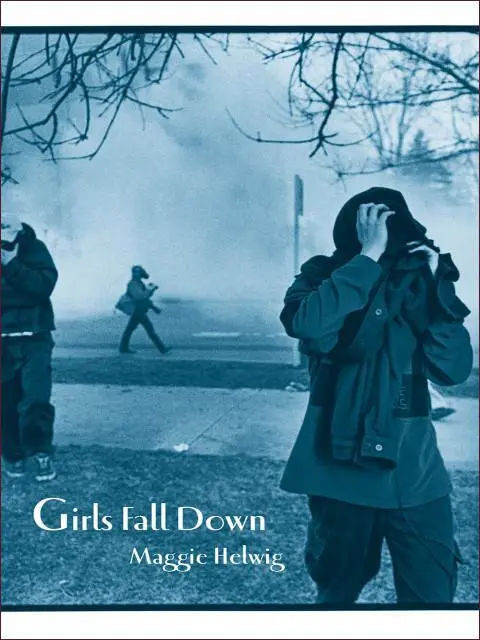
- Название:Girls Fall Down
- Автор:
- Издательство:Coach House Books
- Жанр:
- Год:2008
- Город:Toronto
- ISBN:978-1-55245-196-0
- Рейтинг книги:3 / 5. Голосов: 1
-
Избранное:Добавить в избранное
- Отзывы:
-
Ваша оценка:
Girls Fall Down: краткое содержание, описание и аннотация
Предлагаем к чтению аннотацию, описание, краткое содержание или предисловие (зависит от того, что написал сам автор книги «Girls Fall Down»). Если вы не нашли необходимую информацию о книге — напишите в комментариях, мы постараемся отыскать её.
Alex was witness to this first episode. He’s a photographer: of injuries and deaths, for his job at the hospital, and of life, in his evening explorations of every nook and cranny of the city. Alex is a diabetic, now facing the very real possibility of losing his sight, and he’s determined to create a permanent vision of his city through his camera lens. As he rushes to take advantage of his dying sight, he encounters an old girlfriend – the one who shattered his heart in the eighties, while she was fighting for abortion rights and social justice and he was battling his body’s chemical demons. But now Susie-Paul is fighting her own crisis: her schizophrenic brother has been missing for months, and the streets of Toronto are more hostile than ever.
Maggie Helwig, author of the critically lauded
, has fashioned a novel not of bold actions but of small gestures, showing how easy and gentle is the slide into paranoia, and how enormous and terrifying is the slide into love. This is a remarkable novel: romantically and politically charged, utterly convincing in its portrait of our individual and societal instability, and steadfast in its faith in redemption.
Girls Fall Down — читать онлайн бесплатно полную книгу (весь текст) целиком
Ниже представлен текст книги, разбитый по страницам. Система сохранения места последней прочитанной страницы, позволяет с удобством читать онлайн бесплатно книгу «Girls Fall Down», без необходимости каждый раз заново искать на чём Вы остановились. Поставьте закладку, и сможете в любой момент перейти на страницу, на которой закончили чтение.
Интервал:
Закладка:
There was nothing different to do, nothing that had to be done but to send the photos to the hard drive by wireless transfer. Alex would hear, sooner or later, what was needed from them. He would sort and select the shots, isolate the particular details that were requested. He would know this man’s heart. He might not ever find out what happened to him.
But the afternoon was lucky. Things could change like that; he could walk out of the OR shaky and sick, and then be sent on one of those assignments that was pure enjoyment, upbeat and playful. This time a girl with new prosthetic legs, a bright, opinionated kid with spiky black hair and little gold earrings who found the devices – her fourth set so far – to be totally excellent. She had never had such good legs before, she told him, doing little steps to demonstrate. The previous legs had sucked like a suckhole but these were much better, her old doctor didn’t know what he was doing, not like this new lady doctor who was absolutely cool. Completely aware of the camera, and flirting with it in a little-girl way, a necklace of rainbow butterflies around her neck.
So he didn’t feel so bad by the time he got home, a light snow drifting around him. It wasn’t, in the end, what he would have called a bad day. It was just that he was tired, that it was too complex to absorb all at once.
He picked Queen Jane up from the bed where she was sleeping and carried her against his chest to the couch, lay down with the heavy grey cat curled under his chin, her claws hooked into his shirt at the shoulder. It was not very comfortable, and he got tufts of cat hair in his mouth when he breathed, but it was easier than trying to move her. He would get up soon and make dinner; he would spend the night at home, working in the darkroom.
He remembered, then, Susie’s piece of paper. Queen Jane stretched on his chest and pushed one paw against his throat, making him cough and sit up; he rearranged her into his lap despite her cries of complaint. He could run over to the rooming house easily; it was only a few blocks away, and maybe a good time to catch people at home.
There was something to be said for getting it over with. Being able to tell her that he’d tried. Of course there was also something to be said for not trying at all, for keeping his distance from the whole situation, that dangerous maze of emotion and memory.
But he put on his coat and walked up Bathurst Street to a squat, cramped building, decaying white plaster on the front. There were a dozen doorbells of various types and ages fastened to either side of the door, some with names or numbers written in chalk underneath, some with scraps of paper pasted onto them, the letters faded into illegibility. One had a red painted arrow pointing to it, with the words DOSE’NT WORK alongside. The door itself was locked. He chose one button randomly, pushed it and waited for a few minutes, but there was no response.
Under the bells, also in chalk, someone had written BSMT APTS, and added another arrow that seemed to point south down the street. Presumably it was intended to direct people – assuming anyone ever came here – to the narrow laneway that ran by the side of the house. Alex went down the front stairs and followed the laneway to the back, where he found another door, heavy steel and painted green. This one wasn’t locked, and he pushed it open and walked down a flight of stairs into a narrow corridor that smelled of cooked cabbage and damp rot. There was a row of apartments on either side, the chain-locked entrances just a few feet apart, and a sheet of drywall and a hammer lying in the corner as if the rooms were in the process of being subdivided into even smaller units.
He knocked at the door marked #15. A bare-legged girl in a T-shirt peered around the chain, shouted, ‘Foreign student visa!’ and slammed the door again. At #13 there was no answer, though he could hear a television playing inside, canned applause, probably a game show. He was standing in the corridor considering his next move when he heard a chain lock rattle open, and a young man with dreadlocks wrestled a bicycle out into the hallway.
‘Hey, man,’ he said, nodding to Alex in a vaguely friendly way.
‘Hey,’ said Alex. ‘Do you think you could help me?’
‘You here about the election or something?’
‘Is there an election?’
‘Beats me. But I sometimes think I should take more of an interest, you know? Getting to that age where I should take responsibility?’
‘No, the thing is, I’m looking for someone who used to live here.’
‘Oh, well, I couldn’t do much there, I just moved in a few months ago. But you should talk to Mrs. Nakamura in #8. She’s been here, like, forever.’
‘Okay. Thanks.’
‘No problem. Let me know if there’s an election, eh?’ He dragged his bicycle up the stairs, dislodging the chunk of wood so that the door swung closed, and Alex wondered if he was locked in now, but decided to try Mrs. Nakamura before looking for an escape route.
There was a mat outside #8, a pair of red slippers placed carefully side by side. Alex knocked, and heard movement, and then the door was opened by a diminutive woman in a faded floral smock, her hair tied tightly back.
‘Come in!’ she said, with a wide smile. ‘Please come in!’ She pulled the door open wider.
‘It’s all right,’ said Alex. ‘I just need to… ’
‘No, no. Please come in.’ She tugged gently on his arm, and he found himself inside the room, which was windowless, dimly lit by a single desk lamp. ‘Sit down. Sit here.’ The woman moved him towards a folding chair.
As his eyes adjusted, he saw that he was in a bare and very neat space, a little writing table at his elbow. There was a larger melamine table against the wall, an old but spotless toaster oven and a radio sitting on it; a cot nearby, with a red blanket tucked tightly around the corners. There was a can of tuna and part of a loaf of bread on the toaster oven, and half the wall was covered with large colour posters of tennis players. In the centre of the room, and taking up much of the space, was an ironing board, and once he was safely seated the woman returned to it, and resumed her task of meticulously, slowly, ironing a piece of junk mail.
‘You have to be careful with the mail,’ she said brightly. ‘In these days. I always make sure to iron. Then it’s safe. You agree? I hope you take precautions. Is that right?’
‘Ah,’ said Alex. ‘I don’t get much mail.’
‘I always make sure. Now, can I help you? You’re from the city hall?’
The basement was overheated; he was already uncomfortable in his winter coat. He took his cap off and held it in his lap. ‘No, I just wanted to ask about someone who lived here a few years ago.’
‘You’re from immigration? Nobody here has any problems with immigration. All the papers are in order.’
‘No, no. It’s just for a friend.’
The woman finished ironing the envelope, picked it up and set it neatly on the corner of the desk, then pulled over another chair and sat down near Alex. ‘Let me ask you, did you hear the weather report on the radio?’
‘I’m afraid not.’
‘They said there could be a blizzard. I’m very worried about that. I was thinking that the power might go off.’
‘I don’t think so.’
‘If there’s a blizzard, and then ice on the power lines. The power could go off. I’ve been very worried. I tried to call my son, but he said he didn’t have time to buy me a flashlight. But, you know, he goes to this church? All the way up at Finch? I would think if he could get all the way up there he could buy me a flashlight. Don’t you think?’
‘I just wanted to ask you about someone,’ said Alex.
‘I know. It’s so good of you to come to talk to me. I called my son, you know, and I said, if you could buy me some Ritz Crackers, if the power goes off, I could put the tuna on them, and it would still be a meal, right? But he isn’t very kind.’
Читать дальшеИнтервал:
Закладка:
Похожие книги на «Girls Fall Down»
Представляем Вашему вниманию похожие книги на «Girls Fall Down» списком для выбора. Мы отобрали схожую по названию и смыслу литературу в надежде предоставить читателям больше вариантов отыскать новые, интересные, ещё непрочитанные произведения.









Обсуждение, отзывы о книге «Girls Fall Down» и просто собственные мнения читателей. Оставьте ваши комментарии, напишите, что Вы думаете о произведении, его смысле или главных героях. Укажите что конкретно понравилось, а что нет, и почему Вы так считаете.