Claire Watkins - Battleborn
Здесь есть возможность читать онлайн «Claire Watkins - Battleborn» весь текст электронной книги совершенно бесплатно (целиком полную версию без сокращений). В некоторых случаях можно слушать аудио, скачать через торрент в формате fb2 и присутствует краткое содержание. Город: New York, Год выпуска: 2012, ISBN: 2012, Издательство: Riverhead Books, Жанр: Современная проза, на английском языке. Описание произведения, (предисловие) а так же отзывы посетителей доступны на портале библиотеки ЛибКат.
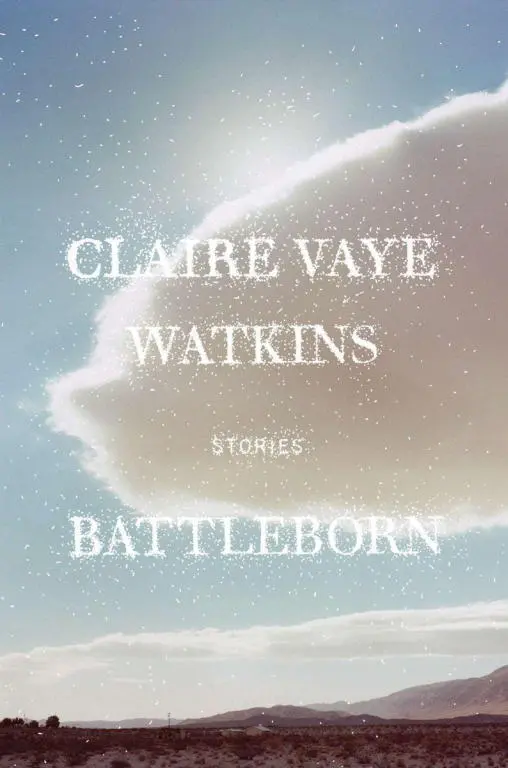
- Название:Battleborn
- Автор:
- Издательство:Riverhead Books
- Жанр:
- Год:2012
- Город:New York
- ISBN:978-1-101-59675-3
- Рейтинг книги:4 / 5. Голосов: 1
-
Избранное:Добавить в избранное
- Отзывы:
-
Ваша оценка:
Battleborn: краткое содержание, описание и аннотация
Предлагаем к чтению аннотацию, описание, краткое содержание или предисловие (зависит от того, что написал сам автор книги «Battleborn»). Если вы не нашли необходимую информацию о книге — напишите в комментариях, мы постараемся отыскать её.
,
, and
Best Book of the year, and more… Like the work of Cormac McCarthy, Denis Johnson, Richard Ford, and Annie Proulx,
represents a near-perfect confluence of sensibility and setting, and the introduction of an exceptionally powerful and original literary voice. In each of these ten unforgettable stories, Claire Vaye Watkins writes her way fearlessly into the mythology of the American West, utterly re-imagining it. Her characters orbit around the region’s vast spaces, winning redemption despite—and often because of—the hardship and violence they endure. The arrival of a foreigner transforms the exchange of eroticism and emotion at a prostitution ranch. A prospecting hermit discovers the limits of his rugged individualism when he tries to rescue an abused teenager. Decades after she led her best friend into a degrading encounter in a Vegas hotel room, a woman feels the aftershock. Most bravely of all, Watkins takes on—and reinvents—her own troubled legacy in a story that emerges from the mayhem and destruction of Helter Skelter. Arcing from the sweeping and sublime to the minute and personal, from Gold Rush to ghost town to desert to brothel, the collection echoes not only in its title but also in its fierce, undefeated spirit the motto of her home state.
Battleborn — читать онлайн бесплатно полную книгу (весь текст) целиком
Ниже представлен текст книги, разбитый по страницам. Система сохранения места последней прочитанной страницы, позволяет с удобством читать онлайн бесплатно книгу «Battleborn», без необходимости каждый раз заново искать на чём Вы остановились. Поставьте закладку, и сможете в любой момент перейти на страницу, на которой закончили чтение.
Интервал:
Закладка:
“You don’t even know him.”
“I don’t have to.”
He was right and I should have told him as much. Instead I said, “We should get back.”
He nodded once and turned. We walked back without speaking, him always a few steps ahead of me. A couple times his back straightened and he inhaled sharply as if he wanted to say something. But he never did. In front of my apartment he said, “I’m going to catch a bus. Let your sister know, will you?”
I said, “Wait, Sam. Will you wait a second?” I brought my keys out of my pocket and unlocked my car.
It had been glossy when they printed it out but it had gone satin, somehow. The edges of the quarter sheet had curled in on themselves. He took it from my hand. “What’s this?”
“They gave it to me.” I pointed where the heavy woman had pointed, the white brackets, the dark space. “There,” I said.
He opened his mouth a little. “You kept this?”
“Yeah,” I said. It was true, though not in the way I let him believe.
He held it delicately, smoothing a curled corner with his thumb. He said nothing for a long time; then he ran his finger along the bottom edge. “What do these numbers mean?”
“I don’t know,” I said. “I didn’t ask.” He held it a while longer, closer to him. When he tried to give it back I gestured for him to keep it. It seemed he would, at first. But then, suddenly, he thrust it back at me and said, “What am I supposed to do with this?”
“I thought you’d want it.”
He looked at it again, disgusted, as though he could see everything wrong with me in the image. “It’s a piece of paper,” he said finally. “It doesn’t work like that.”
“I thought—”
“Is that what this is about?” He laughed that hard-edged laugh again. “It is. You’re gonna have this baby as some kind of memento. The centerpiece to your little shrine up there? Jesus, Nat. You are fucked up.”
“I love him.”
He slipped the ultrasound into his coat pocket. “You don’t love people,” he said. “You love what they do to you.”
When I went inside, Carly was at the window. She’d been watching us. “Jesus,” I said. “What were you thinking?”
She put her finger to her lips and said, “Shh.” She gestured to the bedroom.
“Fine,” I said. I walked into the kitchen, retrieved a pack of cigarettes from on top of the fridge, and went out to the fire escape. My hands were shaking.
Carly followed me outside. “What are you doing? You promised.”
I lit a cigarette and took a drag. “Why the fuck would you bring him here?”
“I was worried about you.”
I exhaled. “The fuck you were. You’re coming over here, dressing the Miracle like—”
“You promised,” she said again.
“Get out.”
“What?”
“Leave. Take her with you. Don’t come back.”
She began to cry. “Listen to yourself—”
“You listen. Do you know what you’re saying? Have a baby ? Look at me.” I was shouting. “Look at my life. Why would you want anyone to have a life like ours?”
She wiped her eyes, sending out little sooty shooting stars of mascara. “You don’t even sound like you.”
“I don’t sound like you ,” I said. I was crying now, too. A car alarm sounded somewhere. Beyond its wailing was downtown, the lights of the casinos crisp in the cold, the Truckee running through. Sam was on a bus, homebound. And beyond that, somewhere, was Ezra, his impossible laugh, his half breaths, his index finger looped around my big toe. Here was my sister, pulling me to her.
“I’ve got too much of her in me,” I said. “I can feel it.”
Carly took a deep breath of cold air. “Me, too,” she said into my hair. She sounded surprised. “Me, too.”
She held me that way for some time. When she let me go she touched the soft places under my eyes with the cuff of her sweater. She nodded to my cigarettes. “Give me one of those, would you?”
We leaned against the building and smoked in silence. Once, Carly turned and cupped her hands against my bedroom window. “Look at this,” she said.
Inside, the Miracle was splayed out on my bed, asleep. Her wings and headband had been cast off, and the nunchucks Sam bought her were on the floor. She was sleepmoist, and the wild wispy hairs around her face curled in the dampness. We watched her stretch triumphantly, her brawny hands curled in fists.
THE DIGGINGS
for Captain John Sutter
There were stories in the territory, stories that could turn a sane man sour and a sour man worse. Three Frenchmen in Coloma dug up a stump to make way for a road and panned two thousand dollars in flakes from the hole. Above the Feather River a Michigander lawyer staked his mule for the night and when he pulled it in the morning a vein winked up at him. Down on the Tuolumne a Hoosier survived a gunfight and found his fortune in the hole the bullet drilled in the rock above his shoulder. In Rough and Ready a man called Bennager Raspberry, aiming to free a ramrod jammed in his musket, fired at random into the exposed roots of a manzanita bush. There he found five thousand dollars in gold, free and pure. Near Carson Creek a Massachusetts man died of isthmus sickness, and mourners shoveled up a seven-pound nugget while digging his grave.
In California gold was what God was in the rest of the country: everything, everywhere. My brother Errol told of a man on a stool beside him who bought a round with a pinch of dust. He told of a child dawdling in a gully who found a queerly colored rock and took it to his mother, who boiled it with lye in her teakettle for a day to be sure of its composition. He told of a drunkard Pike who’d found a lake whose shores sparkled with the stuff but could not, once sober, retrieve the memory of where it was. There were men drowning in color, men who could not walk into the woods to empty their bladders without shouting, Eureka!
And there were those who had nothing. There were those who worked like slaves every single day, those who had attended expensive lectures on geology and chemistry back home, those who had absorbed every metallurgy manual on the passage westward, put to memory every map of those sinister foothills, scrutinized every speck of filth the territory offered and in the end were rewarded without so much as a glinting in their pans.
And there was a third category of miner too, more wretched and volatile than the others: the luckless believer. Here was a forty-niner ever poised on the cusp of the having class, his strike a breath away in his mind. Belief was a dangerous sickness at the diggings—it made a man greedy, violent and insane. This fever burned hotter within my brother than in any other prospector among the placers. I know, because I lit him.
I. HO FOR CALIFORNIA!
My brother and I came to gold country from Ohio when Errol was twenty and I seventeen. Our father had gone to God in December of 1848, leaving us three hundred dollars each. I had not been especially interested in the activity out west—my eyes looked eastward, in fact, to Harvard Divinity. But my brother was married to the notion. He diverted the considerable energies he usually spent clouting me or bossing me around and put them toward convincing me to join him. I admit I rather enjoyed this process of conversion—it was maybe the first in all our life together that Errol had regarded me with greater interest than that due an old boot. His efforts having roused in me the spirit of adventure, I began to fancy us brother Argonauts, bold and divine.
We left our mother and sisters in Cincinnati in the early spring of 1849, and set out by way of the Ohio and Missouri rivers. In Independence we bought a small freight wagon and spent a week and what was left of our money readying it. We fit iron rims to the wheels, tightened the spokes, greased the axles, secured the bolts and reinforced the harnesses. We purchased new canvas from an outfitter, coated it with linseed oil and beeswax and stretched it across the new pine bows. My brother, despite his want of artistic aptitude, painted the canvas with a crude outline of Ohio and a script reading Ho for California!
Читать дальшеИнтервал:
Закладка:
Похожие книги на «Battleborn»
Представляем Вашему вниманию похожие книги на «Battleborn» списком для выбора. Мы отобрали схожую по названию и смыслу литературу в надежде предоставить читателям больше вариантов отыскать новые, интересные, ещё непрочитанные произведения.





Обсуждение, отзывы о книге «Battleborn» и просто собственные мнения читателей. Оставьте ваши комментарии, напишите, что Вы думаете о произведении, его смысле или главных героях. Укажите что конкретно понравилось, а что нет, и почему Вы так считаете.