Gerbrand Bakker - Ten White Geese
Здесь есть возможность читать онлайн «Gerbrand Bakker - Ten White Geese» весь текст электронной книги совершенно бесплатно (целиком полную версию без сокращений). В некоторых случаях можно слушать аудио, скачать через торрент в формате fb2 и присутствует краткое содержание. Год выпуска: 2013, ISBN: 2013, Издательство: Penguin USA, Жанр: Современная проза, на английском языке. Описание произведения, (предисловие) а так же отзывы посетителей доступны на портале библиотеки ЛибКат.
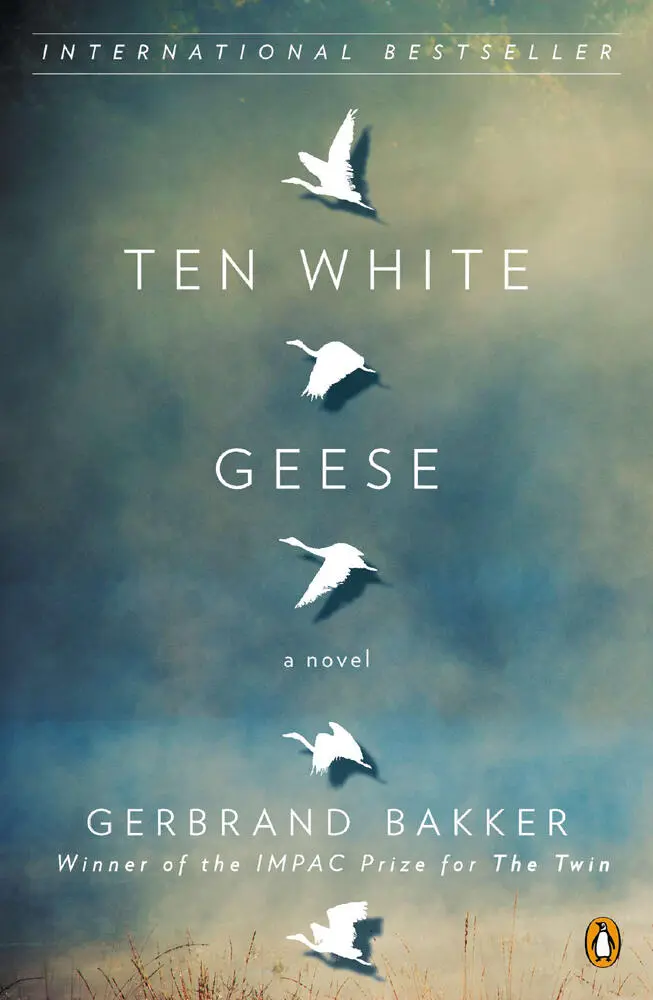
- Название:Ten White Geese
- Автор:
- Издательство:Penguin USA
- Жанр:
- Год:2013
- ISBN:9781101603055
- Рейтинг книги:3 / 5. Голосов: 1
-
Избранное:Добавить в избранное
- Отзывы:
-
Ваша оценка:
Ten White Geese: краткое содержание, описание и аннотация
Предлагаем к чтению аннотацию, описание, краткое содержание или предисловие (зависит от того, что написал сам автор книги «Ten White Geese»). Если вы не нашли необходимую информацию о книге — напишите в комментариях, мы постараемся отыскать её.
A woman rents a remote farm in rural Wales. She says her name is Emilie. An Emily Dickinson scholar, she has fled Amsterdam, having just confessed to an affair. On the farm she finds ten geese. One by one they disappear. Who is this woman? Will her husband manage to find her? The young man who stays the night: why won’t he leave? And the vanishing geese?
Set against a stark and pristine landscape, and with a seductive blend of solace and menace, this novel of stealth intrigue summons from a woman’s silent longing fugitive moments of profound beauty and compassion.
Ten White Geese — читать онлайн бесплатно полную книгу (весь текст) целиком
Ниже представлен текст книги, разбитый по страницам. Система сохранения места последней прочитанной страницы, позволяет с удобством читать онлайн бесплатно книгу «Ten White Geese», без необходимости каждый раз заново искать на чём Вы остановились. Поставьте закладку, и сможете в любой момент перейти на страницу, на которой закончили чтение.
Интервал:
Закладка:
‘You coming?’
‘No. I’ve got things to do.’
He gestured at the table. ‘Were you working?’
‘You could just go away for good,’ she said.
‘How do you mean?’
‘I mean what I say.’
‘You don’t give up, do you?’
She wanted to look straight into his eyes, but couldn’t because the window, the light, was behind him. ‘Don’t say I didn’t warn you,’ she said.
He stood there with his bum against the sink, then started taking the bread out of his rucksack. ‘I miss Sam,’ he said. ‘That’s all.’
She sniffed. Despite the lack of wind, her excursion outdoors had dispelled the old-woman smell, but now it was rising again from her clothes, drifting up from her shoulders. ‘Get going,’ she said.
He picked up the shopping list. ‘Why do I have to buy so much water?’ he asked.
‘I’m starting to get sick of the tap water,’ she said.
‘Have you got some money for me?’ he asked.
56
The ferry’s departure was delayed. There was a problem with one of the propellers. They announced over the PA that divers had been sent down to fix it, without specifying exactly what the problem was. The husband and the policeman drank a second whisky. It was busy on the boat. Fake Christmas trees everywhere, fairy lights, boisterous Brits and quiet Dutchies. Someone was up on a small stage entertaining people. They were sitting off to one side at a round table that was bolted to the floor, next to a window that had rainwater trickling across it on the outside. Through the window they could look out over an enormous expanse of brightly lit petrochemical industry. Somewhere far below them was the policeman’s car, among hundreds of other cars. Christmas Eve. Force 5 to 6 winds, north-westerly.
‘We won’t arrive at nine in the morning then,’ the husband said.
‘Doesn’t matter,’ the policeman said. ‘We’re not in a hurry, are we?’
‘No.’ He sipped his whisky: the policeman had got both rounds at the bar, which was decorated with lots of brass. ‘A fine Scotch,’ he’d said, ‘single malt.’ It tasted smoky, peaty. The policeman knew what he was talking about; the husband hardly ever drank spirits. Now that he was sitting here, he remembered a crossing he’d made long ago with a friend from high school. They drank gin and tonics because they were travelling to England. The friend had spent the whole night puking into the shared toilet in the corridor; he had warded off the nausea by rubbing his breastbone for hours, lying motionless on his back on a narrow bed in a windowless cabin with two complete strangers in the next bunk. That was before he knew his wife. Now he knew her and now he was drinking whisky, a drink for grown men, he thought, but equally good, or even better, as a way of getting in the mood for England. Packed in his travel bag, dozens of metres lower in the boat, was a marble cake his mother-in-law had made. That was a tradition: when they went on holiday, she produced a marble cake for them to eat at their destination, whether it was a campsite or a hotel room. As if this were an ordinary holiday, as if she hadn’t noticed that her son-in-law was going away with the policeman, not her daughter. He looked at the man on the chair next to him. He had just taken a sip of whisky and was watching the entertainer put a hat on a redhead he’d hauled up onto the stage; he let the whisky wash around his mouth before swallowing it. Even out of uniform he looked like a policeman. Maybe because he knew what he looked like in uniform.
‘I’m not looking forward to it,’ he said.
‘The wind’s not that strong,’ the policeman said.
‘No, not the crossing.’
‘Oh, that.’
‘Yes, that . I wish it was just a normal trip.’
‘Imagine it is.’ The policeman drank his whisky, seemingly at ease.
The husband looked at the stage, where a clown had now appeared. The large room smelt of chips and deep-fried snacks. ‘I’m going to go and lie down,’ he said.
‘Fine,’ said the policeman.
*
The cabin was nothing like the cramped closet next to the engine room he remembered from more than twenty years ago. Two beds with a picture above each bed and a large window between them, a small hallway with a wardrobe and a toilet with a sink. The husband sat on one of the beds and poked a knitting needle in under his cast. The policeman got undressed, folding his clothes neatly before laying them on a small bench. He went into the toilet. In the cabin you could feel the ship hum and shudder. It was as if it wanted to leave but was being held back. The dark cold sea. Scratching with the knitting needle gave him virtually no relief. He heard the policeman clear his throat and spit, then turn on the tap. A little later he flushed the toilet. Anton was his name.
*
Hours later the husband woke up. The ship was on its way, rising and falling. Somewhere in the depths, a car alarm howled constantly. With every movement — up and down, side to side — he tensed his muscles, pushing back as if to stop the ship from capsizing. Had his school friend convinced him that you could hold back nausea by rubbing your breastbone? The ceiling light was still glowing: after being turned off, it had switched to a kind of emergency setting. The policeman was asleep, breathing evenly, one hand on his bare chest. There was a completeness about him, everything as it should be. The way he did things, the way he looked. His cropped black hair. The husband couldn’t wait to get off the ship. He hoped that it was almost morning and that they would soon be docking in Hull, but he knew they might have just left Rotterdam. He didn’t look at his mobile, which was lying on the shelf next to his bed as an alarm clock. He rubbed his breastbone and breathed deeply in and out. It was incredible how lonely it was in the cabin with that weak but inescapable light, a sleeping person next to him, coats on the coat rack swinging away from the wall and flopping back against it to a regular beat. He could get up. The bar might still be open; maybe the clown was still onstage. He imagined the journey his card had made, probably by air. ‘I’m coming.’ And then? he thought. When it started to get light, he couldn’t see anything except grey water through the window.
*
The ferry arrived in Hull four hours late. The morning had been strange, passengers weren’t meant to stay on the boat this long. Staff were few and far between, there was no entertainment, the gambling area was deserted. This boat wasn’t set up for meals: it left at 9 p.m. and docked at nine the next morning. The husband and the policeman couldn’t find any breakfast. Everywhere people were sitting or walking around with their bags or rucksacks; all they could do was wait.
After driving off the ferry without any hitches, the policeman switched to the left side of the road almost automatically and a navigation system started giving him directions in Dutch. The voice was called Bram. The policeman had the kind of car the husband found slightly annoying when he saw them in Amsterdam. Big and black. He looked around. It was a grey day and Hull was hideous: a broad stretch of water on his left and not a hill in sight. He was exhausted and his itchy leg was driving him to distraction. He hadn’t thought to get the knitting needle out of his bag; he might even have left it on the boat. ‘Thanks, Bram, we’ve got the idea,’ the policeman said after the voice gave instruction after instruction through a series of roundabouts.
‘Can we get a coffee somewhere?’ the husband said.
‘I’m dying for one too,’ the policeman said. ‘And something to eat.’
Shortly afterwards there was a sign for a Little Chef. The policeman parked the car and helped the husband out, handing him his crutches. The husband followed him in, stood behind him at the cashpoint, the self-service counter and the checkout, and paid for both of them, joining the policeman at a table by the window, where he watched him eat a chicken roll. For himself he’d taken a bacon-and-egg roll and a large coffee. They ate and drank in silence. When they’d finished, a woman in a red Santa hat cleared away their empty mugs and plates.
Читать дальшеИнтервал:
Закладка:
Похожие книги на «Ten White Geese»
Представляем Вашему вниманию похожие книги на «Ten White Geese» списком для выбора. Мы отобрали схожую по названию и смыслу литературу в надежде предоставить читателям больше вариантов отыскать новые, интересные, ещё непрочитанные произведения.











Обсуждение, отзывы о книге «Ten White Geese» и просто собственные мнения читателей. Оставьте ваши комментарии, напишите, что Вы думаете о произведении, его смысле или главных героях. Укажите что конкретно понравилось, а что нет, и почему Вы так считаете.