Gerbrand Bakker - Ten White Geese
Здесь есть возможность читать онлайн «Gerbrand Bakker - Ten White Geese» весь текст электронной книги совершенно бесплатно (целиком полную версию без сокращений). В некоторых случаях можно слушать аудио, скачать через торрент в формате fb2 и присутствует краткое содержание. Год выпуска: 2013, ISBN: 2013, Издательство: Penguin USA, Жанр: Современная проза, на английском языке. Описание произведения, (предисловие) а так же отзывы посетителей доступны на портале библиотеки ЛибКат.
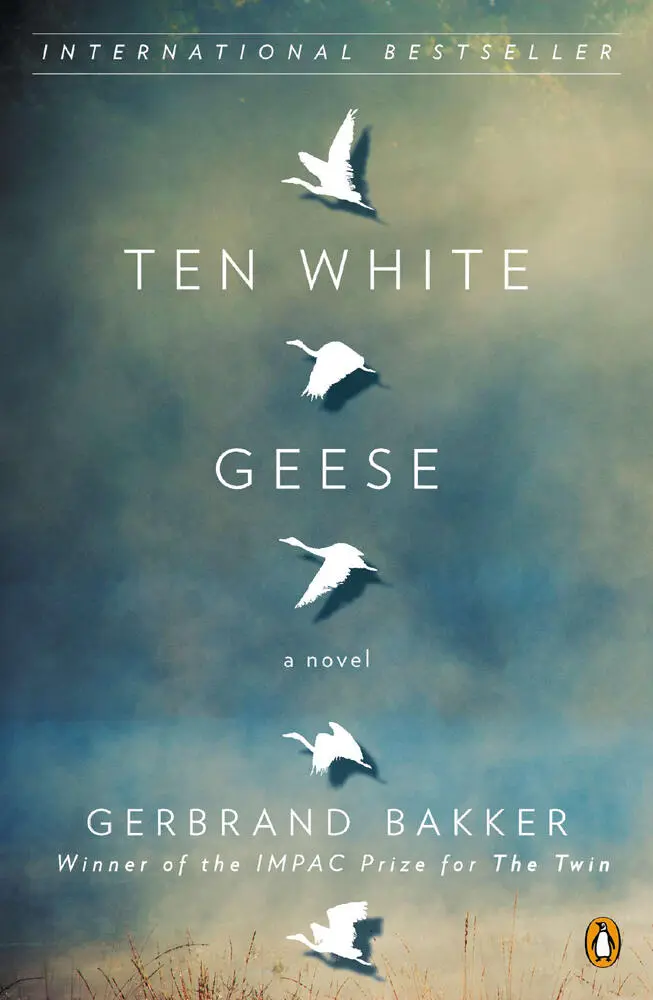
- Название:Ten White Geese
- Автор:
- Издательство:Penguin USA
- Жанр:
- Год:2013
- ISBN:9781101603055
- Рейтинг книги:3 / 5. Голосов: 1
-
Избранное:Добавить в избранное
- Отзывы:
-
Ваша оценка:
Ten White Geese: краткое содержание, описание и аннотация
Предлагаем к чтению аннотацию, описание, краткое содержание или предисловие (зависит от того, что написал сам автор книги «Ten White Geese»). Если вы не нашли необходимую информацию о книге — напишите в комментариях, мы постараемся отыскать её.
A woman rents a remote farm in rural Wales. She says her name is Emilie. An Emily Dickinson scholar, she has fled Amsterdam, having just confessed to an affair. On the farm she finds ten geese. One by one they disappear. Who is this woman? Will her husband manage to find her? The young man who stays the night: why won’t he leave? And the vanishing geese?
Set against a stark and pristine landscape, and with a seductive blend of solace and menace, this novel of stealth intrigue summons from a woman’s silent longing fugitive moments of profound beauty and compassion.
Ten White Geese — читать онлайн бесплатно полную книгу (весь текст) целиком
Ниже представлен текст книги, разбитый по страницам. Система сохранения места последней прочитанной страницы, позволяет с удобством читать онлайн бесплатно книгу «Ten White Geese», без необходимости каждый раз заново искать на чём Вы остановились. Поставьте закладку, и сможете в любой момент перейти на страницу, на которой закончили чтение.
Интервал:
Закладка:
*
A girl, she thought. ‘Will we see your father around here again?’ she asked.
‘I don’t think so. He’s got his dog back and you weren’t interested.’
Almost unnoticed, the boy had joined her under the duvet. She must have lost the feeling in her left arm for a moment. She didn’t complain, this body full of heavy things was not that delicate. He was giving off something, a kind of electricity: his chest shimmered, his hand smouldered, his breath was as hot as a happy dog’s. What would it feel like if she weren’t wearing her nightie? She wanted to take it off, but the fire had made her sluggish and it was the middle of the night; she was tired, exhausted. ‘Can you…?’ she asked, raising her head slightly off the pillow.
He understood and soon they were lying next to each other in their underpants like two wary adolescents. Her on her back and him on his side, still a little lower, his nose against her upper arm, his arms against her hips. Arms full of tension, she could feel it radiating. The stream was rushing. Just when the sound of the flowing water was about to give way to sleep, he said, ‘We’re going to the mountain. The day after tomorrow. Christmas Day. The train’s running.’
Fine, she thought. To the mountain, I should be able to manage that. ‘Will you go to the baker’s tomorrow? To buy some Christmas pudding? Give them both my greetings. The fondest greetings from the Dutchwoman.’
The boy made a sound at the back of his throat and fell asleep. Did he find her old and ugly? Could he smell something? She sighed and closed her eyes. Don’t think about it. Not now.
55
The boy had gone to the baker’s. On foot. She had the house to herself until he came back. Then he had to go to Tesco’s to get some food in for Christmas. The radio was on. She was sitting at the kitchen table with the woolly hat on her head. In front of her: Dickinson’s Collected Poems , open at pages 216 and 217, ‘A Country Burial’. She’d written down two translations of the first line and crossed them both out: Spreid ruim dit bed and Spreid dit bed breeduit . The first one was a syllable short and the second alliterated where the original didn’t. In the end she shifted the meaning slightly and came up with Spreid dit bed met zorg , ‘Make this bed with care’. The second line was crossed out too: Spreid het met ontzag . She’d changed that to Spreid het ademloos , ‘Make it breathlessly’, ‘with bated breath’. She’d written the third and fourth lines on a separate sheet that was otherwise covered with individual words: variations on ‘judgement’, ‘excellent’ and the several distinct meanings of ‘fair’. The rhythm is most important here, she’d thought. She wrote the four lines down again on a third sheet of paper and gazed out of the window. The flowering plants just kept flowering. Dickson’s Garden Centre delivered quality. The radio played Christmas evergreen after Christmas evergreen, a calm voice announcing the titles after every third song. She got stuck on the first two lines of the second quatrain. That strange imperative still baffled her, it baffled her completely. ‘Be its mattress straight / Be its pillow round’.
The smell of old Mrs Evans grew too strong, she had to go outside. She didn’t put on her coat. Not going outside without a coat is for healthy people who are afraid of catching a cold, she thought. She stopped under the rose arch and stared at how the new slate path came to a dead end on the lawn. It wasn’t right. It needed something at the end. The path had to lead somewhere, to a pillar maybe, with a big pot on it. The stream murmured, the fallen oak lay dead still. She couldn’t imagine the alders ever budding again; there seemed to be no life left in the stumps at all. She went round the side of the house. The geese were tearing at the grass. Still four of them. She wondered if foxes hibernated too. Asleep in a den with a bulging stomach, its snout between its paws, sighing now and then with contentment? She pressed her palms against her temples because she noticed that she was measuring her thoughts in rhythmic syllables, and changed the ‘contentment’ in her last thought to ‘satisfaction’. There was no wind, not a breath of it. The geese saw her and started to cluck softly. She leant on the thick wall. Do they think I’m a goose too, just like the dog thought I was a dog, according to the boy? No, I look more like a turkey, she thought, tugging on the tassels of the purple hat.
A few minutes later she was back at the kitchen table. Instead of returning to what she’d written, she leafed through the section titled NATURE. After a while — she’d almost finished the section — the letters started to run together, making it more and more difficult to read. She didn’t find the words ‘goose’ or ‘geese’ anywhere. Just as she’d thought. It was all ‘bees’ and ‘butterflies’ and ‘robins’. She sniffed, clapped the book shut and pushed it away. Dragged herself upstairs, pressed a tablet out of the strip, went back downstairs and poured herself a glass of white wine. Taking the tablet with the wine. When she heard footsteps on the slate, everything was pleasantly fuzzy again.
*
He’d bring the bread in, then they might talk about the shopping list, then he’d leave again. She would order him to leave. As if he were a dog. He would go to buy superfluous things. Afterwards, possibly after a second tablet, she would get ready. Taking bread and wine to the old pigsty, cushions and rugs, trimming the end of a candle with a sharp knife so it would fit in the neck of an empty bottle, a box of matches next to it. Tonight he could lie next to her, his head lower than hers, his broad thumbs on her breasts. If he dared, at least.
Bradwen came in. He put his rucksack on the table and took off his hat. ‘They said hello back,’ he said. ‘The baker’s wife asked when you’d be coming again yourself.’
She shook her head.
‘You on the wine?’
‘One glass.’
‘She’s in a reading club. She said it would be nice if you’d join.’
‘A reading club?’
‘Yes. She even told me the title of the book she’s reading now.’
She looked at him. His hair was stuck to his forehead and, as usual, he didn’t run his fingers through it. The grey eyes, the squint that made it so hard to see what he was thinking and feeling. He was different, really different, without the dog. It’s his own fault, she thought. I sent him away several times. Water suddenly occurred to her. There has to be water too, wine by itself isn’t enough. While she was adding it to the shopping list on the kitchen table, she tried to picture the faces of Rhys Jones and his estate agent friend. Not the stony expression of the former, seven or so days ago, or the supposedly jovial look of the latter, a few months ago, but their surprised faces about a week from now. She only half succeeded, she had no recollection of the estate agent’s features at all. She tapped a cigarette out of the packet and lit it with a match. Without thinking she drew on it hard and didn’t know what hit her: it was so horrible that she didn’t take the time to use her fingers but just spat it out. It landed on one of the sheets of paper she had written on. When the boy noticed that she was going to leave it there, he picked it up for her and pressed down on the smouldering paper with one thumb. Then he walked over to the sink and held the cigarette under the tap before throwing it in the bin.
‘Did Mrs Evans smoke?’ she asked, after she’d taken a mouthful of wine and had to swallow again emphatically to keep down the rising nausea.
‘No.’ The boy stayed near the sink.
‘You have to go and do the shopping.’
Читать дальшеИнтервал:
Закладка:
Похожие книги на «Ten White Geese»
Представляем Вашему вниманию похожие книги на «Ten White Geese» списком для выбора. Мы отобрали схожую по названию и смыслу литературу в надежде предоставить читателям больше вариантов отыскать новые, интересные, ещё непрочитанные произведения.








Обсуждение, отзывы о книге «Ten White Geese» и просто собственные мнения читателей. Оставьте ваши комментарии, напишите, что Вы думаете о произведении, его смысле или главных героях. Укажите что конкретно понравилось, а что нет, и почему Вы так считаете.