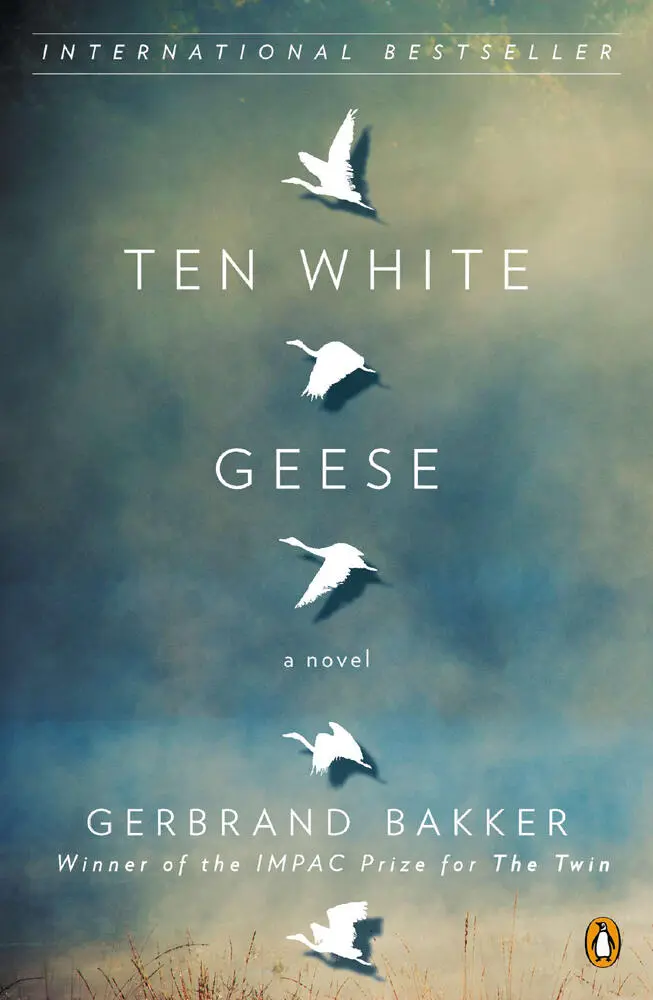
Gerbrand Bakker - Ten White Geese
Здесь есть возможность читать онлайн «Gerbrand Bakker - Ten White Geese» весь текст электронной книги совершенно бесплатно (целиком полную версию без сокращений). В некоторых случаях можно слушать аудио, скачать через торрент в формате fb2 и присутствует краткое содержание. Год выпуска: 2013, ISBN: 2013, Издательство: Penguin USA, Жанр: Современная проза, на английском языке. Описание произведения, (предисловие) а так же отзывы посетителей доступны на портале библиотеки ЛибКат.
- Название:Ten White Geese
- Автор:
- Издательство:Penguin USA
- Жанр:
- Год:2013
- ISBN:9781101603055
- Рейтинг книги:3 / 5. Голосов: 1
-
Избранное:Добавить в избранное
- Отзывы:
-
Ваша оценка:
Ten White Geese: краткое содержание, описание и аннотация
Предлагаем к чтению аннотацию, описание, краткое содержание или предисловие (зависит от того, что написал сам автор книги «Ten White Geese»). Если вы не нашли необходимую информацию о книге — напишите в комментариях, мы постараемся отыскать её.
A woman rents a remote farm in rural Wales. She says her name is Emilie. An Emily Dickinson scholar, she has fled Amsterdam, having just confessed to an affair. On the farm she finds ten geese. One by one they disappear. Who is this woman? Will her husband manage to find her? The young man who stays the night: why won’t he leave? And the vanishing geese?
Set against a stark and pristine landscape, and with a seductive blend of solace and menace, this novel of stealth intrigue summons from a woman’s silent longing fugitive moments of profound beauty and compassion.
Ten White Geese — читать онлайн бесплатно полную книгу (весь текст) целиком
Ниже представлен текст книги, разбитый по страницам. Система сохранения места последней прочитанной страницы, позволяет с удобством читать онлайн бесплатно книгу «Ten White Geese», без необходимости каждый раз заново искать на чём Вы остановились. Поставьте закладку, и сможете в любой момент перейти на страницу, на которой закончили чтение.
Интервал:
Закладка:
She slumped a little and leant her head back against the sofa. Although on TV they were now talking about a typical Victorian hallway, she saw Shirley’s hairdressing salon before her: Rhys Jones waving his big hands to clear the cigarette smoke; the doctor in the cobalt-blue hairdresser’s cape with bloodshot smoker’s eyes and a strangely lecherous twist to his mouth; the hairdresser laughing so shrilly that her breasts jiggled and the tendons in her neck stood out obscenely; the house-and-garden magazines full of green pumpkins; and there’s the door opening to let in the baker of all people, it’s high time he had his hair cut too and his wife Awen pushes him in — her perm is sagging and a bit listless and it will be Christmas in a few days’ time. The hairdressing salon has got very busy all of a sudden. A Border collie is lying under the magazine table; it licks one of the table legs, maybe another dog lay there not so long ago. There goes the telephone. Shirley answers and says, astonished, ‘Yes, he is here. You must be psychic.’ And Rhys Jones takes the handset for a short conversation with his estate agent friend, assuring him with a smile that the woman will leave the house and also telling him that he groped her, that she’s got a ‘glorious arse’ and that she was only too keen to respond to his advances; a shame that she’s leaving really and no one knows where. Strangely enough there’s no cutting, washing or hairdrying going on. The word ‘badger’ crops up regularly and when it does they all laugh, except for the baker’s wife and the dog, dogs don’t laugh, and this dog seems to be trying to creep farther and farther away from the people. Near the door are plastic crates with big lumps of meat in them, watery blood trickling out over the tiled floor. Shirley asks the sheep farmer how his son is, what he’s getting up to these days, and the sheep farmer turns pale, whistles his dog out from under the magazine table and almost slips over in the puddle of blood that’s formed near the door. His dog starts to lick the tiles. ‘Enjoy your lamb,’ Rhys Jones says before banging the door shut behind him. Now she hears ‘Emily’ in the hairdressing salon. ‘Emily.’ It’s unclear who’s speaking. The doctor looks guilty and, like a bad actor, asks who they’re talking about.
Bradwen was standing next to the sofa. ‘Tea’s ready,’ he said, maybe for the second time.
On TV a team of clever people were competing in a quiz. Eggheads they called them here, even more mocking than bollebozen in Holland, the kind of people who did a PhD on someone like Emily Dickinson.
53
The boy had put new candles in the holders on the windowsill. There was a lit candle on the table too. Dickinson’s Collected Poems lay next to her plate, shut. On the plate it was haddock again, with mashed potato and fennel. Colourless food.
She sat down and looked at him, thinking of the almost subservient way he had worked for her an hour and a half ago. Stamping down the soil, pouring the water. ‘Why haven’t you gone away?’ she asked.
‘Who’d cook?’
‘I can cook too.’
‘Who’d plant the roses? Who’d do the shopping? Who’d keep the stove burning?’
‘Why?’
The boy looked at her. The hat looked really good on him, even at the dinner table.
‘Have you already brought in the pan?’
‘No,’ he said.
‘Why?’ she asked again.
‘Do I ask you questions?’ he said. ‘Just look under the Christmas tree instead.’
She looked aside. A present was lying there. Before standing up to get it, she took a big mouthful of wine. She stayed next to the Christmas tree with Bradwen’s gift in her hand.
‘Socks,’ she said softly.
The boy sniggered. ‘That woman doesn’t know what she’s talking about.’
She tore off the paper. He had simply bought her a woolly hat. An incredibly ugly hat, purple, with sewn-on flowers in a range of colours, almost all of which clashed with the colour of the hat itself. A hippie hat, it even had two tassels hanging down the sides. She swallowed and was glad she was facing away from him. She swallowed again before pulling it on. It fitted perfectly. ‘Just what I needed,’ she said, turning and going back to the table.
Bradwen looked pleased and ate.
She drank and poked at the fish.
‘What is it with this Dickinson?’ he asked, gesturing at the poems with the mash-filled serving spoon.
‘Yes. I wanted to ask you that too.’
‘How do you mean?’
‘Why do you keep turning her portrait round?’
‘Those beady little eyes.’
‘It’s a photo.’
‘So? She gives me the creeps. And you?’
‘I was involved with her because of my work.’
The boy chewed. ‘Hmm.’
‘She had a dog too.’
‘Yeah?’
‘Yes, Carla.’ She squeezed her lips into a circle between her thumb and index finger. It was called Carl o , the name was in her head, another detail that had angered her in Habegger’s biography because the man only mentioned the dog four times. It was a Newfoundland, an enormous hairy beast — she had looked up a picture of the breed — and it was called Carl o . A timid little woman whose only friend was a big dog and Habegger didn’t care. Now that she’d squeezed her lips into a circle, she tried it again. ‘Carla.’
‘A lapdog,’ the boy said.
‘No, a very large one.’ She ran the back of her hand over her hot forehead and drained her glass of wine. ‘Pour some more.’
Bradwen picked up the bottle obediently. ‘Funny name for a big dog.’
‘Yes.’ Funny name for a big dog. She knew it meant something, but translating it was somehow beyond her. She wanted to go upstairs to the shelf under the mirror. Not one, but two tablets. She stood up. She walked through to the living room and stairs. The boy didn’t call after her. Without turning on the bathroom light, she grabbed the strips and dared to look at her backlit self. Fortunately she was wearing a hideous hat, a fancy-dress article, nothing anyone could take seriously. ‘Carlo,’ she said. ‘Ohhhhh.’ She saw her mouth open and close again: vague, colourless. The bathroom smelt of Mrs Evans, of course, as if she’d got out of the bath ten minutes ago and dried herself, leaning on the washbasin now and then with one hand. She swallowed the two tablets with a single mouthful of water. When she straightened up again, the two tassels swung cheerfully.
*
‘You’re not smoking,’ the boy said. He had cleared the table, letting the food slide off her plate into the bin. Now he was washing up.
‘What?’
‘I haven’t seen you smoking since this morning when I was doing the raking.’
She looked around. The packet of cigarettes wasn’t on the table. She stood up slowly and rested on the back of the chair before moving farther.
‘You don’t have to,’ he said without turning.
She picked up her coat, which was lying on the chair next to the sideboard, and felt the cigarettes in one of the pockets. The lighter wasn’t in the other pocket. Now that she was standing next to the sideboard anyway, she turned on the radio. Music. There was something she wanted to do, something she had to do. She thought about it. From the sound of it, Bradwen was up to the cutlery, the crackling of burning wood came from the living room. The radio was turned down. Something. She’d already got rid of the tablet boxes. She thought hard and saw the lighter sliding out of her hand, heard it bounce off the rock with a dry click and land in the grass. ‘Throw me those matches,’ she said.
The boy took the box of matches from the windowsill and lobbed it over. She reached out to catch it, but was too sluggish or else the box was moving too fast. It bounced off the sideboard and landed on the floor near the Christmas tree. She bent over and fell. Immediately he was beside her.
Читать дальшеИнтервал:
Закладка:
Похожие книги на «Ten White Geese»
Представляем Вашему вниманию похожие книги на «Ten White Geese» списком для выбора. Мы отобрали схожую по названию и смыслу литературу в надежде предоставить читателям больше вариантов отыскать новые, интересные, ещё непрочитанные произведения.





Обсуждение, отзывы о книге «Ten White Geese» и просто собственные мнения читателей. Оставьте ваши комментарии, напишите, что Вы думаете о произведении, его смысле или главных героях. Укажите что конкретно понравилось, а что нет, и почему Вы так считаете.