Gerbrand Bakker - Ten White Geese
Здесь есть возможность читать онлайн «Gerbrand Bakker - Ten White Geese» весь текст электронной книги совершенно бесплатно (целиком полную версию без сокращений). В некоторых случаях можно слушать аудио, скачать через торрент в формате fb2 и присутствует краткое содержание. Год выпуска: 2013, ISBN: 2013, Издательство: Penguin USA, Жанр: Современная проза, на английском языке. Описание произведения, (предисловие) а так же отзывы посетителей доступны на портале библиотеки ЛибКат.
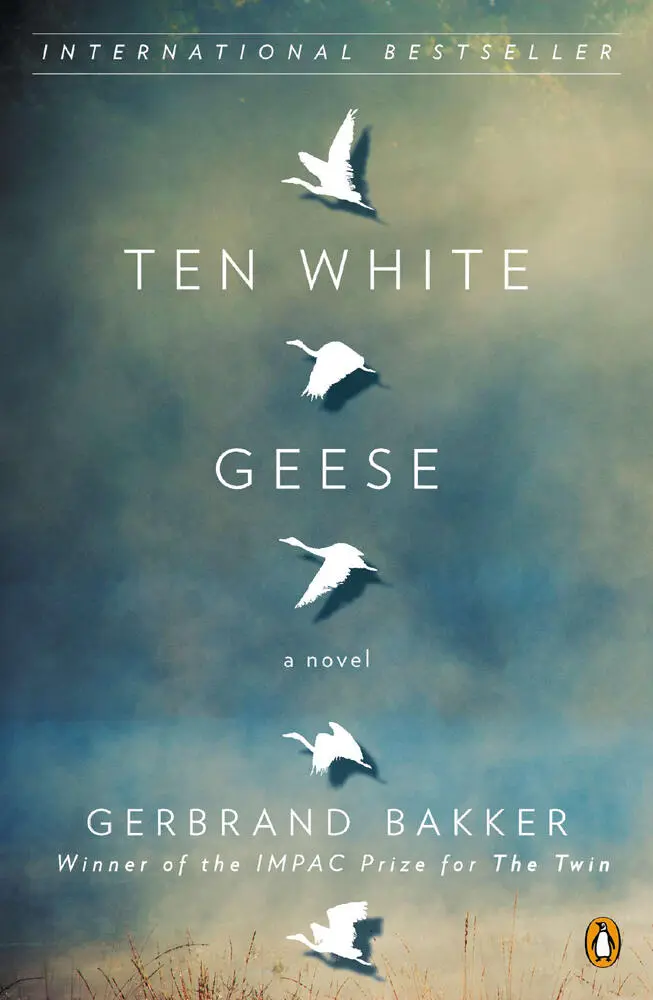
- Название:Ten White Geese
- Автор:
- Издательство:Penguin USA
- Жанр:
- Год:2013
- ISBN:9781101603055
- Рейтинг книги:3 / 5. Голосов: 1
-
Избранное:Добавить в избранное
- Отзывы:
-
Ваша оценка:
Ten White Geese: краткое содержание, описание и аннотация
Предлагаем к чтению аннотацию, описание, краткое содержание или предисловие (зависит от того, что написал сам автор книги «Ten White Geese»). Если вы не нашли необходимую информацию о книге — напишите в комментариях, мы постараемся отыскать её.
A woman rents a remote farm in rural Wales. She says her name is Emilie. An Emily Dickinson scholar, she has fled Amsterdam, having just confessed to an affair. On the farm she finds ten geese. One by one they disappear. Who is this woman? Will her husband manage to find her? The young man who stays the night: why won’t he leave? And the vanishing geese?
Set against a stark and pristine landscape, and with a seductive blend of solace and menace, this novel of stealth intrigue summons from a woman’s silent longing fugitive moments of profound beauty and compassion.
Ten White Geese — читать онлайн бесплатно полную книгу (весь текст) целиком
Ниже представлен текст книги, разбитый по страницам. Система сохранения места последней прочитанной страницы, позволяет с удобством читать онлайн бесплатно книгу «Ten White Geese», без необходимости каждый раз заново искать на чём Вы остановились. Поставьте закладку, и сможете в любой момент перейти на страницу, на которой закончили чтение.
Интервал:
Закладка:
‘Don’t worry,’ she said. ‘I’m OK.’
He took her by the hand and pulled her to her feet.
She sat down at the table and finally lit the cigarette. It was horrible, almost disgusting. As if she was fourteen again and smoking her first cigarette, a Camel non-filter her uncle had given her. That must have been one of the last times she was allowed to stay at his house. She coughed and tried again. Something that had tasted good for years couldn’t suddenly turn disgusting, could it? Bradwen was still standing close by, at her elbow. The very idea of a cloud of smoke passing through her mouth and windpipe and into her lungs was so repulsive she couldn’t inhale. She stubbed the cigarette out.
The boy coughed. Then asked, ‘Coffee?’
‘No.’ She drained her glass, stood up and walked into the living room. She switched on the TV and sat down on the sofa. She heard him turn off the radio and go back to the washing-up. There was movement and noise in front of her, everything with a one-second delay. A wide ditch, more a canal really, a boat with two men in it. They pulled baskets out of the water and one of them contained an eel. They shook it out. Catches down 95 per cent since the replacement of the wooden lock gates, the fisherman explained. In the field next to the canal there was a solitary sheep. She stood up immediately and returned to the kitchen.
‘Coffee after all?’ the boy asked.
‘No.’ She went over to the freezer and pulled it open, removing the hunks of meat and putting them in the plastic crate that was still on the floor next to the freezer.
‘What are you doing?’
She didn’t answer, but picked up the crate and walked into the living room with it. The boy watched her every move like a dog. Ears pricked up, eyes alert, waiting for a command. She had to put the crate down to open the front door. It wasn’t cold, even though there were no clouds. A vast sky hung over the house and garden. For the first few steps she had light, shining out through the kitchen window. Beyond that band of light, she stopped briefly to let her eyes adjust. The stream murmured and the crushed slate crunched under her bare feet. One by one, she took the stiff, frozen pieces of lamb out of the crate and hurled them into the water with all the strength she had. Each lump was as heavy as a rock; like rocks they would lie on the bed of the stream. Holding the empty crate loosely in one hand, she stared at the dark water in which the enormous sky slowly became visible. Giving up smoking, she thought to herself, that’s something healthy people do. Walking back to the door, she saw the white rosebud grow lighter. Her head was warm. Maybe the hat was made of real wool. Sheep’s wool.
*
After closing the front door, she heard Bradwen rummaging around upstairs. ‘What’s going on up there?’ she called, wiping the grit off her feet.
Bradwen emerged from the study. ‘I’m arranging the new bedroom.’
It was hard for her to look up after having looked down for a while.
‘I’ve put your bed in front of the fireplace. I still have to light it.’
‘And you?’
‘On the divan as usual.’
‘ Godnogaantoe ,’ she swore softly, under her breath. Only now, after weeks and weeks living in this house, did she realise that the stove in the living room and the fireplace above it shared the same flue. ‘After Christmas, you’re gone,’ she said.
‘I don’t think so,’ he said, coming downstairs.
54
She woke up because the boy had laid two logs on the embers and needed to blow to get the fire going again. He crept back to the divan. Earlier he’d pushed both windows up a little. It was unbearable in the study otherwise.
‘It was very different with Sam here,’ he said.
She didn’t answer, staring at the ceiling.
‘Dogs like Sam can’t sleep all night, they start to move around. He’d whimper and come and sniff at me.’
‘He even went downstairs.’
‘No, not that. He’d always stay here.’
She sighed, turning her head towards him. Bradwen was half under the duvet with his hands behind his head. ‘What time is it?’
‘No idea. Three-ish?’
Her whole body seemed to be full of heavy things: lead, concrete, oak beams. She didn’t even want to try to turn over onto her side. She thought of the night Bradwen vomited, the idea that some part of the tension in his body had passed into hers through her hands. ‘You’re moving around too,’ she said.
‘Just now. The fire was almost out.’
No, her body itself was the heavy things: legs made of oak beams, a belly of concrete, liquid lead flowing through her veins.
‘What’s your real name?’ the boy asked.
She thought for a moment. ‘Emilie.’
Bradwen rolled onto his side very easily, leaving his right hand under his cheek and scratching his chest with his left. His eyes glowed in the firelight.
‘What was Mrs Evans’s first name?’
‘I don’t know. She was Mrs Evans to me.’
‘Did you come here often?’
‘I used to. In the old days.’
‘Did you know Mr Evans too?’
‘No. He died when I was two or three.’
‘Do you still smell her?’
‘What?’
‘Do you still smell Mrs Evans? Here, in the house?’
He lifted his head up from his hand. ‘No.’
‘I do.’ The stream was clearly audible here in the study too. More clearly because the window on the drive side was closer to the water than the window in her bedroom. It sounded different, as if it were a different stream. Or a different house.
‘How long?’ she said after a lengthy pause. ‘How long do you think the smell of the dog will linger at the goose field?’
‘Fairly long, I’d guess.’
‘Hmm.’ The wood on the fire crackled. She felt its warmth on the top of her head. The old days, she thought. What does an expression like that mean when you’re twenty? Suddenly a thought entered her mind. ‘How could you not have known about the stone circle?’
‘I did know about it.’
‘You said you didn’t.’
‘Not at all. I said I “didn’t notice it”. It was misty that day.’
‘And you asked me how to get to the mountain.’
‘Not how. I asked if you had a suggestion for the most beautiful way to get there.’
‘Are you lying or what?’
‘No, I’m not lying. Are you?’
‘Yes. Constantly.’
The boy sniggered, his chest shaking.
‘Your father wanted to tell me how she met her end.’
‘Yeah?’
‘But I didn’t want to listen.’
‘No?’
‘I wanted to get rid of him as fast as I could.’
Again, he sniggered.
‘I’ll listen to you ,’ she said, although she was suddenly finding it almost impossible to keep her eyes open.
The boy got up off the divan with his duvet in his hands. ‘Move over a bit.’
She did what he asked, laying her arms alongside her body on top of the covers. He lay down next to her, half under his own duvet, his head at the level of her breasts. There was something submissive about it that reminded her of the night Sam came downstairs and laid his head on her knees.
‘I found her,’ he said.
‘You?’
‘Did my father say otherwise?’
She thought about it. ‘He acted as if he knew all about it.’ She had to dig deep for the English, translating was an effort.
‘That’s true. I arranged it so he’d find her after me. I owed him that much.’
*
The boy talked. She had to do her best to follow him, trying not to miss bits or let her mind stray, because it was easy to listen to his words as sounds alone. It was summer — last summer, she presumed — and he’d wanted to see Mrs Evans again, maybe for the last time, she was over ninety after all. He’d come by bike from Bangor, not another cyclist on the road. People here don’t ride bikes, even though there’s a bike rental place right next to the train station — it’s for the tourists, who don’t use it either. Up the drive: the grass in the fields was very long, which reminded him of his father who was apparently neglecting his mowing duties. Typical. Sam wasn’t with him, he’d left him at home. Replying to her question as to where that was, he said, ‘Liverpool.’ Was that where he studied? ‘Yes, at Hope University. Don’t tell my father.’ Bangor to here was about fifteen miles, he didn’t know if Sam could do that running alongside a bike. And, of course, there was always a chance that his father might be here on any given day, the father he’d stolen the dog from. She could have interrupted him at this point, she was feeling hot from the fire and his talk of summer, but she couldn’t summon the energy to open her mouth. He’d seen the geese huddled together near the small wooden shed and hadn’t found anyone in the house or under the alders along the stream: she used to sit there sometimes on hot days. He’d leant his bike against the side of the pigsty. The geese gaggled excitedly. He’d walked over to them. They reminded him of a group of people standing around a traffic victim, horny with excitement. He climbed over the fence, the geese scattered and there she was, lying where they’d just been standing. Something had been at her. He didn’t know if geese would do that, but imagined it was more likely to have been a fox or a bird of prey of some kind. A kite. Not a vlieger , she thought, a wouw , and she opened her eyes so that she would see the ceiling of the study and not a goose field in the summer and an old woman lying there dead. He’d only glanced at her. Her dress had been pushed up, he found that worst of all. He ran out of the goose field. A moment before he’d been hungry. On the bike he’d been looking forward to huge pieces of home-made cake. Mrs Evans did that better than anyone, cake-making. He realised that he had to phone someone. He’d grabbed the bike and ridden out to the road. There, at the gate that was always open, he’d rung his father, confident that he wouldn’t be home at that time of day. He’d done his best to sound different, leaving a short, deep-voiced message on the answering machine. Then he’d cycled back to Bangor, returned the bike and got on the train. Change at Chester. Final destination: Liverpool Lime Street. The girl in the room next to his at the student house said that the dog had howled all day and asked him to leave it with her next time he planned to go off somewhere alone.
Читать дальшеИнтервал:
Закладка:
Похожие книги на «Ten White Geese»
Представляем Вашему вниманию похожие книги на «Ten White Geese» списком для выбора. Мы отобрали схожую по названию и смыслу литературу в надежде предоставить читателям больше вариантов отыскать новые, интересные, ещё непрочитанные произведения.






Обсуждение, отзывы о книге «Ten White Geese» и просто собственные мнения читателей. Оставьте ваши комментарии, напишите, что Вы думаете о произведении, его смысле или главных героях. Укажите что конкретно понравилось, а что нет, и почему Вы так считаете.