Mircea Cărtărescu - Blinding - Volume 1
Здесь есть возможность читать онлайн «Mircea Cărtărescu - Blinding - Volume 1» весь текст электронной книги совершенно бесплатно (целиком полную версию без сокращений). В некоторых случаях можно слушать аудио, скачать через торрент в формате fb2 и присутствует краткое содержание. Год выпуска: 1996, ISBN: 1996, Издательство: Archipelago, Жанр: Современная проза, на английском языке. Описание произведения, (предисловие) а так же отзывы посетителей доступны на портале библиотеки ЛибКат.
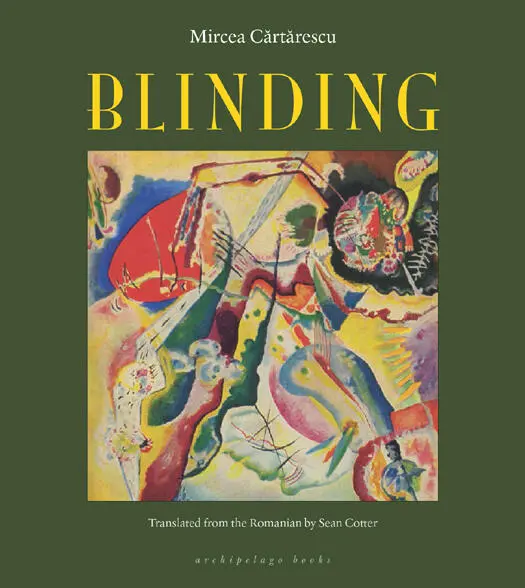
- Название:Blinding: Volume 1
- Автор:
- Издательство:Archipelago
- Жанр:
- Год:1996
- ISBN:9781935744856
- Рейтинг книги:3 / 5. Голосов: 1
-
Избранное:Добавить в избранное
- Отзывы:
-
Ваша оценка:
Blinding: Volume 1: краткое содержание, описание и аннотация
Предлагаем к чтению аннотацию, описание, краткое содержание или предисловие (зависит от того, что написал сам автор книги «Blinding: Volume 1»). Если вы не нашли необходимую информацию о книге — напишите в комментариях, мы постараемся отыскать её.
was one of the most widely heralded literary sensations in contemporary Romania, and a bestseller from the day of its release. Riddled with hidden passageways, mesmerizing tapestries, and whispering butterflies,
takes us on a mystical trip into the protagonist’s childhood, his memories of hospitalization as a teenager, the prehistory of his family, a traveling circus, secret police, zombie armies, American fighter pilots, the underground jazz scene of New Orleans, and the installation of the communist regime. This kaleidoscopic world is both eerily familiar and profoundly new. Readers of
will emerge from this strange pilgrimage shaken, and entirely transformed.
Blinding: Volume 1 — читать онлайн бесплатно полную книгу (весь текст) целиком
Ниже представлен текст книги, разбитый по страницам. Система сохранения места последней прочитанной страницы, позволяет с удобством читать онлайн бесплатно книгу «Blinding: Volume 1», без необходимости каждый раз заново искать на чём Вы остановились. Поставьте закладку, и сможете в любой момент перейти на страницу, на которой закончили чтение.
Интервал:
Закладка:
It was the moment that I waited for all day: when Carla and Bambina took off their pajamas and, like large dolls, with unexpected grace, they climbed from their beds and began to dance through the room. I knelt and, my mouth gaping, watched their small naked bodies, dark brown in the evening light, spinning like two small fish in a glass globe. From time to time, catching the window light, their eyes sparkled one moment and went dull the next. They lay down and rolled over the worn carpet, they crab walked, they tried to walk on their hands, they held each other’s arms and spun … I knew the nurse would never come at that hour (we were horribly frightened of her), so I climbed out of bed, too, tentatively, watching the dance with a kind of prudent enchantment. I looked curiously at their thin chests and the fine line between the lips of their shining pubises. At the house I had played doctor with Anişoara, in the basement, in the little room painted light green, and we often took our underpants off, but this seemed like something else, because the girls dancing around the dark room did not encourage the same complicity in danger and shame as my meetings with Anişoara. The ordinary, dumb girl at the house, who taught me to play “shots with pants off,” looked at my naked body with a kind of dreamy admiration, while I was probably so indifferent that I don’t even remember Anişoara without her underpants, just the fear of our parents catching us.
What was happening now was magic. Neither Carla nor Bambina were themselves any more, as though the acid of evening had dissolved the crust of evil from their faces, and left them pure and inexpressive like benign masks. I could hardly recognize them. When it was so dark that their dance was only visible against the windows — their black and supple silhouettes were like African statues — the two approached me, by the window, their eyes shining, and took off my pajamas. They lay back triumphantly to show me the purple slits between their thighs, as though there was something grand there, and glorious. They smiled to each other, confirming their exorbitant power, and they rejoiced to see me looking at them, but my small sex, in contrast, brought the usual meanness back to their gaze. They pulled on it, pretending to cut it off, and in the end they turned their backs to me, as though I didn’t exist. Then we got dressed again, quickly, since we heard the steps of the blonde nurse, who was bringing us our usual mollusk supper, covered with caramel syrup, which we had to eat to the last spoonful. The last night, while I chewed the tasteless meat, I felt something like a rubber tube in my mouth. I plucked out a white vein, with a greenish tip, which I placed on the edge of my plate, and I vomited. The nurse immediately brought me a fresh helping.
The children in the other rooms were not healthy and whole the way we, at least in appearance, were. Almost all of them had some strange thing wrong that made a powerful impression on my mind. One boy’s fingers stuck out in every direction, like lobster legs. The room next door constantly reeked of stinging urine and maple. A thin, withdrawn person with dull features screamed her head off when Carla and Bambina, after a lengthy hunt, caught her and pulled her into our room. They wrestled for half an hour while the child writhed like a leech, until they pulled her pajama bottoms down, to look one more time, like at a rare flower, at the bud so complicated you couldn’t have said if it was male or female. There was also a little girl, sweet and lively, happily laughing and talking with everyone, whose hands came out directly from her shoulders, like wings, without arms in between. Everyone admired her waist-length hair, like a blond doll’s, and her shining blue eyes. Several other children had terrible deformities from polio. They all wore the same faded pajamas printed with animals, bound with cords like file folders.
My parents’ arrival, one day before we left the hospital, in a milky morning that already foretold the change of seasons, in those days when I could not talk or play with anyone, was the only real event. They abruptly appeared in the room, in windbreakers and arm in arm, young and dark-haired, almost as tall as the ceiling, and they fell upon me in a frightening display of love. In a few moments, I was surrounded by new toys with a strong smell of paint — a set of cardboard boxes with fairy-tale pictures, each smaller and smaller, fitting one in the next, other wooden blocks that made square pictures: turkey, pig, cow, and ones you could make castles with, and especially a white rag horse with glass eyes and a red lacquer saddle. This toy was so dear to me that even at fourteen I still had it, somewhere in the buffet, shaped like a kind of deformed worm, almost totally brown from dirt, marked all over with pen, with its eyes missing and cuts that revealed the fragile roughness of its harness. My parents did not stay long. After they promised to take me home the next day, “to a new house, bigger, you’ll see,” they left just as strange, just as altered. I realized then that their departure made no difference to me: I could have stayed in the hospital my entire life, watching the walls darken and brighten in the sun, melding into the stereoscopic field of my irises, or listening distractedly to the demented inflections of mineymoezish. And always whenever I would later abandon myself to the will of punctual, spherical worlds, the pearl-worlds that I strung, like vertebrae, upon the cord of my spinal marrow, I would stay there, metamorphosed, adapted to the texture of the air there, the flashes of the clouds there, until something from the outside world hurried my abortion through those successive abdomens, with other placental constellations, amniotic waters, dawns and gods … Once my parents were gone, I was left sitting on my bottom, on the carpet, building block towers and pyramids for the horse. A bit later, however, coming back from the potty, I found the tower I had worked so hard to balance until it was as tall as I was toppled and scattered, and the purple lacquer saddle torn from my horse’s body. Only then did I begin to cry, in despair, the way I should have cried when my parents were leaving. When the nurse came, the pious little girls were in their beds, playing dolls.
The next day, my clothes were brought back, and my pajamas, balled up, sour-smelling, stayed on the floor, like an anatomical specimen on a slide. The nurse took me by the hand, under the hostile gazes of Carla and Bambina, who did not want to say good-bye as the large blond woman asked, and we walked again, together, through the sinuous corridors and the frozen stairways, until we reached the waiting room with the plaster model of the skinned man. My parents again went into the next room, to talk to an unseen doctor, so I was alone in the olive air, listening to the sound of my footsteps on the square floor tiles. I approached, as I had the week before, the armless and legless statue, half a person with painted yellow skin, hair like a black hat and one coin-like brown nipple, and half a nightmarish monster, made of blood-red muscular fibers, knotted blue veins, and the tips of ivory bones. Through a hole in his cranial cavity, above the skeleton of his face, you could see his brain. No martyr had ever suffered so much, or been so savagely and scientifically tortured. On each detachable organ, held by nails to the next, there were small numbers written in an ancient hand, seconded by a table on the wall with knowledgeable explanations, which for me were nothing but thorny decorations. I stood still in front of the tragic sculpture, its gaze lost in its spherical eye, held up by orbital muscles like hands raising an offering. The blue, porcelain eye had a brown glass iris, where a fragment of light flashed. Leaning my head far back, since I was only waist-high to the man skinned alive, I contemplated the sinister foreshortening, the same way I had stared at the field of ink-colored flowers, until in my self-hypnosis, self-forgetting, the statue’s trepidacious extermination of being became suddenly pregnant and luminous, its contours irradiated by hesitant stripes of gold. And then, only then, I realized the man was screaming — hoarse, unending, in wild glissandi, coughing out pieces of larynx and bloody strands of tracheal mucous. He screamed like a hyena, like a stray dog being beaten to death, like someone being boiled in oil, like a woman giving birth to a bat. His body was gripped by unbelievable convulsions. Bloody stumps reached toward the ceiling, stained by squirting arteries. I started to howl in terror along with him. We howled together, we writhed together, and in my little brain with soft bones the scream turned a blinding yellow, apocalyptic, pulsating, unbearable. I screamed with my hands on my ears and my entire body, through the narrow tunnel of my throat and my buccal cavities, became a howl, it dressed my howling body in a howling anatomy, so that I didn’t howl, but the howl howled me, I was the one that ran through the vocal cords of my howl, wounded by my glottis and epiglottis, flowing down my tongue, narrowing myself to pass through my howling lips.
Читать дальшеИнтервал:
Закладка:
Похожие книги на «Blinding: Volume 1»
Представляем Вашему вниманию похожие книги на «Blinding: Volume 1» списком для выбора. Мы отобрали схожую по названию и смыслу литературу в надежде предоставить читателям больше вариантов отыскать новые, интересные, ещё непрочитанные произведения.












Обсуждение, отзывы о книге «Blinding: Volume 1» и просто собственные мнения читателей. Оставьте ваши комментарии, напишите, что Вы думаете о произведении, его смысле или главных героях. Укажите что конкретно понравилось, а что нет, и почему Вы так считаете.