Mircea Cărtărescu - Blinding - Volume 1
Здесь есть возможность читать онлайн «Mircea Cărtărescu - Blinding - Volume 1» весь текст электронной книги совершенно бесплатно (целиком полную версию без сокращений). В некоторых случаях можно слушать аудио, скачать через торрент в формате fb2 и присутствует краткое содержание. Год выпуска: 1996, ISBN: 1996, Издательство: Archipelago, Жанр: Современная проза, на английском языке. Описание произведения, (предисловие) а так же отзывы посетителей доступны на портале библиотеки ЛибКат.
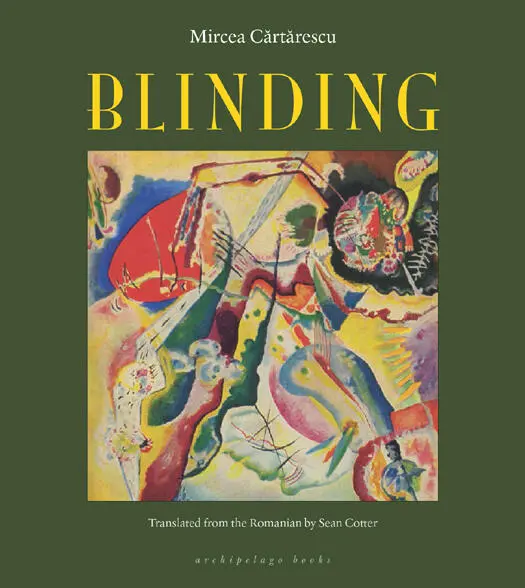
- Название:Blinding: Volume 1
- Автор:
- Издательство:Archipelago
- Жанр:
- Год:1996
- ISBN:9781935744856
- Рейтинг книги:3 / 5. Голосов: 1
-
Избранное:Добавить в избранное
- Отзывы:
-
Ваша оценка:
Blinding: Volume 1: краткое содержание, описание и аннотация
Предлагаем к чтению аннотацию, описание, краткое содержание или предисловие (зависит от того, что написал сам автор книги «Blinding: Volume 1»). Если вы не нашли необходимую информацию о книге — напишите в комментариях, мы постараемся отыскать её.
was one of the most widely heralded literary sensations in contemporary Romania, and a bestseller from the day of its release. Riddled with hidden passageways, mesmerizing tapestries, and whispering butterflies,
takes us on a mystical trip into the protagonist’s childhood, his memories of hospitalization as a teenager, the prehistory of his family, a traveling circus, secret police, zombie armies, American fighter pilots, the underground jazz scene of New Orleans, and the installation of the communist regime. This kaleidoscopic world is both eerily familiar and profoundly new. Readers of
will emerge from this strange pilgrimage shaken, and entirely transformed.
Blinding: Volume 1 — читать онлайн бесплатно полную книгу (весь текст) целиком
Ниже представлен текст книги, разбитый по страницам. Система сохранения места последней прочитанной страницы, позволяет с удобством читать онлайн бесплатно книгу «Blinding: Volume 1», без необходимости каждый раз заново искать на чём Вы остановились. Поставьте закладку, и сможете в любой момент перейти на страницу, на которой закончили чтение.
Интервал:
Закладка:
I found myself again in my bed, and it seemed I was awake. The green room pulled into itself, and rotated the same lunatic light. It seemed tears had dried on my cheeks. I got up and went to look for my mother. Dawn was breaking. I walked down the halls and through the rooms of our home, still lost in the twilight. The doors opened before me by themselves, letting me enter, slowly and steadily, three rooms in turn. When the living-room door opened, I saw the dawn sun in the window, small and red, without shining, rising over the Dâmboviţa mill. On the ravished sofa my parents were sleeping, Mamma with her head completely beneath the sheet, curled up, so that she seemed oddly small, and my father on his back, with the buttons of his wrinkled pajamas undone and wearing a sleeping cap, made of a knotted woman’s stocking, to keep his hair back. I walked closer and looked at my mother with a strange intensity. Almost immediately, I actually woke up, and I remained for a bit in a state of complete confusion, like I had the night before. Then I did some little, absurd things. I went to the bathroom, and after I looked at myself in the mirror a while, without a single thought, I began to cut my fingernails. Or I screwed and unscrewed the cap of the rubbing alcohol. My scalp burned all over, as though it were covered with an incandescent metal web. I walked mechanically back to my bed, where I fell right asleep again and vegetated for a few hours without dreams, until dawn came.
During one of my dream-wanderings through twilit rooms, on reaching the living room, I was surprised that my mother was no longer sleeping in the sofa bed. Only my father was there, with his face turned toward the wall, wearing just an undershirt and breathing steadily. Frustration and disquiet woke me immediately. When morning came and my mother came back with the milk, she told me, black with anger, that “this father of yours” had gone out again with his newspaper buddies to celebrate someone-or-other. Mamma had made such fuss over the expense that she slept in the little room, leaving my father to sleep alone … The dream, therefore, involved a kind of bizarre clairvoyance, as though in a way I could touch reality — even if it was outside my body — through dark rooms.
It all began in the late fall of 1973, when I was caught in a bad, freezing rain while coming back from some workshop classes. My uniform was drenched immediately and water ran through my hair, under my collar, zigzagging over the naked flesh of my spine and spreading over my back. The view from number 5 was desolate in any case, but beneath the steady rain, all the houses and the sky looked like they were made from clay and pitch. The leaves stuck, dead, to the tram’s sides and windshield, rotted in puddles, and caught on the hunched shoulders of a crazy baba who leaned against a fence, spread her legs, and urinated along with the rain. When I got home, I took a hot bath and I soaked with the water over my ears, listening to the curiously clear sounds coming from the neighbors — voices, barking, a washing machine humming — until the heat almost made me sick. Afterwards, for the entire evening, one after the next, I emphatically recited works of poets I had discovered, one after the next. The latest poet always seeming like the greatest, the only one touched by genius, the only one. The emotions of my declamation — in a low voice, still, since I was afraid my parents would tease me, even though they usually were lounging like the dead in the blue aura of the living-room television — passed all measure. On the edge of my bed, book in hand, I whistled, hooted, and barked the verses, contorting the muscles of my face trance-like until they started to hurt, and, like the peribuccal sphincter of trumpet players, they even went numb for a bit. Each line had to be experienced with absolute intensity, since each line brought new meaning, an interior light to my pathetic life in my room with dim bulbs and old furniture. When I recited these poems, looking in my own eyes in the mirror and grimacing (I thought) desperately, prophetically, purely , or passionately , it seemed my interior chemistry changed: my hair rose up, not just on my head and arms but even on my thighs, my eyes widened, the acne that covered my forehead lit up across my pale skin … I sweated profusely, soaking my pajamas, which always had broken buttons. I could not stay still. I was encompassed in exaltation. I went to the panoramic window, where stitches of rain fell over Bucharest, to recite:
Girl like a lizard ,
Asleep on the slate ,
Throw yourself in the river
Your life to escape
Across the way, Nenea Căţelu’s dogs were huddled like black rags in the rain. The crucified figures on neon pillars between the tram rails, each with his crown of thorns, raised their bloody faces toward the sky lapping up the November rain. The rails carried only service cars, with a kind of yellow gallows on the back platform, metal, with a hoist. I sat on the top of the bedstead and propped my bare feet on the burning elements of the radiator, which they had already turned on for testing. I stayed like that until it was completely dark and the city, like in an illustration in an old children’s book, was blotted out delicately under the silver clouds and moon. Only neon signs, flashing on and off in the distance like phosphorescent deep-water fish, broke the nightfall with their indistinct green, azure, and purple letters. As I had done since childhood, when a sign went out I closed my eyes, counted to seven or eleven, and when I opened them again, I saw the same sign again, lit. In this way I could keep it lit endlessly, leaping over the night’s emptiness, because the dark space that remained after the rectangle or circle of light went out on the top of the blocks downtown became suddenly much blacker than the rest of the nocturnal panorama. I didn’t turn on the light in my room, and I stayed like that until two in the morning, watching the dark through the sparking blue window, feeling like a cave animal, with transparent flesh and no eyes, touching the walls with the thin tips of my tactile organs.
That night, as I fell asleep, the mask of my face felt heavy, like bronze, from so much effort and contortion. I woke up the next day pale and dizzy. As I brushed my teeth I realized, without yet understanding, that in fact, there really was something unusual: the cold water I used to wash was running out of my mouth, even though my lips were pressed together: a muscle in the upper one, on the left side, had gone soft, powerless and a little twitchy. It was odd, and almost funny. “What the hell?” I said to myself, and I sipped some more water into my mouth, trying as hard as I could to keep it in. But the harder I tried to control my lips and cheeks, the more strongly the twisting, turbulent stream squirted from the lax dam of my upper lip. I walked out of the bathroom and, for about an hour, I piddled around, trying to avoid thinking about that peculiarity that, I hoped, would gradually pass, like a twitch or a fluttering eyelid. But the anomaly stubbornly persisted. I realized I could no longer whistle, and my lip, for about a centimeter, was covered with bestial puffiness, soft like a snail’s flesh. Not even then was I scared, but I showed my mother (just back from the piaţa, weighted down with enormous shopping bags) what had happened to me, smiling naïvely, as though she was going to praise my soon-to-be-demonstrated dexterity. But Mamma was scared, she clamped her hand to her mouth like a peasant and let out a highly aspirated “aaoleo!” We left quickly for the Emergency Hospital. It was Saturday, and there was no one in the waiting room. It smelled like rubber and antibiotics. Finally, a middle-aged doctor came, who examined me and made a snap diagnosis that turned out to be correct: facial palsy, probably peripheral, sinister, additionally named “a frigore,” since the nerve that activated the musculature of half my face was broken, at the ear, from excessive cold. The frozen rain that had fallen on my head a day before had done me in. Hospitalization was demanded, in the neurology ward, to begin treatment as soon as possible, and so the doctor, after she joked and chatted with me a little, wrote an admittance to Colentina Hospital, where I arrived that same afternoon.
Читать дальшеИнтервал:
Закладка:
Похожие книги на «Blinding: Volume 1»
Представляем Вашему вниманию похожие книги на «Blinding: Volume 1» списком для выбора. Мы отобрали схожую по названию и смыслу литературу в надежде предоставить читателям больше вариантов отыскать новые, интересные, ещё непрочитанные произведения.












Обсуждение, отзывы о книге «Blinding: Volume 1» и просто собственные мнения читателей. Оставьте ваши комментарии, напишите, что Вы думаете о произведении, его смысле или главных героях. Укажите что конкретно понравилось, а что нет, и почему Вы так считаете.