Mircea Cărtărescu - Blinding - Volume 1
Здесь есть возможность читать онлайн «Mircea Cărtărescu - Blinding - Volume 1» весь текст электронной книги совершенно бесплатно (целиком полную версию без сокращений). В некоторых случаях можно слушать аудио, скачать через торрент в формате fb2 и присутствует краткое содержание. Год выпуска: 1996, ISBN: 1996, Издательство: Archipelago, Жанр: Современная проза, на английском языке. Описание произведения, (предисловие) а так же отзывы посетителей доступны на портале библиотеки ЛибКат.
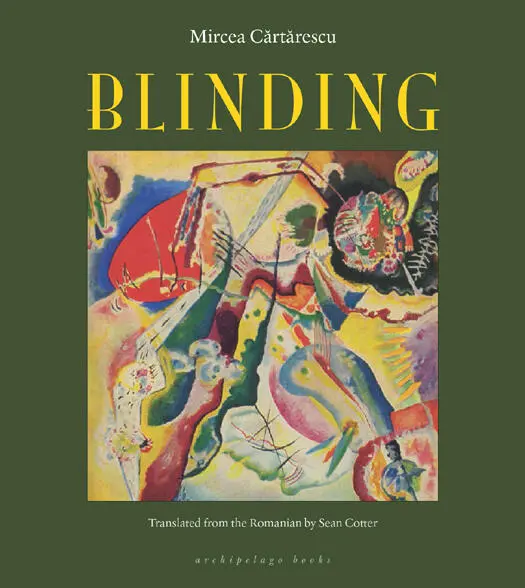
- Название:Blinding: Volume 1
- Автор:
- Издательство:Archipelago
- Жанр:
- Год:1996
- ISBN:9781935744856
- Рейтинг книги:3 / 5. Голосов: 1
-
Избранное:Добавить в избранное
- Отзывы:
-
Ваша оценка:
Blinding: Volume 1: краткое содержание, описание и аннотация
Предлагаем к чтению аннотацию, описание, краткое содержание или предисловие (зависит от того, что написал сам автор книги «Blinding: Volume 1»). Если вы не нашли необходимую информацию о книге — напишите в комментариях, мы постараемся отыскать её.
was one of the most widely heralded literary sensations in contemporary Romania, and a bestseller from the day of its release. Riddled with hidden passageways, mesmerizing tapestries, and whispering butterflies,
takes us on a mystical trip into the protagonist’s childhood, his memories of hospitalization as a teenager, the prehistory of his family, a traveling circus, secret police, zombie armies, American fighter pilots, the underground jazz scene of New Orleans, and the installation of the communist regime. This kaleidoscopic world is both eerily familiar and profoundly new. Readers of
will emerge from this strange pilgrimage shaken, and entirely transformed.
Blinding: Volume 1 — читать онлайн бесплатно полную книгу (весь текст) целиком
Ниже представлен текст книги, разбитый по страницам. Система сохранения места последней прочитанной страницы, позволяет с удобством читать онлайн бесплатно книгу «Blinding: Volume 1», без необходимости каждый раз заново искать на чём Вы остановились. Поставьте закладку, и сможете в любой момент перейти на страницу, на которой закончили чтение.
Интервал:
Закладка:
I was totally isolated from the girls in faded pajamas, as though we were from different worlds, a feeling heightened by my inability to understand them. Most of the time, they spoke an unknown language, made not only of sounds but also of gestures and touches and even of smells (when one of them — in moments of discussion I became able to anticipate — broke wind), and which they performed with unbelievable speed and precision. Much later, reading about Vollapük and Esperanto, I remembered how Carla and Bambina talked, and the idea of naming their language passed through my mind, a language where ordinary sounds were mixed with bizarre glottals, with deaf-mute signs and facial expressions like catatonic schizophrenics. I thought of it as “mineymoezish,” because their most common invented word was “minemoe” or “mynimoe,” accompanied by rolling eyes and the motion of pulling something from their chests with imaginary claws.
Evening meals were almost magical. The nurse sat with us, on a folding chair, and our table was lit by a very weak shaded lamp, which only drew the plates and our nearby faces from the dark. Even the figure of the nurse, whose white and massive chest rose like an iceberg in the light, remained in a penumbra. The plates had the same unique food each night: it looked like a trembling jellyfish, almost completely translucid, with its internal organs (darker, amber-colored) showing through its skin. When you stuck your spoon in it, the jellyfish throbbed and tensed with pain. We had to eat all of it, despite the insipid taste, like flan without enough sugar. If the trembling aspic was not a kind of medicine, then I don’t know what medicine is. But it is possible that it was, because only during this time did the nurse sit with us to the end, to the last swallow. Many times one of the girls, most often Bambina, would lie down and vomit, covering the carpet with cheesy pasta, but without a word of reprimand, the nurse immediately called the housekeeper, who cleaned the floor and brought another plate of jellyfish. Like later, in the Voila sanatorium, whose madness seems to have been prefigured by that of Emilia Irma’s, the child would not escape until his plate was clean, even if it meant he had to stay at the table all night.
When she got them to talk, without their catching on, about their strange speech, the nurse got a story, more mimed than spoken in words. Carla, from time to time, had the same dream, in which, naked and with curly hair past her buttocks (“and I had boobs like a big woman,” she showed, cupping her fingers in front of her chest), she wandered through a vast palace of white marble, with a portico, galleries, and statues, and a shining mosaic spread on the floors, tracing out an incomprehensible design. Suddenly the palace was full of endless vistas, without any furniture or paintings, translucent like it was carved from salt, and filled with torpid, multicolored, butterflies. Surprised, Carla wandered through the halls until, in the center of one, she discovered a crystal mausoleum, sparkling in all the colors of the rainbow. Inside was a soft being, with a complex and delicate anatomy, wet orifices on the edge of an ashen stomach, and a vaguely sketched-out face, from the middle of which protruded a short proboscis, with a large bead of milk inflating and shrinking at its tip. Crinkled skin, like a scrotum, rose slowly, and the being opened a human eye (here, Carla closed her eyelids and then opened them with an unnatural slowness, until her eyes became two staring globes, as though paralyzed with fear; at the same time she made the gesture of pulling her heart, veins and all, out of her chest with the claws of her left hand). Then the statues came to life, climbed from their plinths, gathered around the tomb, and began to speak in this unusual language to each other, which Carla learned after many identical dreams and which she transmitted to Bambina, so she would have someone to practice with in the daytime. Despite all the nurse’s ploys, Carla never breathed a word regarding what, precisely, the statues had said.
The girl projected this same dream to us, directly into our brains somehow, as though we had dreamed it ourselves, because her words and motions were only vesperal flashes on the black crests of waves: elliptical, uncolored, and dissipating soon within the prayer-like atmosphere of the evening meal. After we finished eating, we each went to our own bed like every night, and we curled up under the sheets. In the hospital, the rooms were much taller than in the houses were I had lived, and all the way at the top, they had enormous, white globes attached to the ceiling with long metal stems. Before sleeping, I would fix my gaze on one of those globes, floating like a foggy moon in the brown darkness. I stared at it hard, until I felt that it began to oscillate … right … left … more and more … with the miniscule image of my bed held in its curve … one side … the other … until I sank, sighing, into sleep, to dream bad dreams about the girls, their hands knocking over my block towers …
Like the décor, the days were also incomparably vaster than they seem today. Eternities of fresh, glacial light passed between waking up, long mornings, and afternoon meals, there were fluttering changes of gold and shadow from the flowing clouds covering and revealing the sun in the large, white-framed windows. The girls’ features, the beds’ metal panels, the intense blue of the irises under the sink, and each detail of the hideous dolls: their shiny cardboard flakes, covered in plaster, where a nose or eyes were drawn, vibrant and glowing, that detached themselves vigorously, three-dimensionally, one on top of the other — it was as if I weren’t seeing these things with my eyes, but an impersonal camera lucida , cutting and merciless, that spotlighed even the most unimportant details with a kind of abstract consciousness. Everything glowed and spun in colors and designs from the beginning of the world. From my spot at the window, I watched Carla and Bambina perform their ballet like tiny goddesses of destruction. I watched their glassy fingers tear shreds from the sheets, blindfold their dolls, and execute them by stabbing a splinter of pressed wood in the dolls’ chests. I made myself as small as possible when they began to bounce around, ungracefully like wild animals, throwing whatever they could grab into the middle of the room. I tried to interfere once when they went “hunting” in the other rooms and dragged back a smaller boy, who they threw down, leaning over him, poking him, pulling out strands of his hair and kicking his ribs. Then they turned to me and scratched me like cats on my cheeks and shoulders. Afterwards, they would bang their slippers against the wall for hour after monotonous hour, one beside the other, chattering in mineymoezish and hopping around, until the nurse came in and took them by the ears. Then they started to scream and blame me: I was the one responsible for the mess in the room, the noise, everything. I wouldn’t leave them alone, and I took their toys.
The afternoons were almost taller, like vaults of quotidian architecture. After the meal we were supposed to sleep for two hours, but no one did. The two of them stood up on their beds and pulled each other’s hands and pajamas, trying to make the other fall, while I stared out the window at the shining outlines of the clouds, at their transformations, at their steady advance toward one of the window hinges. I watched how the September evening fell, and the pineal gland at the base of my brain detected the seasonal change in light. My pupils grew, and a gentle, atavistic sadness stole around my chest as evening came. A little before it got completely dark, the air became enchanted. Across the walls, stripes of red liquid stretched, phosphorescent, and the air in the room turned brown. The long rectangles of the windows turned from light blue to yellow, and then an unnatural, gloomy orange that covered everything in the room. Then the silence and boredom became unbearable, and everything (only then) began to reek of doctors and hospitals.
Читать дальшеИнтервал:
Закладка:
Похожие книги на «Blinding: Volume 1»
Представляем Вашему вниманию похожие книги на «Blinding: Volume 1» списком для выбора. Мы отобрали схожую по названию и смыслу литературу в надежде предоставить читателям больше вариантов отыскать новые, интересные, ещё непрочитанные произведения.












Обсуждение, отзывы о книге «Blinding: Volume 1» и просто собственные мнения читателей. Оставьте ваши комментарии, напишите, что Вы думаете о произведении, его смысле или главных героях. Укажите что конкретно понравилось, а что нет, и почему Вы так считаете.