Mircea Cărtărescu - Blinding - Volume 1
Здесь есть возможность читать онлайн «Mircea Cărtărescu - Blinding - Volume 1» весь текст электронной книги совершенно бесплатно (целиком полную версию без сокращений). В некоторых случаях можно слушать аудио, скачать через торрент в формате fb2 и присутствует краткое содержание. Год выпуска: 1996, ISBN: 1996, Издательство: Archipelago, Жанр: Современная проза, на английском языке. Описание произведения, (предисловие) а так же отзывы посетителей доступны на портале библиотеки ЛибКат.
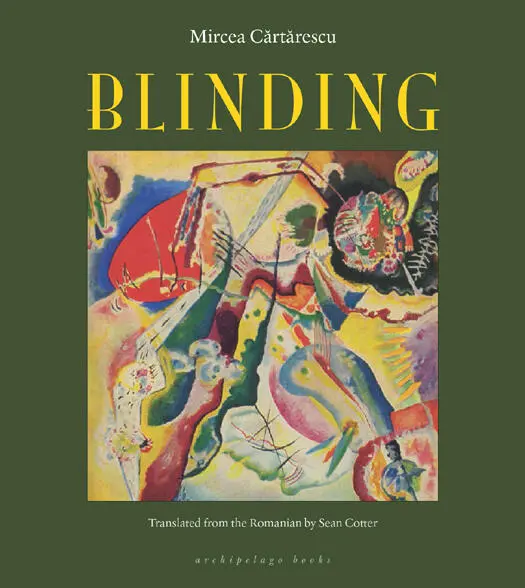
- Название:Blinding: Volume 1
- Автор:
- Издательство:Archipelago
- Жанр:
- Год:1996
- ISBN:9781935744856
- Рейтинг книги:3 / 5. Голосов: 1
-
Избранное:Добавить в избранное
- Отзывы:
-
Ваша оценка:
Blinding: Volume 1: краткое содержание, описание и аннотация
Предлагаем к чтению аннотацию, описание, краткое содержание или предисловие (зависит от того, что написал сам автор книги «Blinding: Volume 1»). Если вы не нашли необходимую информацию о книге — напишите в комментариях, мы постараемся отыскать её.
was one of the most widely heralded literary sensations in contemporary Romania, and a bestseller from the day of its release. Riddled with hidden passageways, mesmerizing tapestries, and whispering butterflies,
takes us on a mystical trip into the protagonist’s childhood, his memories of hospitalization as a teenager, the prehistory of his family, a traveling circus, secret police, zombie armies, American fighter pilots, the underground jazz scene of New Orleans, and the installation of the communist regime. This kaleidoscopic world is both eerily familiar and profoundly new. Readers of
will emerge from this strange pilgrimage shaken, and entirely transformed.
Blinding: Volume 1 — читать онлайн бесплатно полную книгу (весь текст) целиком
Ниже представлен текст книги, разбитый по страницам. Система сохранения места последней прочитанной страницы, позволяет с удобством читать онлайн бесплатно книгу «Blinding: Volume 1», без необходимости каждый раз заново искать на чём Вы остановились. Поставьте закладку, и сможете в любой момент перейти на страницу, на которой закончили чтение.
Интервал:
Закладка:
One morning at the end of August we left, for the last time, like on an iceberg, the yellow house in Floreasca, where we had lived for three years, and we went off along the quiet neighborhood streets, passing the grocery at the end of our street, where they would send me to buy things with the exact change, past the barber where I had once gotten lost and howled until I turned blue. I held Mamma’s hand. We took various buses, and after burrowing through incomprehensible areas of the city, we arrived in front of an enormous building. I didn’t know I would have to spend a week behind the façade with thousands of windows, after which I would never go back to our apartment in the house, but I would fill a new spiral, much bigger, in another block, where I would live for almost twenty-five years. And it is so clear to me now that the foggy façade of the Emilia Irza Hospital, like the block across Ştefan cel Mare, built fifteen years after we moved, was nothing other than the opercula, impenetrable membranes separating the compartments, ever vaster, of the spiral shell secreted, structured, and inhabited by the soft flesh of my mind (here, in this notebook) and the soft meditation of my flesh (in real life), if life and thought about life are ever separate, which happens outside the awareness of the event, and on the other side the gestural realm where the gesture intervenes and all other beliefs wither, turn to dust, and disappear. Through the muddy filter of the hospital, the previous lives of the siphonophore larvae that I had been, from birth to two-and-a-half years old (on Silistra), from then to three (the block beside the Floreasca garage) and then in the house on Puccini — beings with differently developed brains, with different connections in which images were more like emotions and tastes, and every event took the form of a yet more disorienting surprise; the other fetal lives, a little more evolved than the real fetus, dreaming with rapid eye movements in my mother’s genital paunch, appeared like a magical series of reincarnations, just as odd to the being behind the window-filled wall as the bestiary animals or humanoids who, they say, live on other planets, in the colloidal suspension of the stars.
I remember a freezing morning, consonant with the ancient, legendary, lost in illo tempore purple dawns, that welcomed us, my mother and me, on our way to daycare, and whose engram entered unexpectedly into my poems:
ah, mamma, i dream of you so often!
i walk holding your hand in enormous mornings
you and i reach the factory courtyard and its drums of acid
we enter shops full of threads from mechanical carpets
or, in the black hours of morning
we walk hand-in-hand on narrow streets with little shops
and we turn off the gas by the reddened squash
But, if it is absurd and delusional to use the word “memory” for those unplaceable and atemporal images of asphalt reddened, as far as you can see, from sunrises that warm faces and garments, washing them in a thin liquid purple and extending fine and endless shadows of amber, I can instead mark out scene by scene — how strange — that inexplicable week in the hospital, my first complete separation from my parents and home.
They both took me. I remember how cold I was, as though I were looking at a group of photographs that held in their thick layer of silver nitrate not only images but also sensations, emotions, sounds, and smells. I wore navy corduroy overalls, with two satin mushrooms stitched onto the chest, the same overalls that appear in black-and-white pictures from this period: I am in the Ştefan Gheorghiu schoolyard, in a group of kids, three girls with scarves on their heads, all taller than me, and standing beside us, next to Aunt Estera, is my father’s co-worker, in a kind of raglan sweater often worn in the ’60s. Aunt Estera has wiry hair and a cigarette between the fingers of her left hand. I’m sticking out my chest, relatively chubby in the face, sickly, and my hair combed with a part. As soon as we entered the hospital doors, we were submerged in endless green corridors. We were accompanied by a nurse in white, who kept opening doors with opaque windows ahead of us, and closing them once we passed. Along the walls, between numbered doors, with nickel ashtrays beside them, were glass cases of disgusting and fascinating anatomical displays: slices of heart, pieces of colon, and fetuses in various stages of development, which I stared at in passing, without daring to ask for an explanation. The only one that startled me was the thick jar, half a meter across, where two infants floated, Siamese twins, conjoined at the pelvis, so that two trunks emerged obliquely from what was a single body from the waist down, with only two feet and toes crinkled from the wet. You wouldn’t have been able to say, looking at the bald skulls and eyes rolled back into the head, what sex the two beings were, but their shared pubis was a girl’s. In the ever more imbricated hallways, sometimes rising and falling like a stairway with a banister, sick elderly people sat here and there, in discolored scarlet robes. My mother went into a room with the nurse, while my father and I waited in the hall in front, on a vinyl bench. I couldn’t sit still for more than two minutes. I nosed around, up and down the freezing hall, for fifteen minutes, looking with wide eyes at all the cases, and at the posters of skinned people on the wall. One shelf had a plaster model, also a half-skinned person, who had a face on one side, with a breast and a still-human arm, while on the other side, it grinned bare teeth stuck in its jaws, and its eyeball shone like a marble. Each organ, in various colors, could be removed from the flayed body, to get deeper inside, so that soon I was holding a ribcage in my hands like a pan flute. My father, who did not have a single white strand in his hair combed smoothly back — he was much younger than I am now — stood up, red with anger, and smacked me (“Hey, those things are expensive! Put those bones back!”), but just then Mamma came out. I could barely recognize her in the miserable thin robe, flannel, blue with dots that were once white but now showed the background color, and with a cap of the same material on her head. She hugged me and, to my discomfort and my father’s irritation, started to kiss me with slummy tenderness, saying over and over, like a rosary in a gypsy accent, “I could just eat you up! Mamma’s little boy! What will you do without your Mamma for so long?” and more kisses, so many that I was relieved when she put me down and left me in the care of the nurses. My father kissed me too (I remember the sensation of his unshaven whiskers on my cheeks and the vague smells of cologne and walnut oil) and paused to whisper something to my mother. I remember them there, in the narrow, high hallway, face to face, talking seriously, without smiling, without holding hands.
Leaving them didn’t frighten me at all. I was tugged gently away, down other corridors, by the woman in white (who looked like a typical German, blond, short hair, penciled “eyebrows abroad”). This trust is incomprehensible to me, entering into the great adventure of detachment from my parents and exploring the hospital with a kind of wondrous enchantment. That first week of independence, subtracted from normal life, would be, perhaps, the model for my later experiences of closed, isolated worlds, spherical like pearls and just as precious, adorning the asymmetrical, capricious edifice of my ordinary life, which is impossible to totally comprehend. When they sent me away later, to camp or on trips, or who knows where else, my indifference left my parents at a loss for sufficient expression of their indignation. “Did you miss us?” they always asked, and I always responded, sincerely and naïvely, “No.” “You’ll never win with that attitude of yours,” Mamma would repeat, bitterly, adding: “I’ve never seen such a spiteful child,” meaning that, after the age of six, I would not let her kiss or pat me, but I spurned her, putting my hands across my chest and turning my head. Not once, in my adolescence, did I write them or call from camp. My father did the same when he was in the field, so that, abandoned and in a way offended by everyone, my mother often complained that she lived with two savages. The love and even passion that appear in every line I have written about my mother (and I’ve written almost solely about her) have always taken me by surprise, and made me wonder whether it was poor literary effect or if there had ever been an age in which I truly loved my mother more than anything in the world. If there had, then what conflict, frustration, or betrayal on her part had transformed my adoration into frigidity and, perhaps, a subterranean enmity? It’s true, she often told me I treated her “like an enemy,” and I remember how she cried once on my birthday, when she bought me a jacket and I told her to her face “I won’t wear something like that,” or when I wouldn’t touch the food she made, saying invariably and impersonally: “I don’t like it.” “You’re like your father. When we were first married, I would wait for him to come home from work to hot food on the table. I was thinking maybe he’d say something nice, just a word … But he would eat and not say anything. And if I asked him, when I couldn’t take it anymore, how’s the soup, how’s the steak or whatever, he’d keep his nose on the plate and tell me just ‘How should it be? It’s food!’ It killed me …”
Читать дальшеИнтервал:
Закладка:
Похожие книги на «Blinding: Volume 1»
Представляем Вашему вниманию похожие книги на «Blinding: Volume 1» списком для выбора. Мы отобрали схожую по названию и смыслу литературу в надежде предоставить читателям больше вариантов отыскать новые, интересные, ещё непрочитанные произведения.












Обсуждение, отзывы о книге «Blinding: Volume 1» и просто собственные мнения читателей. Оставьте ваши комментарии, напишите, что Вы думаете о произведении, его смысле или главных героях. Укажите что конкретно понравилось, а что нет, и почему Вы так считаете.