Nadine Gordimer - Life Times - Stories 1952-2007
Здесь есть возможность читать онлайн «Nadine Gordimer - Life Times - Stories 1952-2007» весь текст электронной книги совершенно бесплатно (целиком полную версию без сокращений). В некоторых случаях можно слушать аудио, скачать через торрент в формате fb2 и присутствует краткое содержание. Год выпуска: 2010, Издательство: Farrar, Straus and Giroux, Жанр: Современная проза, на английском языке. Описание произведения, (предисловие) а так же отзывы посетителей доступны на портале библиотеки ЛибКат.
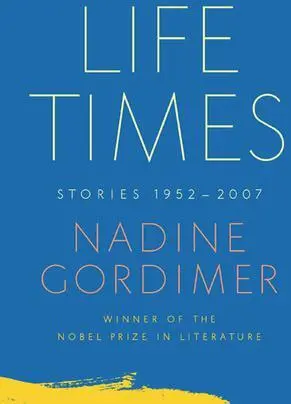
- Название:Life Times: Stories 1952-2007
- Автор:
- Издательство:Farrar, Straus and Giroux
- Жанр:
- Год:2010
- ISBN:нет данных
- Рейтинг книги:5 / 5. Голосов: 1
-
Избранное:Добавить в избранное
- Отзывы:
-
Ваша оценка:
Life Times: Stories 1952-2007: краткое содержание, описание и аннотация
Предлагаем к чтению аннотацию, описание, краткое содержание или предисловие (зависит от того, что написал сам автор книги «Life Times: Stories 1952-2007»). Если вы не нашли необходимую информацию о книге — напишите в комментариях, мы постараемся отыскать её.
This collection of Nadine Gordimer’s short fiction demonstrates her rich use of language and her unsparing vision of politics, sexuality, and race. Whether writing about lovers, parents and children, or married couples, Gordimer maps out the terrain of human relationships with razor-sharp psychological insight and a stunning lack of sentimentality. The selection, which spans the course of Gordimer’s career to date, presents the range of her storytelling abilities and her brilliant insight into human nature. From such epics as “Friday’s Footprint” and “Something Out There” to her shorter, more experimental stories, Gordimer’s work is unfailingly nuanced and complex. Time and again, it forces us to examine how our stated intentions come into conflict with our unspoken desires.
This definitive volume, which includes four new stories from the Nobel laureate, is a testament to the power, force, and ongoing relevance of Gordimer’s vision.
Life Times: Stories 1952-2007 — читать онлайн бесплатно полную книгу (весь текст) целиком
Ниже представлен текст книги, разбитый по страницам. Система сохранения места последней прочитанной страницы, позволяет с удобством читать онлайн бесплатно книгу «Life Times: Stories 1952-2007», без необходимости каждый раз заново искать на чём Вы остановились. Поставьте закладку, и сможете в любой момент перейти на страницу, на которой закончили чтение.
Интервал:
Закладка:
There was as yet no other child in the tribe’s school who was ready for Standard Six. It was difficult to see what could be done, now, but send Praise back over the border to school. So Miss Graham-Grigg decided it would have to be Father Audry. There was nothing else for it. The only alternative was the mission school, those damned Jesuits who’d been sitting in the Protectorate since the days when the white imperialists were on the grab, taking the tribes under their ‘protection’ — and the children the boy would be in class with there wouldn’t provide any sort of stimulation, either. So it would have to be Father Audry, and South Africa. He was a priest, too, an Anglican one, but his school was a place where at least, along with the pious pap, a black child could get an education as good as a white child’s.
When Praise came out into the veld with the other boys his eyes screwed up, against the size: the land ran away all round, and there was no other side to be seen; only the sudden appearance of the sky, that was even bigger. The wind made him snuff like a dog. He stood helpless as the country men he had seen caught by changing traffic lights in the middle of a street. The bits of space between buildings came together, ballooned uninterruptedly over him, he was lost; but there were clouds as big as the buildings had been, and even though space was vaster than any city, it was peopled by birds. If you ran for ten minutes into the veld the village was gone; but down low on the ground thousands of ants knew their way between their hard mounds that stood up endlessly as the land.
He went to herd cattle with the other boys early in the mornings and after school. He taught them some gambling games they had never heard of. He told them about the city they had never seen. The money in the old man’s hat seemed a lot to them, who had never got more than a few pennies when the mail train stopped for water at the halt five miles away; so the sum grew in his own estimation, too, and he exaggerated it a bit. In any case, he was forgetting about the city; in a way; not Miss Graham-Grigg’s way, but in the manner of a child, who makes, like a wasp building with his own spittle, his private context within the circumstance of his surroundings, so that the space around him was reduced to the village, the pan where the cattle were taken to drink, the halt where the train went by; whatever particular patch of sand or rough grass astir with ants the boys rolled on, heads together, among the white egrets and the cattle. He learnt from the others what roots and leaves were good to chew, and how to set wire traps for spring-hares. Though Miss Graham-Grigg had said he need not, he went to church with the children on Sundays.
He did not live where she did, in one of the Chief’s houses, but with the family of one of the other boys; but he was at her house often. She asked him to copy letters for her. She cut things out of the newspapers she got and gave them to him to read; they were about aeroplanes, and dams being built, and the way the people lived in other countries. ‘Now you’ll be able to tell the boys all about the Volta Dam, that is also in Africa — far from here — but still, in Africa,’ she said, with that sudden smile that reddened her face. She had a gramophone and she played records for him. Not only music, but people reading out poems, so that he knew that the poems in the school reader were not just short lines of words, but more like songs. She gave him tea with plenty of sugar and she asked him to help her to learn the language of the tribe, to talk to her in it. He was not allowed to call her madam or missus, as he did the white women who had put money in the hat, but had to learn to say Miss Graham-Grigg.
Although he had never known any white women before except as high-heeled shoes passing quickly in the street, he did not think that all white women must be like her; in the light of what he had seen white people, in their cars, their wealth, their distance, to be, he understood nothing that she did. She looked like them, with her blue eyes, blonde hair and skin that was not one colour but many — brown where the sun burned it, red when she blushed — but she lived here in the Chief’s houses, drove him in his car, and sometimes slept out in the fields with the women when they were harvesting kaffircorn far from the village. He did not know why she had brought him there, or why she should be kind to him. But he could not ask her, any more than he would have asked her why she went out and slept in the fields when she had a gramophone and a lovely gas lamp (he had been able to repair it for her) in her room. If when they were talking together, the talk came anywhere near the pitch outside the post office, she became slowly very red, and they went past it, either by falling silent or (on her part) talking and laughing rather fast.
That was why he was amazed the day she told him that he was going back to Johannesburg. As soon as she had said it she blushed darkly for it, her eyes pleading confusion: so it was really from her that the vision of the pitch outside the post office came again. But she was already speaking: ‘—to school. To a really good boarding school, Father Audry’s school, about nine miles from town. You must get your chance at a good school, Praise. We really can’t teach you properly any longer. Maybe you’ll be the teacher here, yourself, one day. There’ll be a high school and you’ll be the headmaster.’
She succeeded in making him smile; but she looked sad, uncertain. He went on smiling because he couldn’t tell her about the initiation school that he was about to begin with the other boys of his age group. Perhaps someone would tell her. The other women. Even the Chief. But you couldn’t fool her with smiling.
‘You’ll be sorry to leave Tebedi and Joseph and the rest.’
He stood there, smiling.
‘Praise, I don’t think you understand about yourself — about your brain.’ She gave a little sobbing giggle, prodded at her own head. ‘You’ve got an awfully good one. More in there than other boys — you know? It’s something special — it would be such a waste. Lots of people would like to be clever like you, but it’s not easy, when you are the clever one—?’
He went on smiling. He did not want her face looking into his any more and so he fixed his eyes on her feet, white feet in sandals with the veins standing out over the ankles like the feet of Christ dangling above his head in the church.
Adelaide Graham-Grigg had met Father Audry before, of course. All those white people who do not accept the colour bar in Southern Africa seem to know each other, however different the bases of their rejection. She had sat with him on some committee or other in London a few years earlier, along with a couple of exiled white South African leftists and a black nationalist leader. Anyway, everyone knew him — from the newspapers if nowhere else: he had been warned, in a public speech by the Prime Minister of South Africa, Dr Verwoerd, that the interference of a churchman in political matters would not be tolerated. He continued to speak his mind, and (as the newspapers quoted him) ‘to obey the commands of God before the dictates of the State’. He had close friends among African and Indian leaders, and it was said that he even got on well with certain ministers of the Dutch Reformed Church, that, in fact, he was behind some of the dissidents who now and then questioned Divine Sanction for the colour bar — such was the presence of his restless, black-cassocked figure, stammering eloquence and jagged handsome face.
He had aged since she saw him last; he was less handsome. But he had still what he would have as long as he lived: the unconscious bearing of a natural prince among men that makes a celebrated actor, a political leader, a successful lover; an object of attraction and envy who, whatever his generosity of spirit, is careless of one cruelty for which other people will never forgive him — the distinction, the luck with which he was born.
Читать дальшеИнтервал:
Закладка:
Похожие книги на «Life Times: Stories 1952-2007»
Представляем Вашему вниманию похожие книги на «Life Times: Stories 1952-2007» списком для выбора. Мы отобрали схожую по названию и смыслу литературу в надежде предоставить читателям больше вариантов отыскать новые, интересные, ещё непрочитанные произведения.






Обсуждение, отзывы о книге «Life Times: Stories 1952-2007» и просто собственные мнения читателей. Оставьте ваши комментарии, напишите, что Вы думаете о произведении, его смысле или главных героях. Укажите что конкретно понравилось, а что нет, и почему Вы так считаете.