Nadine Gordimer - Life Times - Stories 1952-2007
Здесь есть возможность читать онлайн «Nadine Gordimer - Life Times - Stories 1952-2007» весь текст электронной книги совершенно бесплатно (целиком полную версию без сокращений). В некоторых случаях можно слушать аудио, скачать через торрент в формате fb2 и присутствует краткое содержание. Год выпуска: 2010, Издательство: Farrar, Straus and Giroux, Жанр: Современная проза, на английском языке. Описание произведения, (предисловие) а так же отзывы посетителей доступны на портале библиотеки ЛибКат.
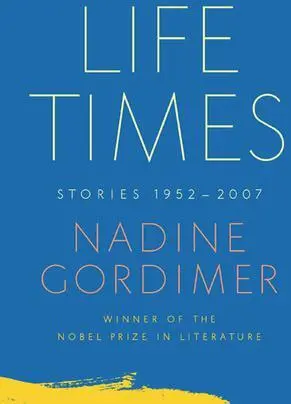
- Название:Life Times: Stories 1952-2007
- Автор:
- Издательство:Farrar, Straus and Giroux
- Жанр:
- Год:2010
- ISBN:нет данных
- Рейтинг книги:5 / 5. Голосов: 1
-
Избранное:Добавить в избранное
- Отзывы:
-
Ваша оценка:
Life Times: Stories 1952-2007: краткое содержание, описание и аннотация
Предлагаем к чтению аннотацию, описание, краткое содержание или предисловие (зависит от того, что написал сам автор книги «Life Times: Stories 1952-2007»). Если вы не нашли необходимую информацию о книге — напишите в комментариях, мы постараемся отыскать её.
This collection of Nadine Gordimer’s short fiction demonstrates her rich use of language and her unsparing vision of politics, sexuality, and race. Whether writing about lovers, parents and children, or married couples, Gordimer maps out the terrain of human relationships with razor-sharp psychological insight and a stunning lack of sentimentality. The selection, which spans the course of Gordimer’s career to date, presents the range of her storytelling abilities and her brilliant insight into human nature. From such epics as “Friday’s Footprint” and “Something Out There” to her shorter, more experimental stories, Gordimer’s work is unfailingly nuanced and complex. Time and again, it forces us to examine how our stated intentions come into conflict with our unspoken desires.
This definitive volume, which includes four new stories from the Nobel laureate, is a testament to the power, force, and ongoing relevance of Gordimer’s vision.
Life Times: Stories 1952-2007 — читать онлайн бесплатно полную книгу (весь текст) целиком
Ниже представлен текст книги, разбитый по страницам. Система сохранения места последней прочитанной страницы, позволяет с удобством читать онлайн бесплатно книгу «Life Times: Stories 1952-2007», без необходимости каждый раз заново искать на чём Вы остановились. Поставьте закладку, и сможете в любой момент перейти на страницу, на которой закончили чтение.
Интервал:
Закладка:
Lagersdorp Location, which they were entering and which Joyce McCoy had never seen before, was much like all such places. A high barbed-wire fence — more a symbol than a means of confinement, since, except for the part near the gates, it had comfortable gaps in many places — enclosed almost a square mile of dreary little dwellings, to which the African population of the nearby town came home to sleep at night. There were mean houses and squalid tin shelters and, near the gates where the administrative offices were, one or two decent cottages, which had been built by the white housing authorities ‘experimentally’ and never duplicated; they were occupied by the favourite African clerks of the white location superintendent. There were very few shops, since every licence granted to a native shop in a location takes business away from the white stores in the town, and there were a great many churches, some built of mud and tin, some neo-Gothic and built of brick, representing a great many sects.
They began to walk, the seven men and women, towards the location gates. Jessica Malherbe and Roy Wilson were a little ahead, and the girl found herself between Shabalala and the bald white man with thick glasses. The flashbulb made its brief sensation, and the two or three picannins who were playing with tin hoops on the roadside looked up, astonished. A fat native woman selling oranges and roast mealies shouted speculatively to a passer-by in ragged trousers.
At the gateway, a fat black policeman sat on a soapbox and gossiped. He raised his hand to his cap as they passed. In Joyce McCoy, the numbness that had followed her nervous crisis began to be replaced by a calm embarrassment; as a child she had often wondered, seeing a circle of Salvation Army people playing a hymn out of tune on a street corner, how it would feel to stand there with them. Now she felt she knew. Little Shabalala ran a finger around the inside of his collar, and the girl thought, with a start of warmth, that he was feeling as she was; she did not know that he was thinking what he had promised himself he would not think about during this walk — that very likely the walk would cost him his job. People did not want to employ Africans who ‘made trouble’. His wife, who was immensely proud of his education and his cleverness, had said nothing when she learnt that he was going — had only gone, with studied consciousness, about her cooking. But, after all, Shabalala, like the girl — though neither he nor she could know it — was also saved by convention. In his case, it was a bold convention — that he was an amusing little man. He said to her as they began to walk up the road, inside the gateway, ‘Feel the bump?’
‘I beg your pardon?’ she said, polite and conspiratorial.
A group of ragged children, their eyes alight with the tenacious beggarliness associated with the East rather than with Africa, were jumping and running around the white members of the party, which they thought was some committee come to judge a competition for the cleanest house, or a baby show. ‘Penny, missus, penny, penny, baas!’ they whined. Shabalala growled something at them playfully in their own language before he answered, with his delightful grin, wide as a slice of melon. ‘The bump over the colour bar.’
Apart from the children, who dropped away desultorily, like flying fish behind a boat, no one took much notice of the defiers. The African women, carrying on their heads food they had bought in town, or bundles of white people’s washing, scarcely looked at them. African men on bicycles rode past, preoccupied. But when the party came up parallel with the administration offices — built of red brick, and, along with the experimental cottages at the gate and the clinic next door, the only buildings of European standard in the location — a middle-aged white man in a suit worn shiny on the seat and the elbows (his slightly stooping body seemed to carry the shape of his office chair and desk) came out and stopped Jessica Malherbe. Obediently, the whole group stopped; there was an air of quiet obstinacy about them. The man, who was the location superintendent himself, evidently knew Jessica Malherbe, and was awkward with the necessity of making this an official and not a personal encounter. ‘You know that I must tell you it is prohibited for Europeans to enter Lagersdorp Location,’ he said. The girl noticed that he carried his glasses in his left hand, dangling by one earpiece, as if he had been waiting for the arrival of the party and had jumped up from his desk nervously at last.
Jessica Malherbe smiled, and there was in her smile something of the easy, informal amusement with which Afrikaners discount pomposity. ‘Mr Dougal, good afternoon. Yes, of course, we know you have to give us official warning. How far do you think we’ll get?’
The man’s face relaxed. He shrugged and said, ‘They’re waiting for you.’
And suddenly the girl, Joyce McCoy, felt this — the sense of something lying in wait for them. The neat, stereotyped faces of African clerks appeared at the windows of the administrative offices. As the party approached the clinic, the European doctor, in his white coat, looked out; two white nurses and an African nurse came out on to the veranda. And all the patient African women who were sitting about in the sun outside, suckling their babies and gossiping, sat silent while the party walked by — sat silent, and had in their eyes something of the look of the Indian grandmother, waiting at home in Fordsburg.
The party walked on up the street, and on either side, in the little houses, which had homemade verandas flanking the strip of worn, unpaved earth that was the pavement, or whose front doors opened straight out on to a foot or two of fenced garden, where hens ran and pumpkins had been put to ripen, doors were open, and men and women stood, their children gathered in around them, as if they sensed the approach of a storm. Yet the sun was hot on the heads of the party, walking slowly up the street. And they were silent, and the watchers were silent, or spoke to one another only in whispers, each bending his head to another’s ear but keeping his eyes on the group passing up the street. Someone laughed, but it was only a drunk — a wizened little old man — returning from some shebeen. And ahead, at the corner of a crossroad, stood the police car, a black car, with the aerial from its radio-communication equipment a shining lash against all the shabbiness of the street. The rear doors opened and two heavy, smartly dressed policemen got out and slammed the doors behind them. They approached the party slowly, not hurrying themselves. When they drew abreast, one said, as if in reflex, ‘Ah — good afternoon.’ But the other cut in, in an emotionless official voice, ‘You are all under arrest for illegal entry into Lagersdorp Location. If you’ll just give us your names. .’
Joyce stood waiting her turn, and her heart beat slowly and evenly. She thought again, as she had once before — how long ago was that party? — I feel nothing . It’s all right. I feel nothing .
But as the policeman came to her, and she spelled out her name for him, she looked up and saw the faces of the African onlookers who stood nearest her. Two men, a small boy and a woman, dressed in ill-matched cast-offs of European clothing, which hung upon them without meaning, like coats spread on bushes, were looking at her. When she looked back, they met her gaze. And she felt, suddenly, not nothing but what they were feeling, at the sight of her, a white girl, taken — incomprehensibly, as they themselves were used to being taken — under the force of white men’s wills, which dispensed and withdrew life, which imprisoned and set free, fed or starved, like God himself.
Not for Publication
Интервал:
Закладка:
Похожие книги на «Life Times: Stories 1952-2007»
Представляем Вашему вниманию похожие книги на «Life Times: Stories 1952-2007» списком для выбора. Мы отобрали схожую по названию и смыслу литературу в надежде предоставить читателям больше вариантов отыскать новые, интересные, ещё непрочитанные произведения.







Обсуждение, отзывы о книге «Life Times: Stories 1952-2007» и просто собственные мнения читателей. Оставьте ваши комментарии, напишите, что Вы думаете о произведении, его смысле или главных героях. Укажите что конкретно понравилось, а что нет, и почему Вы так считаете.