Nadine Gordimer - Life Times - Stories 1952-2007
Здесь есть возможность читать онлайн «Nadine Gordimer - Life Times - Stories 1952-2007» весь текст электронной книги совершенно бесплатно (целиком полную версию без сокращений). В некоторых случаях можно слушать аудио, скачать через торрент в формате fb2 и присутствует краткое содержание. Год выпуска: 2010, Издательство: Farrar, Straus and Giroux, Жанр: Современная проза, на английском языке. Описание произведения, (предисловие) а так же отзывы посетителей доступны на портале библиотеки ЛибКат.
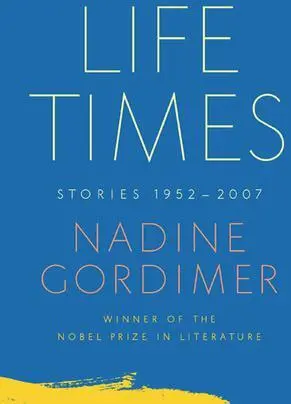
- Название:Life Times: Stories 1952-2007
- Автор:
- Издательство:Farrar, Straus and Giroux
- Жанр:
- Год:2010
- ISBN:нет данных
- Рейтинг книги:5 / 5. Голосов: 1
-
Избранное:Добавить в избранное
- Отзывы:
-
Ваша оценка:
Life Times: Stories 1952-2007: краткое содержание, описание и аннотация
Предлагаем к чтению аннотацию, описание, краткое содержание или предисловие (зависит от того, что написал сам автор книги «Life Times: Stories 1952-2007»). Если вы не нашли необходимую информацию о книге — напишите в комментариях, мы постараемся отыскать её.
This collection of Nadine Gordimer’s short fiction demonstrates her rich use of language and her unsparing vision of politics, sexuality, and race. Whether writing about lovers, parents and children, or married couples, Gordimer maps out the terrain of human relationships with razor-sharp psychological insight and a stunning lack of sentimentality. The selection, which spans the course of Gordimer’s career to date, presents the range of her storytelling abilities and her brilliant insight into human nature. From such epics as “Friday’s Footprint” and “Something Out There” to her shorter, more experimental stories, Gordimer’s work is unfailingly nuanced and complex. Time and again, it forces us to examine how our stated intentions come into conflict with our unspoken desires.
This definitive volume, which includes four new stories from the Nobel laureate, is a testament to the power, force, and ongoing relevance of Gordimer’s vision.
Life Times: Stories 1952-2007 — читать онлайн бесплатно полную книгу (весь текст) целиком
Ниже представлен текст книги, разбитый по страницам. Система сохранения места последней прочитанной страницы, позволяет с удобством читать онлайн бесплатно книгу «Life Times: Stories 1952-2007», без необходимости каждый раз заново искать на чём Вы остановились. Поставьте закладку, и сможете в любой момент перейти на страницу, на которой закончили чтение.
Интервал:
Закладка:
He was tired and closed his eyes in a grimace straining at concentration when he talked to her, yet in spite of this she felt the dimness of the candle of her being within his radius. Everything was right, with him; nothing was quite right with her. She was only thirty-six but she had never looked any younger. Her eyes were the bright shy eyes of a young woman but her feet and hands with their ridged nails had the look of tension and suffering of extremities that would never caress: she saw it, he saw it, she knew in his presence that they were deprived for ever.
Her humiliation gave her force. She said, ‘I must tell you we want him back in the tribe — I mean, there are terribly few with enough education even for administration. Within the next few years we’ll desperately need more and more educated men. . We shouldn’t want him to be allowed to think of becoming a priest.’
Father Audry smiled at what he knew he was expected to come out with: that if the boy chose the way of the Lord, etc.
He said, ‘What you want is someone who will turn out to be an able politician without challenging the tribal system.’
They both laughed, but, again, he had unconsciously taken the advantage of admitting their deeply divergent views; he believed the chiefs must go, while she, of course, saw no reason why Africans shouldn’t develop their own tribal democracy instead of taking over the Western pattern.
‘Well, he’s a little young for us to be worrying about that now, don’t you think. .?’ He smiled. There were a great many papers on his desk and she had the sense of pressure of his preoccupation with other things. ‘What about the Lemeribe Mission? What’s the teaching like these days — I used to know Father Chalmon when he was there—’
‘I wouldn’t send him to those people,’ she said spiritedly, implying that he knew her views on missionaries and their role in Africa. In this atmosphere of candour they discussed Praise’s background. Father Audry suggested that the boy should be encouraged to resume relations with his family, once he was back within reach of Johannesburg.
‘They’re pretty awful.’
‘It would be best for him to acknowledge what he was, if he is to accept what he is to become.’ He got up with a swish of his black skirts and strode, stooping in the opened door, to call, ‘Simon, bring the boy.’ Miss Graham-Grigg was smiling excitedly towards the doorway, all the will to love pacing behind the bars of her glance.
Praise entered in the navy-blue shorts and white shirt of his new school uniform. The woman’s kindness, the man’s attention, got him in the eyes like the sun striking off the pan where the cattle had been taken to drink. Father Audry came from England, Miss Graham-Grigg had told him, like herself. That was what they were, these two white people who were not like any white people he had seen to be. What they were was being English. From far off; six thousand miles from here, as he knew from his geography book.
Praise did very well at the new school. He sang in the choir in the big church on Sundays; his body, that was to have been made a man’s out in the bush, was hidden under the white robes. The boys smoked in the lavatories and once there was a girl who came and lay down for them in a storm-water ditch behind the workshops. He knew all about these things from before, on the streets and in the location where he had slept in one room with a whole family. But he did not tell the boys about the initiation. The women had not said anything to Miss Graham-Grigg. The Chief hadn’t, either. Soon when Praise thought about it he realised that by now it must be over. Those boys must have come back from the bush. Miss Graham-Grigg had said that after a year, when Christmas came, she would fetch him for the summer holidays. She did come and see him twice that first year, when she was down in Johannesburg, but he couldn’t go back with her at Christmas because Father Audry had him in the Nativity play, and was giving him personal coaching in Latin and algebra. Father Audry didn’t actually teach in the school at all — it was ‘his’ school simply because he had begun it, and it was run by the Order of which he was Father Provincial — but the reports of the boy’s progress were so astonishing that, as he said to Miss Graham-Grigg, one felt one must give him all the mental stimulation one could.
‘I begin to believe we may be able to sit him for his matric when he is just sixteen.’ Father Audry made the pronouncement with the air of doing so at the risk of sounding ridiculous.
Miss Graham-Grigg always had her hair done when she got to Johannesburg, she was looking pretty and optimistic. ‘D’you think he could do a Cambridge entrance? My committee in London would set up a scholarship, I’m sure — investment in a future Prime Minister for the Chief!’
When Praise was sent for, she said she hardly knew him; he hadn’t grown much, but he looked so grown-up , with his long trousers and glasses. ‘You really needn’t wear them when you’re not working,’ said Father Audry. ‘Well, I suppose if you take ’em on and off you keep leaving them about, eh?’ They both stood back, smiling, letting the phenomenon embody in the boy.
Praise saw that she had never been reminded by anyone about the initiation. She began to give him news of his friends, Tebedi and Joseph and the others, but when he heard their names they seemed to belong to people he couldn’t see in his mind.
Father Audry talked to him sometimes about what Father called his ‘family’, and when first he came to the school he had been told to write to them. It was a well-written, well-spelled letter in English, exactly the letter he presented as a school exercise when one was required in class. They didn’t answer. Then Father Audry must have made private efforts to get in touch with them, because the old woman, a couple of children who had been babies when he left and one of his grown-up ‘sisters’ came to the school on a visiting day. They had to be pointed out to him among the other boys’ visitors; he would not have known them, nor they him.
He said, ‘Where’s my uncle?’ — because he would have known him at once; he had never grown out of the slight stoop of the left shoulder where the weight of the old man’s hand had impressed the young bone. But the old man was dead.
Father Audry came up and put a long arm round the bent shoulder and another long arm round one of the small children and said from one to the other: ‘Are you going to work hard and learn a lot like your brother?’ and the small black child stared up into the nostrils filled with strong hair, the tufted eyebrows, the red mouth surrounded by the pale jowl dark-pored with beard beneath the skin, and then down, torn by fascination, to the string of beads that hung from the leather belt.
They did not come again, but Praise did not much miss visitors because he spent more and more time with Father Audry. When he was not actually being coached, he was set to work to prepare his lessons or do his reading in the Father’s study, where he could concentrate as one could not hope to do up at the school. Father Audry taught him chess as a form of mental gymnastics, and was jubilant the first time Praise beat him. Praise went up to the house for a game nearly every evening after supper. He tried to teach the other boys but after the first ten minutes of explanation of moves, someone would bring out the cards or dice and they would all play one of the old games that were played in the streets and yards and locations. Johannesburg was only nine miles away; you could see the lights.
Father Audry rediscovered what Miss Graham-Grigg had found — that Praise listened attentively to music, serious music. One day Father Audry handed the boy the flute that had lain for years in its velvet-lined box that bore still the little silver nameplate: Rowland Audry. He watched while Praise gave the preliminary swaying wriggle and assumed the bent-kneed stance of all the urchin performers Father Audry had seen, and then tried to blow down it in the shy, fierce attack of penny whistle music. Father Audry took it out of his hands. ‘It’s what you’ve just heard there.’ Bach’s unaccompanied flute sonata lay on the record player. Praise smiled and frowned, giving his glasses a lift with his nose — a habit he was developing. ‘But you’ll soon learn to play it the right way round,’ said Father Audry, and with the lack of self-consciousness that comes from the habit of privilege, put the flute to his mouth and played what he remembered after ten years.
Читать дальшеИнтервал:
Закладка:
Похожие книги на «Life Times: Stories 1952-2007»
Представляем Вашему вниманию похожие книги на «Life Times: Stories 1952-2007» списком для выбора. Мы отобрали схожую по названию и смыслу литературу в надежде предоставить читателям больше вариантов отыскать новые, интересные, ещё непрочитанные произведения.







Обсуждение, отзывы о книге «Life Times: Stories 1952-2007» и просто собственные мнения читателей. Оставьте ваши комментарии, напишите, что Вы думаете о произведении, его смысле или главных героях. Укажите что конкретно понравилось, а что нет, и почему Вы так считаете.