Norman Rush - Mortals
Здесь есть возможность читать онлайн «Norman Rush - Mortals» весь текст электронной книги совершенно бесплатно (целиком полную версию без сокращений). В некоторых случаях можно слушать аудио, скачать через торрент в формате fb2 и присутствует краткое содержание. Год выпуска: 2003, ISBN: 2003, Издательство: Vintage Books, Жанр: Современная проза, на английском языке. Описание произведения, (предисловие) а так же отзывы посетителей доступны на портале библиотеки ЛибКат.
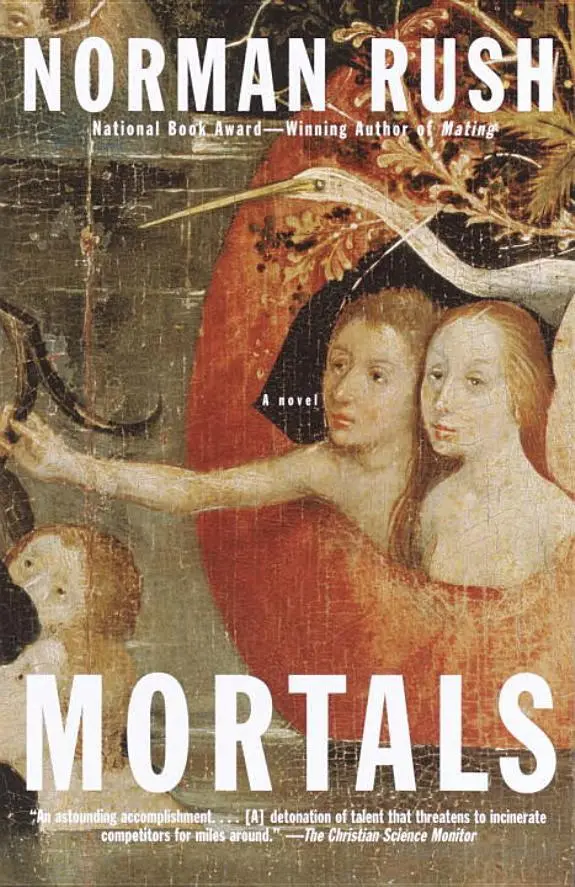
- Название:Mortals
- Автор:
- Издательство:Vintage Books
- Жанр:
- Год:2003
- ISBN:9780307789365
- Рейтинг книги:3 / 5. Голосов: 1
-
Избранное:Добавить в избранное
- Отзывы:
-
Ваша оценка:
Mortals: краткое содержание, описание и аннотация
Предлагаем к чтению аннотацию, описание, краткое содержание или предисловие (зависит от того, что написал сам автор книги «Mortals»). Если вы не нашли необходимую информацию о книге — напишите в комментариях, мы постараемся отыскать её.
As a spy, the compulsively literate Ray ought to have no trouble confirming his suspicions. But there’s the distraction of actual spying. Most of all, there’s the problem of love, which Norman Rush anatomizes in all its hopeless splendor in a novel that would have delighted Milton, Nabokov, and Graham Greene.
Mortals — читать онлайн бесплатно полную книгу (весь текст) целиком
Ниже представлен текст книги, разбитый по страницам. Система сохранения места последней прочитанной страницы, позволяет с удобством читать онлайн бесплатно книгу «Mortals», без необходимости каждый раз заново искать на чём Вы остановились. Поставьте закладку, и сможете в любой момент перейти на страницу, на которой закончили чтение.
Интервал:
Закладка:
“For a lot, though, Ray. Three thousand dollars.”
“That’s perfectly okay.”
“We can still stop the check.”
“We don’t need to. It’s fine, it’s fine. Come on.”
“I felt guilty about leaving her. It was an impulse. I need to discuss it with Davis. I don’t like that I did it so impulsively, Ellen is almost in and out of reality, almost to that point. So I wrote the check.”
He squatted, got the carry-on straps over his shoulders, and stood up, with difficulty.
As he turned to lead the way out, he saw or thought he saw what he wanted least of all at this moment to see … Morel, dodging out of sight into the Tiro ya Diatla fabrics stand. Rage filled him.
I could be wrong, he thought. It ought to be easy with someone who had a short leg, because his gait would betray him, normally. But Morel’s gait was perfect. He had trained himself to hide his condition and done that admirably.
“What is it?” Iris asked. Clearly she had seen nothing. And it had been brazen. Clearly Morel had been hiding in among the skirts at Tiro ya Diatla and scanning the arrivals scene. Ray had to get Iris out of there. He felt like telling her what her limping swain really was. He was a paranoid . He had a universal diagnosis for the world’s ill, which if it wasn’t paranoid was close to it. In his humble opinion her glorious boyfriend was a panacean , so to say, not that he would ever really be her boyfriend, so help him God. Of course something was wrong with the world, clearly. But what was wrong was hardly just one thing, like the existence of national languages with the cure being Esperanto. And what’s wrong isn’t that the workers don’t rule, either, he thought. And who was the one who said it was all due to people not having orgasms, a German? Reich, another panacean, he thought. It was possible he had coined the term, right there.
A porter drifted toward them, but he waved him off.
“Why don’t we get a porter?”
“No this is faster. The porters make you wait while they go for their carts.”
“But we have time.”
“No, I want to get home.”
He was making for an exit door at the extreme north end of the terminal.
“Where are we going?” she asked.
“Over there.”
My life is taking forever, he thought.
“Where are you parked , Ray? Why are we going over there?”
He had no answer.
“Why are you running?” she asked.
How she had managed these monstrously heavy bags was something he wanted to know. She was strong. Or he was getting old.
There was no kiss, he thought, with pain. It was true that the recommended protocol for expatriates in Botswana was decorum in public. The Batswana were supposed to find kissing objectionable. The injunction was in the embassy orientation pamphlet. Even the Westernized younger Batswana who took up kissing would, he had been told, rub their forearms across their lips before they went at it.
“Why are we here?” she asked. She meant Why had they emerged into an overflow parking area not in use, with barrier booms down at its entry and exit points? Their Volkswagen was in the main lot. They had doubled the distance they had to travel to reach it by coming out where they had.
He was making a show of scanning intently around.
He said, “I thought I saw Moyo come out here. I need to talk to him about St. James. You have to catch him when you can. He has no phone. Well if he was here, he’s gone.” It was the best he could do.
“Africa,” Iris said. “I need my sun hat.”
“Take mine,” Ray said.
“Yes, and kill you. You’ll get a stroke as it is. We should have gotten a porter.”
He toiled on. She would warn him about his knee, shortly.
“Why don’t you rest for a minute, Ray?”
“Because we need to get home.” And because Morel could be anywhere, he thought. He had wanted to get her away because an encounter with Morel would have wrecked the homecoming. Now he was wrecking it himself. There had been no pleasantries from her about how good it was to see his face, nothing. He had done everything he could think of at home, including buying a new pair of shoes for Fikile.
“ Please let me take one of those, Ray.”
“There’s the car. I’m fine.”
“I worry about your knee.”
“I know, but it’s fine and that was years ago. What have you got in this big one, anyway?”
“Something I have to tell you about. There’s a huge manuscript.”
“What manuscript?”
“I’ll explain it later. It’s your brother’s.”
“Oh God let this cup pass from me. Don’t tell me this. What am I supposed to do with it?”
“Read it.”
“But what is it, a memoir, something embarrassing about his miserable life?” A bitter triviality from the stupid past thrust itself on him. For a long period, growing up, Rex had gone out of his way to claim that his favorite thing to eat was mashed beef-stew sandwich, saying this on those occasions when children were expected to answer with spaghetti or hamburger or chocolate cake. Their mother had been proud of her boeuf bourguignon. And rightly so, as everybody seemed to say these days. And at one point Rex had childishly mashed his beef and carrots and pearl onions into a spread and clapped it between two slices of bread. He had given Ray a bite. Ray had found it delicious. But when Ray had tried to make the same sandwich for himself, his mother had turned on him and he had been prohibited from doing such a thing. It had been fine for Rex because he was, and apparently continued to be for years, a baby. Rex had been able to make sandwiches out of his boeuf bourguignon for as long as he chose to. And he had chosen to for years, rolling his eyes and smacking his lips and even elaborating the process, to taunt Ray, dropping capers into the mixture, or olives.
And now he had written a book. Ray wanted to write a book. Ray had a book to write. But now he had his brother’s book. He didn’t want it. He didn’t want it. He had Morel to crush. He had no time.
“I have talked so much to Rex,” Iris said.
“So describe this manuscript.” My problem is that I was raised by idiots, first two idiots and then just one, so of course I grew up to be an idiot, he thought.
“I don’t know how to. I don’t know what it is, exactly. It says faits divers in large letters on the title page but that’s crossed out. It’s fragments. I’ve read here and there. It’s very fragmentary. I’ll explain what I can, which is not much. He sent it to me to bring to you because he wanted to be sure it didn’t get lost. It’s called Bright Cities Darken.”
“Poetry?” Poetry wouldn’t be a problem, because any poetry by a family member, private poetry, secret, was ninety percent of the time going to turn out to be pathetic.
“Oh no, prose, definitely.”
I was raised by idiots, he thought. He wanted the last line of Moby-Dick and couldn’t get it, something about I alone have escaped.
He said, “I was raised by idiots.”
“Oh I know,” Iris said. “You can see that in Rex’s book.”
They had reached the car. He was exhausted, but he managed to load up and get them all set to go with celerity. His knee hurt.
First she had wanted to go into her den, her study, and sit there in the baking silence for a few minutes with the door closed. The mail, sorted out on a huge platter by him, she had ignored.
Afternoon was dying.
They had laughed at the alp her travel tunic made, dropped on the floor.
He waited.
She was lying full length on the sofa in the living room and he was preparing to rub her feet, at her request. He had aimed two electric fans toward her, one at her head, the other at her midsection. Nothing had been said about the house, the way it looked. He was back with the Nivea cream.
Читать дальшеИнтервал:
Закладка:
Похожие книги на «Mortals»
Представляем Вашему вниманию похожие книги на «Mortals» списком для выбора. Мы отобрали схожую по названию и смыслу литературу в надежде предоставить читателям больше вариантов отыскать новые, интересные, ещё непрочитанные произведения.




Обсуждение, отзывы о книге «Mortals» и просто собственные мнения читателей. Оставьте ваши комментарии, напишите, что Вы думаете о произведении, его смысле или главных героях. Укажите что конкретно понравилось, а что нет, и почему Вы так считаете.