Norman Rush - Mortals
Здесь есть возможность читать онлайн «Norman Rush - Mortals» весь текст электронной книги совершенно бесплатно (целиком полную версию без сокращений). В некоторых случаях можно слушать аудио, скачать через торрент в формате fb2 и присутствует краткое содержание. Год выпуска: 2003, ISBN: 2003, Издательство: Vintage Books, Жанр: Современная проза, на английском языке. Описание произведения, (предисловие) а так же отзывы посетителей доступны на портале библиотеки ЛибКат.
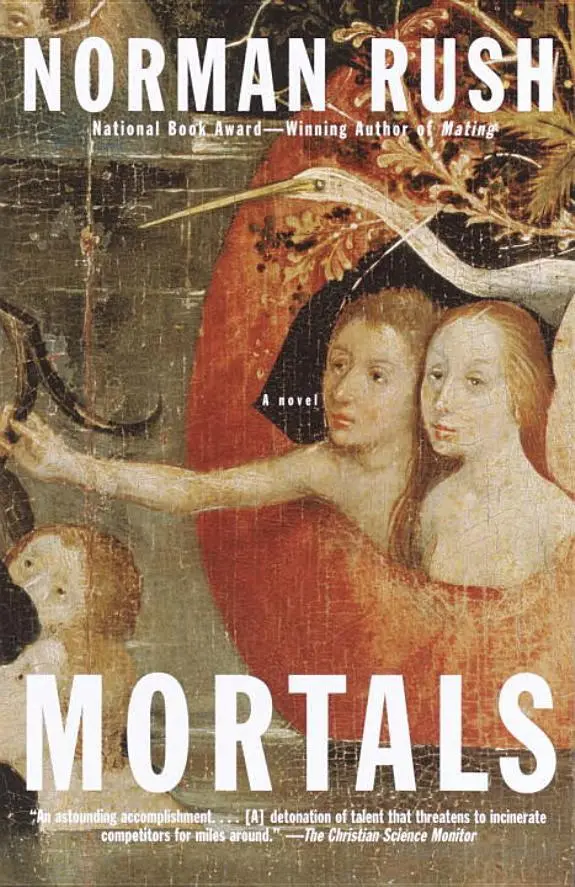
- Название:Mortals
- Автор:
- Издательство:Vintage Books
- Жанр:
- Год:2003
- ISBN:9780307789365
- Рейтинг книги:3 / 5. Голосов: 1
-
Избранное:Добавить в избранное
- Отзывы:
-
Ваша оценка:
Mortals: краткое содержание, описание и аннотация
Предлагаем к чтению аннотацию, описание, краткое содержание или предисловие (зависит от того, что написал сам автор книги «Mortals»). Если вы не нашли необходимую информацию о книге — напишите в комментариях, мы постараемся отыскать её.
As a spy, the compulsively literate Ray ought to have no trouble confirming his suspicions. But there’s the distraction of actual spying. Most of all, there’s the problem of love, which Norman Rush anatomizes in all its hopeless splendor in a novel that would have delighted Milton, Nabokov, and Graham Greene.
Mortals — читать онлайн бесплатно полную книгу (весь текст) целиком
Ниже представлен текст книги, разбитый по страницам. Система сохранения места последней прочитанной страницы, позволяет с удобством читать онлайн бесплатно книгу «Mortals», без необходимости каждый раз заново искать на чём Вы остановились. Поставьте закладку, и сможете в любой момент перейти на страницу, на которой закончили чтение.
Интервал:
Закладка:
“It just never arose. It’s ancient history. Look . Look, it was during the First World War, for God’s sake, and there was a lot of feeling against Germans, so my grandfather decided to change the family name.”
“Germans?”
“Yes of course.”
“Well I thought Fisch was a Jewish name.”
“No it was because we were German , Iris. And then when the Lindbergh baby was kidnapped there was a Fisch involved in that, so my grandfather had to consider it a doubly good idea.”
“Your brother obviously thinks it’s a Jewish name. He says you’re Jewish, or half or some part.”
“Well, a perfect example of my brother’s nonsense. Look, and may I add that by the time Hitler came along, they were very glad to be Finch, I would guess, with what Hitler did for being German.”
“You’re saying the family was never Jewish?”
“Never, so far as I know. Fisch is a common German name. It can be Jewish, of course. But we weren’t. The family is from Stuttgart.”
“Your brother is so convinced.”
“My mother has whatever papers there are, if you want, you can follow it up. But Rex says things just for effect, you know, Iris.”
“It would be interesting if you were Jewish, Rex.”
“Look, if it’s interesting to you, then get in touch with my mother. If there are any papers, she has them, so get in touch with her . Take up genealogy. You might enjoy it.”
He said, “I’m sorry. I am not testy about this, in fact. I’m just not interested in it. If you want to pursue it, fine with me.”
“You are testy, so forget it.”
“No I’m not. It’s just that life, now with the assistance of my dear brother, is presenting me with more tasks than I can currently shake a stick at. This is Rex getting attention, Iris. You know the line ‘Family I hate you’?”
“Yes, Ezra Pound.”
“You mean I’ve quoted it to you before?”
“Yes, and we discussed it. I don’t admire Ezra Pound. And I don’t admire the sentiment. I know things about your brother that are pitiful.”
“I have a feeling you’re going to share, as they say.”
She looked pityingly at him, and said, “I intend to. There are certain things you have to do …”
A sudden impulse to break secrecy startled him. He fiercely wanted to tell her something he had learned about Boyle that he shouldn’t tell her. Probably it was to get sympathy. There were heavy movements going on behind the scenery. There was some very unusual conferencing taking place. Things were abnormal, or getting to be. The agency was going to do something instead of sitting there collecting data forever. He could tell. He didn’t like it. He was about to break secrecy, in a minor way only, really. He wanted to.
He said, “I want to tell you something funny about Boyle, Iris.” She looked amazed. They were both so practiced at circumlocution when it came to his work with the agency that what he was saying felt major to her, obviously.
He went ahead. I am not thinking, he thought.
“This is Boyle for you.
“There are certain times when the chief of station may have to call all his actors together into one conference, to get at something, to fix something, to stop something from happening that it’s urgent to stop.
“These are called action inquests or operation inquests, if they’re taking place after the fact, or called just, well, plenaries, if they’re for preemptive emergencies.” There was no need for him to offer technical terms. But he felt like it.
“By his actors, I mean the whole range of operatives, from contract agents like me to staff members, officers, to various special short-term contract parties, informants, occasionally. Now of course the key thing, a key thing, is to preserve internal ignorance about who is working for the agency. The actors are supposed to know who their boss is, no more than that.
“Now in a very large station there are sophisticated ways of planning things and maintaining general anonymity, using high tech. You can convene and deliberate and get what you want and nobody finds out who the next guy is. But in smaller stations, it’s a lot more difficult. As you can imagine.
“So Boyle had a situation come up in Central America. Namely Guatemala. He was new in the post. The technology was out of commission for some reason. And this need arose. So Boyle improvised. He found a venue and called a plenary and got his thirty or forty actors in one room, with every one of them wearing a paper bag over his or her head, with eyeholes and mouth holes cut into them, and Boyle presiding and shouting out to them to press the mouth holes tight across their faces so that words were not muffled up in these bags. And there were numbers on the foreheads of the bags, so he could keep track of who was contributing.”
Ray was laughing. So was Iris.
“That is hilarious! And Ray, thank you for telling me! And I mean that. And it shows me something I didn’t know about the business you’re in. It was interesting!”
She had a grateful look, soft, he thought.
“This goes no further, of course.”
She nodded, offering a friendly, comic-mournful expression he realized he craved from her. That was better.
She took his hands across the table. “Your brother’s book, Ray.”
“I’m listening.”
“First, he’s been working on this for years. It’s huge. I’m going to do my best to describe it. The title for the whole thing is either Strange News or Bright Cities Darken …”
“Clarae urbes . He stole that from Horace.”
“What?”
“The phrase. Also Strange News is Elizabethan. Yes, it’s Thomas Nashe. The title has been used.”
“Please don’t just pour out scorn and objections before I even get two words out on this subject. Please. You don’t know how important this is.”
She went on. “It’s in four sections, Sentences, Paragraphs, Incidents, Plots, and each section contains a thousand items, that is, a thousand sentences, a thousand …”
“I get it.”
“And each item or exemplar, as he calls them, is on a separate page, so you can tell how many reams of paper you were hauling around.”
“No wonder my knee hurts. That’s a joke. May I ask a question?”
“Sure.”
“A sentence on a single page, a paragraph …? Can you explain what that’s about?”
“Well, as I understand it, it’s so you absorb, in a complete way, the particular item on the page, really take it in. He described the book in various ways, but mostly he described it as an anatomy. And he was explicit that I should tell you that it was not , was not just faits divers , you would know what that means. I can tell you what he told me it means …”
“I know what it means.”
“Every individual element is numbered, but the numbers don’t mean anything. What I understood him to say was that they were just numbers. He also described the book as a machine and also as a game, or was it that there’s a game buried in it? Can’t remember.”
“It’s a machine to destroy my spare time, what little I have. Machine is right.”
“It’s so hard to remember everything he said. Oh, one was that you shouldn’t start reading this with the idea that it’s some kind of Commonplace Book. It isn’t. Nothing is from other books. It’s all real, from letters, overheard items, his observations, stupid things said in the media. There are very few names. There are initials, mostly, where they’re needed. He said you would recognize some of the people and incidents. Don’t groan like that. Some of the items are from his childhood. He said he’s been working on it all his life, but not knowing it until he got into his twenties.
Читать дальшеИнтервал:
Закладка:
Похожие книги на «Mortals»
Представляем Вашему вниманию похожие книги на «Mortals» списком для выбора. Мы отобрали схожую по названию и смыслу литературу в надежде предоставить читателям больше вариантов отыскать новые, интересные, ещё непрочитанные произведения.






Обсуждение, отзывы о книге «Mortals» и просто собственные мнения читателей. Оставьте ваши комментарии, напишите, что Вы думаете о произведении, его смысле или главных героях. Укажите что конкретно понравилось, а что нет, и почему Вы так считаете.