Norman Rush - Mortals
Здесь есть возможность читать онлайн «Norman Rush - Mortals» весь текст электронной книги совершенно бесплатно (целиком полную версию без сокращений). В некоторых случаях можно слушать аудио, скачать через торрент в формате fb2 и присутствует краткое содержание. Год выпуска: 2003, ISBN: 2003, Издательство: Vintage Books, Жанр: Современная проза, на английском языке. Описание произведения, (предисловие) а так же отзывы посетителей доступны на портале библиотеки ЛибКат.
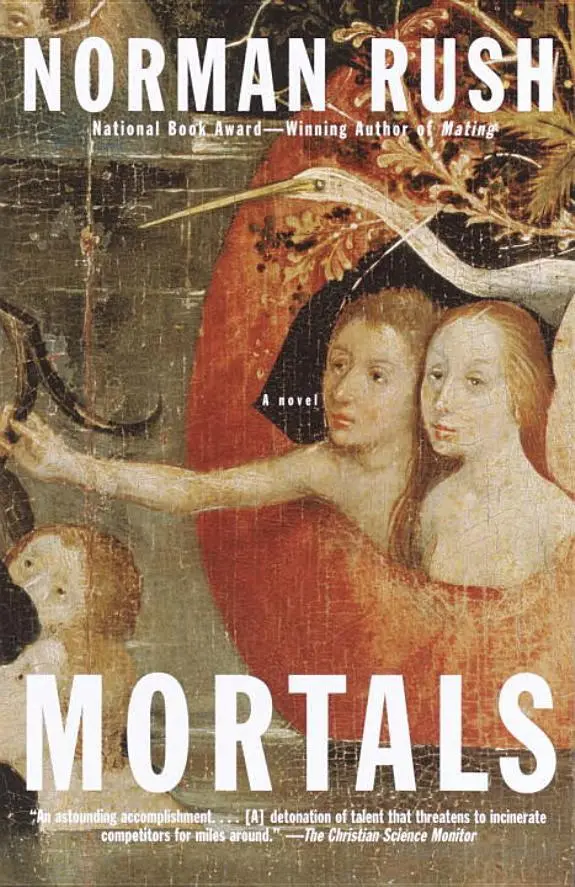
- Название:Mortals
- Автор:
- Издательство:Vintage Books
- Жанр:
- Год:2003
- ISBN:9780307789365
- Рейтинг книги:3 / 5. Голосов: 1
-
Избранное:Добавить в избранное
- Отзывы:
-
Ваша оценка:
Mortals: краткое содержание, описание и аннотация
Предлагаем к чтению аннотацию, описание, краткое содержание или предисловие (зависит от того, что написал сам автор книги «Mortals»). Если вы не нашли необходимую информацию о книге — напишите в комментариях, мы постараемся отыскать её.
As a spy, the compulsively literate Ray ought to have no trouble confirming his suspicions. But there’s the distraction of actual spying. Most of all, there’s the problem of love, which Norman Rush anatomizes in all its hopeless splendor in a novel that would have delighted Milton, Nabokov, and Graham Greene.
Mortals — читать онлайн бесплатно полную книгу (весь текст) целиком
Ниже представлен текст книги, разбитый по страницам. Система сохранения места последней прочитанной страницы, позволяет с удобством читать онлайн бесплатно книгу «Mortals», без необходимости каждый раз заново искать на чём Вы остановились. Поставьте закладку, и сможете в любой момент перейти на страницу, на которой закончили чтение.
Интервал:
Закладка:
“And then you hardly seemed pleased about the situation in Africa, where the rate of conversion is the highest in the world and going up all the time and more than making up for the denominational declines in Europe, and where two beasts, the Christian beast and the Muslim beast, are fighting to see which can eat the most Africans before dark. Because the darkness is coming. Is coming.
“And I explained how faith is a toxin, a peculiar and dangerous toxin because even in dilution it waits in the blood to blaze back into madness under the right conditions of fear and trembling. In its most virulent forms, it prevents the host from knowing that it is going to die, to die forever , that the host is a dying animal, that we are merely mortals, and that death is our common fate, the fact of life that should make brothers and sisters of us all. And I tried to show you how even in dilution religion addles and undoes our ability to see death, how even in dilution it sweetens death, allows it to be denied, allows the deaths of others to be made casual.”
Morel paused. “Our task is to do everything, in a way. Too bad, but we may just have to do everything. Too bad for us, but unless we bring free minds to the work of renewing the world, keeping our minds fixed on death and the disguises death puts on, we will raise up a new hell, like Russia where they closed the churches and made the state their god. We must say no gods. None.
“And be sure to remember that the great architects of injustice in Russia were products of centuries of Christian processing, beginning with the seminarian Joseph Stalin. Hitler always considered himself a good Catholic, despite the superficial pagan paraphernalia he held up in front of the German people for a while, and the good soldiers who did his filthy work were as Christian as you could ask for.
“And before you or anyone begins about the mission schools and hospitals … and they are worthy, okay, and you may want to say, well, these people are good, they are saving our lives, how can you argue? Which would mean that we should be quiet on this subject. But I am telling you to see the matter whole .
“Here is a picture. You conquer a country and give the vanquished a clinic. Look around Africa and see if this seems familiar to you. No, conquer a country and then give it a clinic, and oh, also some mission schools , and some Christian bookstores to pump out cheap Bibles to change the children of the land into Christians. The conquerors in this continent and in South America and in my own country came pushing their crosses ahead of them.
“Look, go deep inside yourself, Kerekang. We have been tainted at the deepest levels, deep in the foundations of our minds. Say a man lives his life without regard to faith, as he thinks. But he hasn’t gone deep enough, because to his surprise, when he falters, lo, here it comes, a deathbed conversion. I could keep us here all night with the history of deathbed conversions, amazing ones. A great poet writes Loss of faith is growth and the next thing you know he’s beckoning the priests to his deathbed. We are penetrated with it. It works invisibly and insensibly to direct our accommodation with the world’s evils. God help us!
“Belief is like this … It falls into three types and I ask you to tell me which kind of faith is more dangerous than the other.
“We begin with any society saturated with belief. I’m talking generically. What types of believers do you have? First, the devout, who believe everything up and down and in and out. They make us despair. In Kenya the devout bring death to the sick because the word condom shall not be spoken aloud, on the radio, anywhere. The same in Zimbabwe, with the fine Roman Catholic prime minister nodding yes in the corner. So let that stand as an example for us of a contribution by the devout.
“So then, the next type, the hypocrite, who believes only in himself but who pretends to believe in scripture and uses the blindness of genuine believers to satisfy his own desires. No need to say much about them and the harm they do.
“Ah but then we come to, what shall we call them, the half-believers, like the bulk of the British, the ones who say let the little ones believe that their classmate who jumped off London Bridge is in heaven and happy. Or like the half-believers who say it won’t hurt to have children mumble the Lord’s Prayer every day in school, if they do it under their breath. Which brings us to the half-believer at his most dangerous, the character who begins to feel inwardly that his beliefs are untrue but who cannot bear that feeling and who sets out to perform feats of loyalty to convince himself that he must in fact believe, like killing a doctor who gives women abortions. As their belief weakens they become terrors of the earth, mesmerizing themselves with acts that plunge them into peril, that spread ruin everywhere. They convince themselves through their transgressions that they must, in fact, be believers.
“In America the beautiful, in the mountain West, you have armed madness of just this type. They are under the odd impression that Jews … the ancient enemies of God, according to lying Christian scripture … control the federal government. Therefore government officers are limbs of Satan and therefore appropriate targets. We have already had one president of the country rambling on about the Second Coming. All these types, through the normal workings of the democratic system, are percolating up into positions of power, more and more of them.
“Listen to me, all of you! Do you love Africa? Then let me ask all of you why Africa must be the greatest nursery of fools in the entire world. They are all here, all the churches, and you say we should allow it, no matata you say. Africans fought honorably against the Christian mental slavers, and for a hundred years the external churches were wringing their hands in disappointment at how little progress they were making. But they were relentless, and now they are back in force, with their radio nonsense, their cassettes, technology taken from the science they tried for so long to strangle. Turn on the radio and turn the dial and see how hard it is to find a spot where the moruti are not droning and droning and …”
“Baruti. Baruti.” Someone was correcting Morel. He had used the singular for preacher when what he wanted was the plural.
“Baruti, I meant. Thank you. Always correct me.”
After a pause, he began again. He was losing control over the pleading note in his voice. Ray didn’t like to hear it, for some reason.
“Rra, Kerekang my man, listen to me. I think I’m failing you. I don’t want to. I need to give you the essence, again. I think. Themba, I apologize for taking the floor like this, really. But I have to give you the essence …
“The essence is … is not just the misdirection of human effort, huge huge misdirection of human effort, you get with religion. That’s a consequence of it, and you understand that. It’s everywhere. It’s going to the stadium to pray for rain instead of putting the unemployed to work digging the system of underground cisterns that would make this country droughtproof, virtually — according to the author of the scheme who is sitting right here and who cannot for the life of him get a hearing from government, you yourself, my man.”
Ray knew about that. Kerekang had tried to interest the government in some grandiose self-help project copying the ancient Persian system of linked water-harvesting underground reservoirs, qanats — Ray even remembered what they were called, to his own surprise. Kerekang had presented the scheme as something that could be scaled up or down as much as anyone pleased. He wanted these qanats dug, and he wanted every roof and threshing floor in the country reconstructed for rain capture. No question he was right about the labor for it being there, floating around unused. That Ray conceded. Unused labor power was something that drove Kerekang into frenzies. He wanted to take a megaphone and organize the idle into corvées, immediately. He had been ridiculed over it, in the government paper, caricatured in just that way. The campaign against him had been merciless. Domkrag was seeing Kerekang as an irritant, someone whose objections to social conditions meant more than the rare criticisms coming from the official opposition or the Botswana Social Front, with its discredited cadres of hacks and scoundrels and windbags.
Читать дальшеИнтервал:
Закладка:
Похожие книги на «Mortals»
Представляем Вашему вниманию похожие книги на «Mortals» списком для выбора. Мы отобрали схожую по названию и смыслу литературу в надежде предоставить читателям больше вариантов отыскать новые, интересные, ещё непрочитанные произведения.






Обсуждение, отзывы о книге «Mortals» и просто собственные мнения читателей. Оставьте ваши комментарии, напишите, что Вы думаете о произведении, его смысле или главных героях. Укажите что конкретно понравилось, а что нет, и почему Вы так считаете.