Norman Rush - Mortals
Здесь есть возможность читать онлайн «Norman Rush - Mortals» весь текст электронной книги совершенно бесплатно (целиком полную версию без сокращений). В некоторых случаях можно слушать аудио, скачать через торрент в формате fb2 и присутствует краткое содержание. Год выпуска: 2003, ISBN: 2003, Издательство: Vintage Books, Жанр: Современная проза, на английском языке. Описание произведения, (предисловие) а так же отзывы посетителей доступны на портале библиотеки ЛибКат.
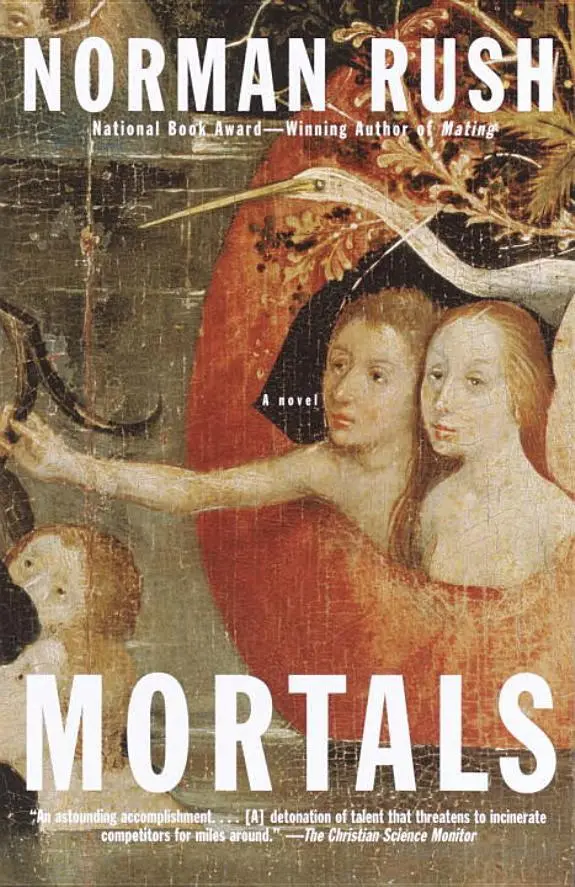
- Название:Mortals
- Автор:
- Издательство:Vintage Books
- Жанр:
- Год:2003
- ISBN:9780307789365
- Рейтинг книги:3 / 5. Голосов: 1
-
Избранное:Добавить в избранное
- Отзывы:
-
Ваша оценка:
Mortals: краткое содержание, описание и аннотация
Предлагаем к чтению аннотацию, описание, краткое содержание или предисловие (зависит от того, что написал сам автор книги «Mortals»). Если вы не нашли необходимую информацию о книге — напишите в комментариях, мы постараемся отыскать её.
As a spy, the compulsively literate Ray ought to have no trouble confirming his suspicions. But there’s the distraction of actual spying. Most of all, there’s the problem of love, which Norman Rush anatomizes in all its hopeless splendor in a novel that would have delighted Milton, Nabokov, and Graham Greene.
Mortals — читать онлайн бесплатно полную книгу (весь текст) целиком
Ниже представлен текст книги, разбитый по страницам. Система сохранения места последней прочитанной страницы, позволяет с удобством читать онлайн бесплатно книгу «Mortals», без необходимости каждый раз заново искать на чём Вы остановились. Поставьте закладку, и сможете в любой момент перейти на страницу, на которой закончили чтение.
Интервал:
Закладка:
“Jesus makes a new package. He proposes to take the satisfaction God got from the regular observers of Torah, their routine piety, and add to that the emunah of the sinners and the screwed, trapped in their situations for one reason or another, and create a blaze of feeling that would surely rouse God to action, especially when he added to the mix his own personal performance of absolute trust … which he was clearly contriving to happen … in the form of placing himself in peril of death.
“I need to stop. And so, well, the point has been made. I keep thinking of things to add. Make yourself as miserable as a child in distress, preferably a male child. Restrictions on the presence of women at groveling services used to be practically universal. You can search the scriptures until you go blind and never encounter the phrase daughter of God once. By the way, if you’re a Hindu, a gift you can bring to the goddess Devi is sleepiness. Certain rituals you attend in a sleep-deprived state because of course what could stir the attention of a patrimorph or matrimorph for that matter more than the sight of a sleepy baby? So. Make yourself miserable, gash yourself, mortify yourself, lick up crumbs of the host off the floor like the Jansenists, sleep on a plank, wear a hair shirt. Poor babies!
“About women, though … You know, look around, so far we have no women with us in this work. But that will change. There is … I have a woman I think is ready. Or soon will be. I think so. Gosiame, we can eat now.”
Ray wanted to hit the tape player. He turned the machine off, his hands shaking. What woman? he thought.
What woman was Morel talking about? Who was she? Had this gotten past him the first time he’d listened to the tape? What woman was he talking about?
He got up and began pacing around the house. The possibility that Morel was referring to Iris was outrageous, making Iris a priestess of reason or whatever they called it, irreligion?
He decided it had to be a Motswana woman, but who?
That wasn’t it. He knew it wasn’t. He wanted to demolish something.
He went into the bathroom and sorted through the painkillers until he found the ones with codeine, which he took three of. That was the best thing about Africa, the paracetamol and the other preparations loaded with codeine you could get over the counter.
He pushed his shorts down and sat on the toilet to urinate. His legs were weak. He had never urinated sitting down except as an adjunct act, in his whole life, he believed.
He was remote from Morel’s arguments, completely. He wondered what that meant. Morel was passionate about his theories, his discoveries, obviously and to say the least.
But he himself had gone through these questions a long time ago and reached conclusions and moved on to other things. That was what he wanted to think. But he suspected that the truth of it was that he hadn’t considered the questions Morel was raising. How much truth there was in one side versus the other was presumably important. There was his hatred of Morel and that was real. But the rest of it was not real to him. It was taking place behind thick glass.
Some complex process he was no longer interested in had disposed him to be where he was and doing what he was doing and, on the whole, feeling okay about it. If he wanted to, he could feel slightly bemused at finding himself cast as some sort of defender of the faith, surrounded by passionate questioners eagerly biting away at the pillars of regular life. The idea of going down, down into the foundations of life and X-raying the historical accidents that had led to a world not completely satisfactory was unreasonable to him. It made him tired.
His attention was on the foreground, where it had to be. It was where he lived. Anyway it was a luxury to be able to devote yourself like Morel to hermeneutic orgies, not bad as a term for what Morel was doing. Resnick would appreciate the phrase, but nobody else.
The fact was that he had his own life to save, his and Iris’s. That was it. That was it. That was all there was.
…
He had come almost to the part he wanted to hear again, urgently, the rebellion. It was simple to follow. There were only two voices, Kerekang first and Morel second and then in unbroken alternation like that to the end. What was nice about it, apart from the drama, was that it had been unexpected. We love the unexpected, he thought. There was no question his own aversion to boredom was abnormally high and that this aversion explained a lot of the attraction that working for the agency held for him. Justifying working for the agency was turning into a compulsion, lately, and he resented it. Still, it was true that boredom kills. When he looked around at what others did for a living he felt like a Martian.
He wanted to be sharp for this. The pills were making him vibrate. They were Iris’s pills. He was used to having to make a case for taking them. It was a comic ritual. She knew he only proposed taking them so he could get sympathy for a particularly bad headache. He could perfectly well take them without saying anything. It was a ritual. We need rituals, he thought. Morel was blind.
He was fast-forwarding and rewinding, searching for the exact beginning of Kerekang’s eruption, which followed Morel’s rather sneering deconstruction of the Sermon on the Mount. Apparently there was nothing to be said for it at all, and the bulk of it was retroactive ventriloquism from parties unknown, followers of Paul. He had to admit he had learned something in the interesting-if-true category, to the effect that the true reason the Lord’s Prayer had been commended to believers was for its brevity. The idea was not to go on with the long, rambling, free-form prayers characteristic of traditional Jewish worship and also of the pagans. And the deeper idea, in line with the rest of Morel’s analysis of the original religion of Jesus as a scheme to trick and flatter God, was to avoid irritating him with lengthy petitions in consideration of the fact that he already knew what everybody wanted, being omniscient. So it was about brevity. But there was something peculiar about Morel’s approach to spreading irreligion in Botswana. He could use some advice. Ray had an opinion about Morel’s standpoint. Morel was being pretty cavalier about actually existing Christianity, the living varieties of the beliefs that people today were bothering to adhere to. It was as if, after proving to his own satisfaction that the original ideas of Jesus constituted a fantasy form of Jewish fundamentalism, that that was enough, should be enough for anybody. The subsequent misappropriations and misconstruings of these original ideas, which turned into Christianity in all its branches, seemed not to be of interest to him. Where were the Trinity and sacerdotal celibacy, what have you, auricular confession, full or partial immersion? It was these misappropriations and misunderstandings and the denominations built around them that were now front and center, on any sensible view of the matter. Yet Morel seemed to be ignoring the beliefs of live, walking-around Christians, in all their particularities. Although maybe that would come later, in other presentations. Here was Kerekang, with his fine voice, his inflections showing his long exposure to British English.
“Rra, yah, you see, I did not wish to speak. But I feel I must, if I may. If my brother Themba says go, and if you won’t mind it, rra.”
“Of course. For sure. This is what we like.”
“And does my brother Themba say I may go, as well?”
“Themba says fine.”
“So then, rra … all you have said may be very true, I think, as to the thoughts of Jesus. I can believe you are right.”
“Well, thanks, my brother. I appreciate that. Of course the general idea of what religion is I take from Freud … ‘God is an exalted father, nothing more.’ So I am in his shadow, and unfortunately he didn’t know how much stronger his interpretation would have been if he had fully appreciated neoteny, this period of helplessness we experience in infancy. And Freud went off the track in many silly ways, it has to be said. But when I apply this basic truth, God as an exalted father, to the history of Christianity, I get a certain result.”
Читать дальшеИнтервал:
Закладка:
Похожие книги на «Mortals»
Представляем Вашему вниманию похожие книги на «Mortals» списком для выбора. Мы отобрали схожую по названию и смыслу литературу в надежде предоставить читателям больше вариантов отыскать новые, интересные, ещё непрочитанные произведения.






Обсуждение, отзывы о книге «Mortals» и просто собственные мнения читателей. Оставьте ваши комментарии, напишите, что Вы думаете о произведении, его смысле или главных героях. Укажите что конкретно понравилось, а что нет, и почему Вы так считаете.