Norman Rush - Mortals
Здесь есть возможность читать онлайн «Norman Rush - Mortals» весь текст электронной книги совершенно бесплатно (целиком полную версию без сокращений). В некоторых случаях можно слушать аудио, скачать через торрент в формате fb2 и присутствует краткое содержание. Год выпуска: 2003, ISBN: 2003, Издательство: Vintage Books, Жанр: Современная проза, на английском языке. Описание произведения, (предисловие) а так же отзывы посетителей доступны на портале библиотеки ЛибКат.
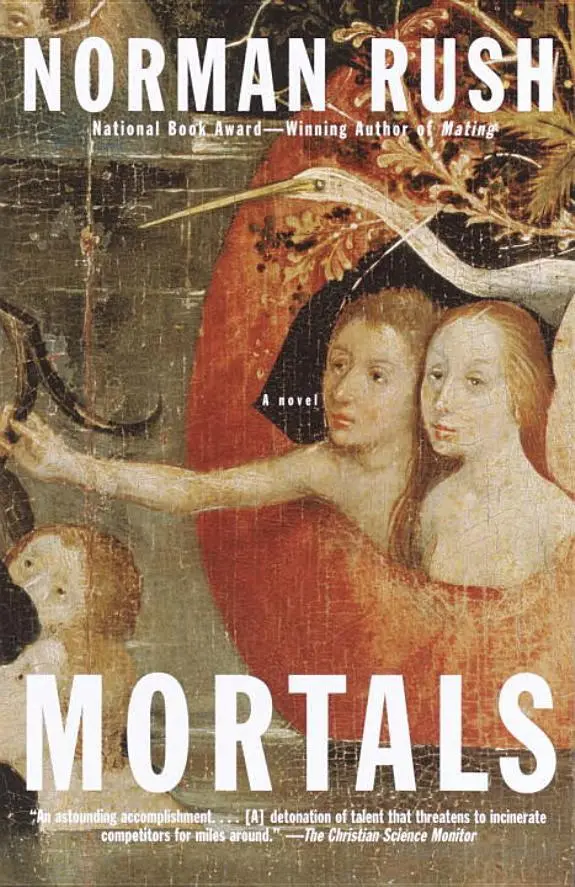
- Название:Mortals
- Автор:
- Издательство:Vintage Books
- Жанр:
- Год:2003
- ISBN:9780307789365
- Рейтинг книги:3 / 5. Голосов: 1
-
Избранное:Добавить в избранное
- Отзывы:
-
Ваша оценка:
Mortals: краткое содержание, описание и аннотация
Предлагаем к чтению аннотацию, описание, краткое содержание или предисловие (зависит от того, что написал сам автор книги «Mortals»). Если вы не нашли необходимую информацию о книге — напишите в комментариях, мы постараемся отыскать её.
As a spy, the compulsively literate Ray ought to have no trouble confirming his suspicions. But there’s the distraction of actual spying. Most of all, there’s the problem of love, which Norman Rush anatomizes in all its hopeless splendor in a novel that would have delighted Milton, Nabokov, and Graham Greene.
Mortals — читать онлайн бесплатно полную книгу (весь текст) целиком
Ниже представлен текст книги, разбитый по страницам. Система сохранения места последней прочитанной страницы, позволяет с удобством читать онлайн бесплатно книгу «Mortals», без необходимости каждый раз заново искать на чём Вы остановились. Поставьте закладку, и сможете в любой момент перейти на страницу, на которой закончили чтение.
Интервал:
Закладка:
“Emunah! We must make ourselves call things by their right names, comrades. If you were asked to come into a church so that you might join others in groveling, would you go in? No, but if they call it worship, you go.
“Now once we can see that the whole work of Jesus was this campaign to pump up eruptions of emunah, we can then see that it must follow that, correctly considered, there is no moral instruction to be gotten from his message, from his original message. Jesus tells those who would truly follow him that their duties to him, their duties to emulate him, are greater than, for example, their most sacred duties to their parents, such as burying them speedily when they die.
“What we see out of all this is that every act you must do is instrumental. No good act is done for its own sake, because it is good. None. Not one . Every act is done to flatter and arouse the imaginary father to descend to earth! No, more exactly, every act is an attempt to shame God into taking action. Jesus knows God’s jealous and murderous and capricious side, his murderous vanity even when it comes to his closest servants. He punishes his beloved agent Moses with death over some insanely minor shortcoming, depriving him of the privilege of entering the promised land with the people he has led through the wilderness for forty years. Jesus knows all about God. And he knows perfectly well also that God’s acts of benefit are for the most part generic, as in letting the sun shine for all and sundry, while his enmity is specific, personal in a way, and often petty, as when he condemns to death some perfectly nice Jewish children for the sin of teasing Elijah about being bald, as we discussed. He has them eaten up by a bear! He is a jealous God. He says so himself. Jesus knows. He knows God sent the serpent.
“No, this emunah … ah we are so pathetic … no one more than Jesus himself. So here is the task he has given to himself …
“On the one hand it is to trick God into acting by calling up surges of unsustainable piety. And on the other hand it is to trick the people into feats of piety by misrepresenting God as an angel of goodness and loving kindness. The sleight of hand Jesus performs is everywhere. Look closely! He deceives even himself as he goes on about love and forbearance, devising to trick God downstairs through acts of organized innocence, get him to come downstairs and crush the shit out of the enemies of the Jews . Through the weakness and need of his people God will be induced to crush not only the Roman oppressors but also the bad Jews who doubted the message of Jesus .
“He is secretive, this Jesus. He is Prometheus, in what he attempts.
“His evasions are stupendous. He calls men to imitate God, the famous Imitatio Dei we spoke about. The sheep in the churches nod and think this is fine, this must be ethics. But look closely. Jesus says be like God in performing feats of giving and forbearance and ask nothing in return , expect no compensation. But this is not like God at all. God requires . God will forgive your debts only if you forgive the debts of others. There is nothing unconditional here. God is famous, notorious , for laying down conditions — ask Lot’s wife. God is continually setting out conditions, a chief one being, and you can find it in his dealings with Abraham and Job, never question my motives . What does ‘Judge not, lest ye be judged’ mean? It means imitate God only in those ways that do not intrude on God’s power to judge and punish. Leave the punishing to Daddy God. It would be arrogant not to, because God likes to punish , consign people to hell or misfortune for their shortcomings. Making judgments is the province of adults, and if God is to like us enough to come downstairs, we must remain as children. ‘God loves a terrified face,’ it says in the Psalms.
“This is a God who loves deals, covenants, all of that. No, the famous Imitatio Dei is a confidence trick, another one, to flatter God that you are acting as he, in his sunnier moments, may, at times.
“This is a complete story , let us never forget, from beginning to end it’s all there.
“The story of Jesus the Jew is the story of an experiment in mystical mass psychology that fails . It fails . It is a complete story whose end features the disciples of Jesus denying him, and running away, and he himself, the poor man, asking Yahweh why he has forsaken him, why he has not come downstairs, alas, alas. Eloi, Eloi, lama sabachthani? are the hardest words to hear. The author of the experiment is being tortured to death and he says My God, my God, why hast thou forsaken me? And then he dies. That’s it.
“I am sure it went, with poor Jesus, after his time with poor John the Baptist, what more can we do , we Jews? Well, we can be children, we can be worms, we can be spat on, hit, we can double the length of the errands the Romans require us to run, we can be pathetic …
“Well, I have to stop because … I have to stop …
“But let me not stop until I point out how perfectly and how completely this embarrassing experiment represents the falling back into childishness we find at the heart of every religion. I won’t go into it right now, but there are three ways to get salvation if you’re a Hindu, and one of the ways is through bakhti, which is identical with the emunah of Jesus the Jew. Do you understand that this falling back is universal , in religions? Take fasting. You approach God with your stomach rumbling, how could a father not help? Celibacy. What a good idea. Make yourself presexual, just like a baby. Shave your head, like the Buddhist nuns and monks. Be as bald as a baby. In both Matthew and Mark, remember, we are given to understand that in the resurrected state we take neither husband nor wife, but live sexless, like angels. Rending garments is a good idea! … an ill-clad child will move God’s heart. Shrink yourself up when you approach God, make yourself as small as a child, lower your head, your eyes, fall on your knees. Speak in tongues! Nice idea. God might think you’re babbling like a baby. Adorable idea. And be sure not to approach any venue God might inhabit if you are less than perfectly clean. A soiled child does not delight a father. Slaughter your best cows, put the first best part of the harvest right there on the altar, and be sure to be mournful, be bereft, as you do this, because what God needs is not the soul of another cow or the perfume of a sheaf of wheat you just cut … no, it’s the misery that parting with these goods makes you feel. And remember, only the best for our maker, only unblemished doves, only the best. God savors your misery, not the smell of roasting kine. God has everything already. By definition. And burnt offerings , by the way, is yet one more piece of priestly trickery, because nicely roasted would be more like it, and because the priests got fine dining out of the offerings until there was a fuss about it and more got distributed outside the temple, but that’s another story.
“Jesus was an innovator. The emunah rising up to God through the conduit of the temple during regular sacrificial ceremonies was not enough, obviously. Now keep firmly in your mind the difference between John the Baptist’s teshuvah, repentance, which accompanied the act of sacrifice, and Jesus’s emunah, childish love and awe. Teshuvah was not enough. Teshuvah was saying you were sorry and wouldn’t do it again if you could help it. But emunah is consciousness of weakness, including weaknesses leading to sin, while you are going on about things , even repeating bad acts like collecting taxes for the Romans and occasionally overindulging, going on, but at least feeling rotten and low about it.
Читать дальшеИнтервал:
Закладка:
Похожие книги на «Mortals»
Представляем Вашему вниманию похожие книги на «Mortals» списком для выбора. Мы отобрали схожую по названию и смыслу литературу в надежде предоставить читателям больше вариантов отыскать новые, интересные, ещё непрочитанные произведения.









Обсуждение, отзывы о книге «Mortals» и просто собственные мнения читателей. Оставьте ваши комментарии, напишите, что Вы думаете о произведении, его смысле или главных героях. Укажите что конкретно понравилось, а что нет, и почему Вы так считаете.