Norman Rush - Mortals
Здесь есть возможность читать онлайн «Norman Rush - Mortals» весь текст электронной книги совершенно бесплатно (целиком полную версию без сокращений). В некоторых случаях можно слушать аудио, скачать через торрент в формате fb2 и присутствует краткое содержание. Год выпуска: 2003, ISBN: 2003, Издательство: Vintage Books, Жанр: Современная проза, на английском языке. Описание произведения, (предисловие) а так же отзывы посетителей доступны на портале библиотеки ЛибКат.
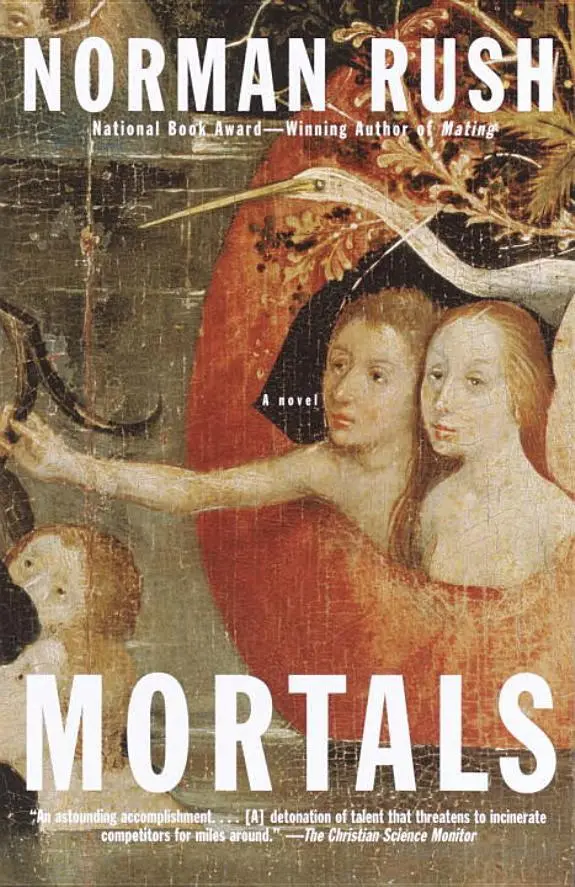
- Название:Mortals
- Автор:
- Издательство:Vintage Books
- Жанр:
- Год:2003
- ISBN:9780307789365
- Рейтинг книги:3 / 5. Голосов: 1
-
Избранное:Добавить в избранное
- Отзывы:
-
Ваша оценка:
Mortals: краткое содержание, описание и аннотация
Предлагаем к чтению аннотацию, описание, краткое содержание или предисловие (зависит от того, что написал сам автор книги «Mortals»). Если вы не нашли необходимую информацию о книге — напишите в комментариях, мы постараемся отыскать её.
As a spy, the compulsively literate Ray ought to have no trouble confirming his suspicions. But there’s the distraction of actual spying. Most of all, there’s the problem of love, which Norman Rush anatomizes in all its hopeless splendor in a novel that would have delighted Milton, Nabokov, and Graham Greene.
Mortals — читать онлайн бесплатно полную книгу (весь текст) целиком
Ниже представлен текст книги, разбитый по страницам. Система сохранения места последней прочитанной страницы, позволяет с удобством читать онлайн бесплатно книгу «Mortals», без необходимости каждый раз заново искать на чём Вы остановились. Поставьте закладку, и сможете в любой момент перейти на страницу, на которой закончили чтение.
Интервал:
Закладка:
Iris was herself in the few words she spoke to Morel next. There was nothing guarded that Ray could see. They seemed to be coming to a standstill too soon for Ray. He wanted the exchange to continue a little longer.
Ray said, “That man was a bishop, in case you didn’t know.”
“A bishop?”
“In one of the Zed CC splinter churches.”
Morel had a good but not great voice, tending toward tenor. Stress was probably driving his pitch higher. His speech was accentless, purified. The man could be a radio announcer.
“He got upset with me. He even … I think this happened … not sure. I think I was referred to as the Antichrist. I think. Not directly but to some of his people.”
Comma Lesole came forward to verify what Morel had said. “In fact, he says you are, very much.”
“This is more than I deserve,” Morel said, shaping his tone for Iris and Ray.
The ambassador’s wife was suddenly striding toward them, making scooping motions to urge them toward the buffet, to Ray’s disappointment. He wanted more time with Morel. There was more to see in him. And what he wanted to see was the hardest thing there was to see and be sure about. He wanted to see, to know, if Morel was a settled man. It was his own term. A settled man meant something different than a True Man. A settled man was … a sound man. Applying the category to Morel was difficult for him. He wanted to know how he, himself, would fare if comparisons were ever to be made between them in that category. And beyond that, he wanted to know what kind of man Morel would be for Iris, to Iris, if the unthinkable happened. A settled man could still be an enemy.
They were moving toward the buffet. He could mention the Antichrist matter, if he did a supplement, except that he had his doubts about whether it had really been said. He felt it was likelier that Morel had said that the bishop’s notion about bogwadi amounted to a calumny against innocent women and that it was un-Christian to falsely condemn them and that the bishop’s reply to Morel had been misconstrued by Comma. Although he could be wrong. African Christians tended to be fairly promiscuous with allegations that their critics were Satans and Judases and so on.
He hoped he’d done what Iris wanted. He certainly hadn’t been able to bring himself to any sort of expression of gratitude for all that Morel had done or was doing for her, whatever that might be.
It’s a battlefield, Ray thought. Today, so far, he was winning. Surveying the scene, he felt a familiar passion flow into him, not a passion exactly but a passionate appreciation for the riches the scene held for him. It was more than just a carnival of egos to him. He knew more. He brought more knowledge of the secret histories the star egos were impaled on, usually, and the brighter the star, the more he tended to know. He liked the feeling. He couldn’t help liking it. Weigher of souls was what he said to himself when he felt he was liking this feeling too much. There was the rub. He tried to mock himself when he needed it, and there were times when he did need it, because he had to be his own critic. He had a master but no colleagues. He was alone in his work. Nobody knew the extent of this. He couldn’t have friends. He had no friends.
They had joined a queue. Morel had left, saying he’d be back shortly.
“Just eat the tomato salad,” Iris said.
“They have some kind of frikadellen that looks good,” Ray answered.
She looked pleadingly at him.
“Ray, you have no idea what’s in them.”
“I’m sure they’re fine, but if you say so.”
She worried about him. Iris was his one great friend, his sufficing friend, his pivot and anchor, all of that. She was perfect. But there was a lot he couldn’t tell her. Aside from Iris, it was fair to say that he had only enemies, or adversaries. Even his little helpers in the game were adversaries in the sense that they were there to produce as little as they could and still get paid, and he was there to induce them to produce more than they wanted for what they got. And those associations were fundamentally mercenary in any case. When it came to his family, he had only critics and adversaries. Rex was his enemy. His mother was neither friend nor enemy. He wasn’t present enough in her consciousness for her to have an attitude toward him. She had stronger feelings about the game of golf. In his opinions on Milton, in his publications, he was alone. He had no seconders. He belonged to no particular school of interpretation. Sometimes his views were objected to, briefly, and set to one side. He could deal with it. That was the world. He would like to get a closer look at Samuel Kerekang. He liked him. He felt a dim bond with him through the man’s evident love of English literature. Kerekang would inspire friendship, Ray thought. When he thought of the world as a spectacle of enemies, he tried to be resigned about it, telling himself that the lives of most men could be shown to resemble his. How unusual was it for men not to have close friends of the same sex except in the context of athletics, of team life? But even that didn’t scan. Team life was riven with rivalry, especially at the professional level. He had had a few friendly superiors in his career, the greatest of them being Marion Resnick of blessed memory. But of course that’s what Marion had been, his superior. That said it all. They had been business friends. And of course real social friendship outside of the agency had been structurally ruled out for him. The feeling of affinity that had overwhelmed him the first time he encountered Milton had been a form of friendly feeling, he supposed, but different, naturally, because Milton was dead and was alive to him only in lines of text. But he loved Milton and had recognized, with some surprise, an element of personal sympathy or pity in his feeling, part of a sense that in some way he could help Milton, help him to be better apprehended and loved. This was nonsense, but he wondered how other English specialists chose their men, chose their people, wondered if there was something like what he had just recognized, if choices were made on the flaws, certain flaws in the achievements of the artist, certain appealing flaws that you might help with. That he had been feeling sorry at some level for the sublime Milton was good for a laugh. The idea of friendship with the dead, in itself, was also good for a laugh.
They were falling back in the queue as Iris let people slip ahead. She was under the impression she was holding a place for her doctor.
“He’s not coming back for this,” Ray said.
“He said he was.”
“He also said he was fasting.”
“But then he got on line.”
“No, he let himself be put on line by Maeve, out of courtesy. That’s all. He’s not coming back.”
She looked distressed. “I thought he’d changed his mind about eating,” she said.
“Is he a vegetarian?” Ray asked.
“He favors it.”
“But is he?”
“Pretty much.”
“Does he have an explanation for the rise in age at death as populations consume more meat?”
“You want the frikadellen.”
“I’m hungry. I’m seeing white. I’m having bizarre ideation.”
“Eat whatever you want, you poor thing.”
“Remember when you said Don’t come to me when you fall over? During one of our first shall we say discussions about meat?”
“You remember my formulations when they’re simple, don’t you? They stay with you. Anything simpleminded.”
“That wasn’t simpleminded. I knew what you meant. You meant when I fell over with a heart attack.”
“The cute me. That’s what you like. That’s all right.”
Don’t come to me when you fall over dead, however she’d put it, had seemed amusing when she’d said it. His talent for making things worse was making itself felt.
Читать дальшеИнтервал:
Закладка:
Похожие книги на «Mortals»
Представляем Вашему вниманию похожие книги на «Mortals» списком для выбора. Мы отобрали схожую по названию и смыслу литературу в надежде предоставить читателям больше вариантов отыскать новые, интересные, ещё непрочитанные произведения.






Обсуждение, отзывы о книге «Mortals» и просто собственные мнения читателей. Оставьте ваши комментарии, напишите, что Вы думаете о произведении, его смысле или главных героях. Укажите что конкретно понравилось, а что нет, и почему Вы так считаете.