Norman Rush - Mortals
Здесь есть возможность читать онлайн «Norman Rush - Mortals» весь текст электронной книги совершенно бесплатно (целиком полную версию без сокращений). В некоторых случаях можно слушать аудио, скачать через торрент в формате fb2 и присутствует краткое содержание. Год выпуска: 2003, ISBN: 2003, Издательство: Vintage Books, Жанр: Современная проза, на английском языке. Описание произведения, (предисловие) а так же отзывы посетителей доступны на портале библиотеки ЛибКат.
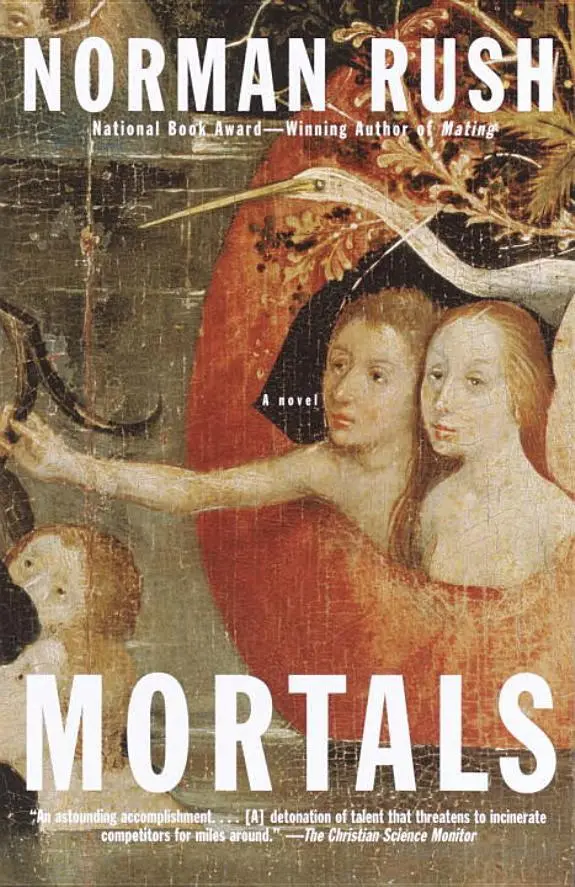
- Название:Mortals
- Автор:
- Издательство:Vintage Books
- Жанр:
- Год:2003
- ISBN:9780307789365
- Рейтинг книги:3 / 5. Голосов: 1
-
Избранное:Добавить в избранное
- Отзывы:
-
Ваша оценка:
Mortals: краткое содержание, описание и аннотация
Предлагаем к чтению аннотацию, описание, краткое содержание или предисловие (зависит от того, что написал сам автор книги «Mortals»). Если вы не нашли необходимую информацию о книге — напишите в комментариях, мы постараемся отыскать её.
As a spy, the compulsively literate Ray ought to have no trouble confirming his suspicions. But there’s the distraction of actual spying. Most of all, there’s the problem of love, which Norman Rush anatomizes in all its hopeless splendor in a novel that would have delighted Milton, Nabokov, and Graham Greene.
Mortals — читать онлайн бесплатно полную книгу (весь текст) целиком
Ниже представлен текст книги, разбитый по страницам. Система сохранения места последней прочитанной страницы, позволяет с удобством читать онлайн бесплатно книгу «Mortals», без необходимости каждый раз заново искать на чём Вы остановились. Поставьте закладку, и сможете в любой момент перейти на страницу, на которой закончили чтение.
Интервал:
Закладка:
And if he wasn’t going to go ahead and learn Setswana, it was certainly stupid of him, and also indefensible, to have pretended to Boyle that he was fluent in it. How base was it to make himself into a liar to Boyle, and how pointless was it to do it over something that didn’t actually matter to his work, to his productivity, and also how stupid was it to try to impress Boyle by claiming a skill Boyle wouldn’t have the sense to value?
Comma Lesole was there in the crowd around Morel. Comma had recently been promoted to chief of maintenance at St. James and Ray couldn’t remember if he had congratulated him or not. Guiding Iris, he moved next to Comma Lesole and touched his shoulder.
“Dumela, rra,” Ray said to him. “Can you say what this is going on about?”
“Dumela, rra, when he can stop I shall say it to you.” But he wanted to be able to listen closely for the moment.
“Very good. But the moruti is …? His name is what?”
“He is their bishop, rra. He is called Bishop Tsatsilebe and you must call him your grace every time.”
He didn’t think Iris had ever met Comma. She was going to be curious about the name. Ray wouldn’t be able to help her because he had never asked Comma why that particular name, his registered Christian name and not a nickname, had been given to him. Odd names were commonplace in Tswana town culture. Questioning people about them was gauche and stamped you as a greenhorn. You just could not overreact to the recurrent necessity to address someone you worked with as Toboggan or Judas or Substitute.
The bishop’s tone was angry. Morel was listening, but saying less and less. He was having trouble knowing when it was appropriate for him to respond. The bishop left large intervals between the points he was making, presumably to allow them to register, but the intervals were just that. A sequence of pronouncements was in progress and the bishop was making it plain that Morel’s attempts to respond to each point were premature and unwelcome. Ray didn’t need to know Setswana to recognize that a good deal of the bishop’s presentation involved emphatic repetition of the same statements.
There was a pause as the bishop was handed his tea, extended by consultations with several of his followers as to whether an umbrella should be held above his head. A woman who was probably his wife pushed a tam-o’-shanter into his hands, which he tossed angrily away. He declined the umbrella. A follower retrieved the tam-o’-shanter.
Morel had a trait which, in Ray’s experience, was common among important or self-important people. This was a reflex tendency to be aware at all times of who in the immediate area of the important person might be more important to talk to than present company. It was a scanning reflex. Morel was doing it now.
Ray decided to bother Comma Lesole again.
Still reluctant, Comma Lesole said, “I cannot tell you all what-what he has said, rra. This chap.” He indicated Morel. He said, “He has said many things, many things. Well well, it was not good. Ehe.”
Ray liked the standard local pronunciation of “said,” making it rhyme with “aid,” as “says” was pronounced to rhyme with “gaze.” It elevated what was being reported, somehow. Maybe it had a biblical ring. The American “sed” sounded vulgar and inferior to him, if he thought about it.
It occurred to Ray that possibly he was being unfair to Morel, who really was trapped. The scanning Morel was doing might not be the one Ray hated, the one that made every conversation with the self-important party provisional and interruptible. After all, Morel was under pressure and all his scanning might be driven by simple fear that somebody like the ambassador might happen by and notice that Morel was agitating a valued guest. That might be. We shall see, Ray thought.
Iris crowded closer to him, clutching his arm. This scene wasn’t what she’d had in mind.
Comma said, “You see, I don’t know him well. In fact, I don’t know him. But this lakhoa is saying such as how we must say bogwadi is no more true amongst us.”
The word meant nothing to Ray, but he noted that Comma was indeed seeing Morel as a lakhoa.
“Can you tell me what that means?”
Arduously, Ray wrested out of Comma’s reticence a semblance of an account of the exchange between Morel and the bishop up to that moment. There was widespread belief among the Batswana that widows were a source of certain diseases. AIDS was one of these diseases. AIDS was something that the Batswana had known of for many years. The bishop had given this information to Morel for him to understand, so he would not be misled. The Tswana name for AIDS was bogwadi. The idea was that widows, resuming sexual relations after the long period of abstention that followed the death of their husbands, would release toxins stored up in their vaginas. These toxins caused diseases. That was why it was so urgent not to be the first man to sleep with a widow after the death of her husband. This the bishop had said many times. But the doctor had said it was not true, at first. But then the doctor had said only that he had not heard of this cause, after the bishop began mocking him. That was the point they had come to.
This was new to Ray. Comma confirmed to him what he suspected, which was that bogwadi was considered curable by the sangomas. So here was another nightmare that somebody at the agency and at the embassy would have to incorporate. He would pass it on.
AIDS was murdering Africa. He hated to think about it. Ten percent of the population in Botswana was seropositive. The percentage was higher in the towns. So here was another obfuscation to deal with. The agency was already exerting itself against another popular belief, which was that AIDS was a piece of white biological warfare against Africans, which somehow was associated with the belief that AIDS was a trick to make Africans use condoms and reduce their population growth. And there was yet another belief that only makhoa could contract AIDS, that the Batswana themselves were immune. It was a mess. The picture of AIDS in Botswana was incoherent and the disease was galloping. A small campaign had begun. Posters were up here and there, saying DON’T SURMISE! CONDOMISE! The posters were frequently torn down or defaced. The agency was interested in knowing who was doing that.
Comma said, “In fact this man is apologizing very much. You can see.” Comma seemed greatly relieved. Ray understood it. Here, Morel was seen as a white man. Batswana arguing with Batswana was one thing. Batswana openly arguing with whites was another. There was something distinctly unusual about it. The past was still alive. Antagonism expressed obliquely was closer to the norm than confrontation, and antagonism denied or concealed in evasions and the lie direct was the norm, although that was putting it harshly.
Apparently it was over. Morel was doing a certain amount of bowing and scraping. The bishop was collecting his people. Ray would be able to do a supplementary on Morel with just what he had so far. Morel was injudicious … insensitive to the prerogatives of people with status or blind to the self-evident status certain people possessed … and then there were the implications of his command of Setswana.
Now he could say something to Morel, interact more adequately with him from Iris’s standpoint, as he’d promised he would.
Ray was cordial. Morel was cordial in the way professionals are cordial, Ray thought. To a member of the free professions everyone is a potential client, and they present themselves within certain limits.
“Excitement,” Ray said.
“All my fault. How are you?” Morel asked.
“You tell me, Doctor,” was Ray’s answer. All smiled.
To Iris, Morel said, “Hello my dear,” rapidly and lightly, avuncular. Ray didn’t like it. It was provocative. It was Morel formally asserting a role toward Iris that surely Ray couldn’t be expected to take seriously. Ray told himself not to bridle.
Читать дальшеИнтервал:
Закладка:
Похожие книги на «Mortals»
Представляем Вашему вниманию похожие книги на «Mortals» списком для выбора. Мы отобрали схожую по названию и смыслу литературу в надежде предоставить читателям больше вариантов отыскать новые, интересные, ещё непрочитанные произведения.







Обсуждение, отзывы о книге «Mortals» и просто собственные мнения читателей. Оставьте ваши комментарии, напишите, что Вы думаете о произведении, его смысле или главных героях. Укажите что конкретно понравилось, а что нет, и почему Вы так считаете.