Norman Rush - Mortals
Здесь есть возможность читать онлайн «Norman Rush - Mortals» весь текст электронной книги совершенно бесплатно (целиком полную версию без сокращений). В некоторых случаях можно слушать аудио, скачать через торрент в формате fb2 и присутствует краткое содержание. Год выпуска: 2003, ISBN: 2003, Издательство: Vintage Books, Жанр: Современная проза, на английском языке. Описание произведения, (предисловие) а так же отзывы посетителей доступны на портале библиотеки ЛибКат.
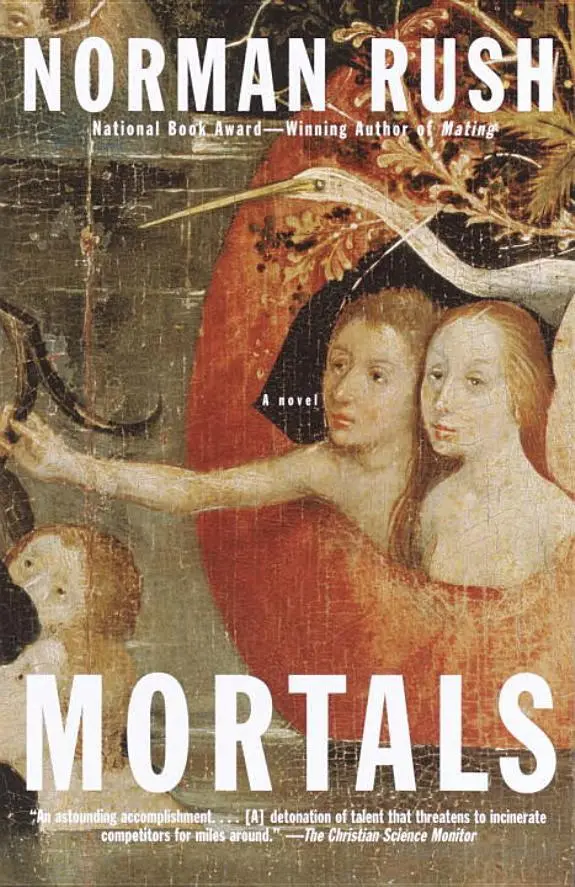
- Название:Mortals
- Автор:
- Издательство:Vintage Books
- Жанр:
- Год:2003
- ISBN:9780307789365
- Рейтинг книги:3 / 5. Голосов: 1
-
Избранное:Добавить в избранное
- Отзывы:
-
Ваша оценка:
Mortals: краткое содержание, описание и аннотация
Предлагаем к чтению аннотацию, описание, краткое содержание или предисловие (зависит от того, что написал сам автор книги «Mortals»). Если вы не нашли необходимую информацию о книге — напишите в комментариях, мы постараемся отыскать её.
As a spy, the compulsively literate Ray ought to have no trouble confirming his suspicions. But there’s the distraction of actual spying. Most of all, there’s the problem of love, which Norman Rush anatomizes in all its hopeless splendor in a novel that would have delighted Milton, Nabokov, and Graham Greene.
Mortals — читать онлайн бесплатно полную книгу (весь текст) целиком
Ниже представлен текст книги, разбитый по страницам. Система сохранения места последней прочитанной страницы, позволяет с удобством читать онлайн бесплатно книгу «Mortals», без необходимости каждый раз заново искать на чём Вы остановились. Поставьте закладку, и сможете в любой момент перейти на страницу, на которой закончили чтение.
Интервал:
Закладка:
“I know. But what’s wrong? Do we need to leave?”
“This will go away if you stop asking me about it. Can you do that?”
She was never like this.
She relented. “I guess it’s nothing. I was very moved and then … then just stupidly started thinking about, this is so stupid, my own death. But not even that. My own funeral service or memorial or whatever I get when I die, what that would be like.”
He guided her to a more private spot beside the garage.
She was continuing. “And what I was thinking was what a joke it’s going to be. I have done nothing . There will be absolutely nothing to say. Nothing.
“But of course people will say things. They have no choice. But it will be lies and it will be nothing like what that man just did, that wonderful thing we just saw for Alice Wemberg. No one will feel that way and why should they, for God’s sake?
“Everything will be lies except for what you have to say.
“This is pointless. I can’t be doing this. It’s idiotic.”
“My darling girl, everyone has something like this at memorial services.”
Something was making it worse for her. She was distraught. She was weeping and not trying to contain it, now.
She said, “And look at you. Half of everything you do is secret …”
He shook her lightly, alarmed. He pointed back in the direction of the Portosans, to remind her that she had to quiet down, that there might be listeners.
“I know. But what would I say about you? I only know half of your life. Even I don’t know about your other involvements, your what, your other accomplishments, Ray. I’m sorry …”
“Maybe we should go home.”
“ No .” She was vehement. He reached out to hold her, but she stood away from him. She fought to compose herself.
“We don’t have to stay beyond this,” he said.
She was adamant. “No, I want you to meet my doctor, meet Davis, like a normal human being, like my normal husband.”
He groaned. “Is this the best moment, Iris? My God.”
“I’m fine,” she said. She was recovering. It was okay if she looked like she had been crying here. The rapidity with which women could recompose themselves was something.
“You know nothing about him, Ray.”
“I’m happy to meet him,” he made himself say. Look bright, he thought.
She said, “I want you to be normal when you meet him. Don’t be formal. Don’t be frozen, the way you can.”
“I hear and obey,” he said, not as lightly as he’d meant to.
They found Morel standing under a silver oak, his back against its spindly trunk, batting now and then at the parched dead leaves that occasionally drifted down past him. Feet spread apart, he was truculently posed, Ray thought. Morel folded his arms across his chest as Ray and Iris came up. He was undergoing a harangue, but managing to radiate goodnatured skepticism for the benefit of the small miscellaneous crowd loosely gathered around him.
Morel was jaunty, which for some reason surprised Ray. And he was definitely in the handsome dog category, alas. His safari suit, which was black, with a shortsleeved jacket-shirt, was custom-tailored and clearly expensive. His arms-folded pose nicely presented his cultivated biceps and the ponderous wristwatch he wore. The man looked solid as a horse. He had the kind of overdone upper body development paraplegics determined to overcome their disabilities have, and undoubtedly the motive for it was to compensate for his short-leg condition, undetectable as that was, thanks to the genius of his bootmaker. Ray knew charm when he saw it. But charm goes with vanity, he thought. Vanity was there. The cut of Morel’s attire was toward formfitting. Wrists as thick as those could only come from hours of boringly squeezing grip-builders, a pair of which Iris had given him several years ago, Ray now remembered, and which he had never used.
“Say hello,” Iris muttered to Ray.
He was going to.
He disliked Morel, genuinely, which came as a relief since up to now his attitude toward him had been based on assumptions. Morel was lighter-skinned than he had appeared to be in his ID photograph. Plenty of Batswana would interact with him as a lakhoa. He would have something to work against. American blacks could be the most disappointed people you came across in Africa. I hate arrogance, Ray thought, and inward arrogance like his I hate the worst. Ray judged himself to be marginally taller than Morel, although it was hard to see why he bothered to care about it since he knew that in fact Morel’s height was a function of his orthopedic footwear. He felt stupid for caring about it, but he couldn’t help it. And only one of Morel’s shoes was built up anyway. He put his hand out. He kept his gaze up, not to show any interest in something he was supposed to know nothing about, Morel’s invisible disability.
Iris said hello, tentatively.
Morel’s hair was close-cropped and dense. In general he was as represented by his photograph, if just that much softer at the edges that a couple of years of passing time would guarantee. Ray thought, Age operates in one of two modes, it either withers you, or it puffs you out … I am withering.
Morel shook Ray’s hand with average force and smiled at him and Iris. There had been nothing to notice in the moment of acknowledgment, which had been casual and quick because Morel was busy being upbraided in Setswana and English by someone Ray knew about, a character, the head of the Star and Arm of David group, one of the thousand offshoots of the Zionist Christian Church.
Unless he was a superb actor, Morel had had no particular reaction to seeing Ray for the first time. It looked as though Ray could relax a little. Of course he had been impossibly positioned to pick up anything in Iris’s expression that might have been there when Morel greeted them, because she had been almost behind Ray as they approached, hanging back, which was unlike her.
The harangue stopped as a young woman, someone associated with the moruti’s group, arrived presenting a plate of food gathered from the buffet. Morel declined, saying he was fasting. Probably this was an evasion. The food was as usual — leaden-looking samoosas, fried chicken … drumsticks only. There were small paper cups of oily bean salad, but no forks, so that eating the beans involved a maneuver more like drinking. Only Morel and the moruti were offered anything. The young woman attended her moruti, wiping his hands for him with a paper towel when he was through. He asked her to find him some tea and she went off to do that.
Ray moved forward, intending to say something more to Morel, but the moruti subtly blocked him. He was a heavy man, all in black, in his late fifties, Ray judged. On a ribbon around his neck hung a medallion of some kind, which he kissed brusquely before resuming with Morel.
“Should we go?” Iris whispered.
Ray was definite that they shouldn’t.
The moruti was proceeding in Setswana. The harangue part one had been mostly in English with short deviations into Setswana, or so Ray had gathered as he’d approached the group. Morel was listening, with his head down, respectfully, and then, startling Ray, he replied to the moruti in Setswana . Woodenly, maybe, but in Setswana. This was new information. It changed the profile. Even Boyle would surely see that.
Not learning Setswana was something Ray held against himself. His original rationalization, because that was what it was, for not learning any particular African language had been that there was no telling where in the continent he might be posted next. He had known it was a rationalization but he had never been able to make himself go beyond learning the basic necessities in the local language anywhere, and in a certain way it had been useful, because host-country nationals would say things to one another in frankness in front of him in their own languages and feel comfortable doing that, and sometimes he had had the option of taping them and securing material somebody else could translate, useful material, often enough. He was normally set up to tape at the drop of a hat. He was today. So over time the original rationalization had gotten stronger. Also, foreign languages had always been difficult for him, a subject outside his best aptitudes. Working in foreign languages, for him, had been like working underwater. He was thinking of his struggle with Latin, which he had been forced to master out of fealty to great Milton, fealty and love. And had been unnatural and difficult for him and he had discovered in himself a mental tendency to forget what he’d learned, like the body expelling a foreign object. And that had led to a defect in his embrace, his total embrace, of the body of Milton, as compared to that of the show-off Latinists in the field, the others. Certain things were not in him, and he had paid for it. Some of his resistance to learning other languages could be attributed to chauvinism about English, some hard relic of his upbringing. Undoubtedly there were other relics as bad or worse he had never had the time to fix. Iris would know. She might have a list. There were seven hundred thousand words available in the English language and in the next closest, German, only four hundred thousand. Someone had written a very funny poem saying that German was originally the language that gargoyles spoke. And as for French, he couldn’t wait for it to become a dead language, since no nation, a nation of peacocks, had ever deserved it more. It was coming, they knew it and were hysterical about it, but adieu, adieu. But still he should have learned Setswana.
Читать дальшеИнтервал:
Закладка:
Похожие книги на «Mortals»
Представляем Вашему вниманию похожие книги на «Mortals» списком для выбора. Мы отобрали схожую по названию и смыслу литературу в надежде предоставить читателям больше вариантов отыскать новые, интересные, ещё непрочитанные произведения.






Обсуждение, отзывы о книге «Mortals» и просто собственные мнения читателей. Оставьте ваши комментарии, напишите, что Вы думаете о произведении, его смысле или главных героях. Укажите что конкретно понравилось, а что нет, и почему Вы так считаете.