Norman Rush - Mating
Здесь есть возможность читать онлайн «Norman Rush - Mating» весь текст электронной книги совершенно бесплатно (целиком полную версию без сокращений). В некоторых случаях можно слушать аудио, скачать через торрент в формате fb2 и присутствует краткое содержание. Жанр: Современная проза, на английском языке. Описание произведения, (предисловие) а так же отзывы посетителей доступны на портале библиотеки ЛибКат.
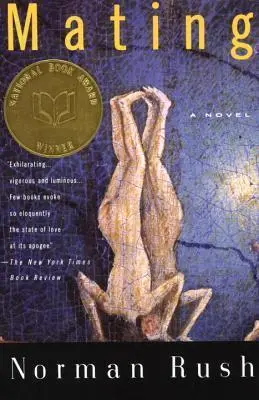
- Название:Mating
- Автор:
- Жанр:
- Год:неизвестен
- ISBN:нет данных
- Рейтинг книги:4 / 5. Голосов: 1
-
Избранное:Добавить в избранное
- Отзывы:
-
Ваша оценка:
Mating: краткое содержание, описание и аннотация
Предлагаем к чтению аннотацию, описание, краткое содержание или предисловие (зависит от того, что написал сам автор книги «Mating»). Если вы не нашли необходимую информацию о книге — напишите в комментариях, мы постараемся отыскать её.
Mating — читать онлайн бесплатно полную книгу (весь текст) целиком
Ниже представлен текст книги, разбитый по страницам. Система сохранения места последней прочитанной страницы, позволяет с удобством читать онлайн бесплатно книгу «Mating», без необходимости каждый раз заново искать на чём Вы остановились. Поставьте закладку, и сможете в любой момент перейти на страницу, на которой закончили чтение.
Интервал:
Закладка:
For me another link to vomiting is the destruction of my mother’s last best chance to secure a better life for us. Through a friend my mother had gotten recommended for a job as a receptionist, with the prospect of moving up to bookkeeping. She was prepared to demonstrate that she knew bookkeeping. Her friend had coached her for a month. Concurrently my mother had been crash dieting in a pathetic attempt to get within armslength of normal overweight. My mother is not stupid. She is accursed but not stupid. She learned bookkeeping. But on the eve of her interview she had lost a trifling amount of weight and was still, by any standard, terribly fat. So in a moment of hysteria she decided that the thing to do to get the last ounce of fat off her that she could would be to induce vomiting. So she had gone into the bathroom and stuck her finger down her throat and, because she’d eaten virtually nothing, got almost nothing up. So she had performed the act repeatedly, enough times to burst every capillary in the whites of her eyes, thusly guaranteeing that she would show up at the interview as a certifiable movie monster with eyes like embers. In the morning, there she was with this condition. So it was her one big chance, she just knew, down the drain. After that it was aide positions in playschools. Don’t miss your one big chance, was the message to me my whole childhood. Of course the one-big-chance-lost proposition is often a lie. Nelson’s father had a one-big-chance story too, which was supposed to explain his ending up in advertising. He had been given a partial scholarship to a place called Brookwood Labor College, which had he gone to it might have changed his life. Other people who came out of Brookwood had gone on to do significant things in the labor movement. But his mother had either refused to give him the little extra he needed to support himself at school or in some even more insidious way had put a spoke in his wheel — she was a follower of Father Coughlin — so that naturally he had been forced to drink his way through life thereafter and apply his genius to being a brilliant sellout in advertising, the obvious antiprofession to leading labor for a living.
The storm was a cage sliding over us. I wanted to retreat to the octagon, but Nelson wanted to stay put until he felt rain. Staying there was ridiculous. The thunder was so shattering you wanted to get down low. The ozone smell was cutting, a stench and not just the usual tinge. I relinquished our embrace and decided it would be better to annoy him by pulling him back with me than see him electrocuted before my very eyes after I’d come this far. Lightning was streaming over us and striking the summit of the koppie. I swore to him I could hear rain coming.
There was a roaring overhead I could hardly credit, and then the rain smote us — there’s no other word for it. Nelson gave a cry of utter joy as the blast hit. He was overcome. He swung his arm in a circle like a demented softball pitcher winding up. Then he froze, spun around, and dashed past me into the house, shouting something over his shoulder.
He had remembered about the roof. When I got inside he was manically unfurling plastic sheeting everywhere. Water like a jagged blade was already coming down from the roof join. I helped.
When that was done we went back to huddle in the doorway, jammed together like people in the hideout cave behind the waterfall in? movies. He was ecstatic, and it was a lovely sight and, to me, proof that Tsau was not just something he was doing with his left hand or in an exhausted or pro forma way or as his final practical joke on someone or other. Come on, he kept saying to the deluge. We all want a passionate man. This may be the man, I thought. I realized you never see a man in a state of public joy except in connection with professional sports, stupidly enough. His arms disappeared to the elbow when he held them out into the solid glassy sheet the rain made, pouring beyond reason, and when water from inside began purling out between our feet he was the happiest yet. I went back in and started peeling up the karosses on the floor before they got too saturated. I heard him singing. He did come in to reascertain that the roof over the radio area was sound and holding.
The rain roared on. Now there was the secondary roar of the flow in the catchment systems above and all around us. For twenty minutes, we watched while the rain went from a sheet, to vertical lines, to diagonals. With his hair matted down, I could see that Denoon had the beginnings of male pattern baldness. For his age it was slight.
There was a certain divergence in our attitudes now that the rain was slackening. It was hard for him to contain his elation at the drenching Tsau had gotten and what it would mean. But I was thinking about the mess our place was in. Water was still coming in from the back someplace. Was this supposed to be my particular province, when I could hardly be said to have even moved in properly? Incredibly he was making as if to go out, leaving me with flood relief responsibilities vis-à-vis all our goods while he went to see about damage elsewhere, how particular sluices or channels had held up. I asked myself what a genius would do in my situation. Ordering him to stay and help on our first night as a ménage seemed dubious. But then so was the idea of my meekly becoming a charwoman while he attended to the putatively greater needs of the populace, then my fixing myself up nicely and then waiting for him to come home so our intimate life could commence. I know myself, and I knew that that experience was almost designed to leave me in a carnally unenthusiastic state.
So I said something on the order of Do me a favor and don’t go off to check things out until we get the basics under control here, and if you do I’ll tell you something interesting about thunder I bet you don’t know. I guaranteed he’d find it interesting.
He went for it. One of the virtues of studying anthropology is that you collect hoards of information on intriguing subjects not strictly germane to your specialty. He knew this about me already. How many students of computer science or, say, communications know that all over Europe the corpses of hanged men became the property of the executioner until late in the nineteenth century and that executioners conducted a lively trade in bits of flesh, selling them to apothecaries who used the morsels in various nostrums. How can I ever regret going into anthropology? The blood of freshly hanged persons was popular as a medication for epileptics, also. I had leverage over Denoon with informational sweepings like this because his anthropology was out of date and because his, I would say, premature rejection of the discipline meant there was lots he didn’t know, thanks to the information explosion. And not to know something that might be somehow germane to his hubristic project in the world made him alert and uneasy instantly. He knew I understood this position he was in, but it was okay.
So as we worked I told him what I could remember about findings showing that infrasound waves just below twenty hertz associated with approaching thunder seem to have strange effects on the temporal lobe in some part of the population, to wit producing feelings of baseless awe and ecstasy. The theory is that certain types of chanting in the special vault acoustics of churches, the sounds certain ritual horns and bull roarers emit, certain organ notes, reproduce the same effect. And then by a miracle I remembered the names of the seven or eight out of ten founders of major religions who were suspected of being epileptics, epilepsy being a temporal lobe disorder par excellence. I have to say he loved it, which was because he loved the idea of a biometeorological cause for the existence of one of his bêtes noires, religion. This was right up his alley, as of course I’d guessed it would have to be. He questioned me pretty closely. My thunder theory immediately ousted the theory he’d previously liked, also biological, which has religion resulting from consumption of the Amanita muscaria or some related mushroom. This was a theory he was glad to relinquish because the case was weak but also because it was the brainchild of a wealthy person whose occupation in life he highly disapproved of. I think he was a banker, or bankster, as Denoon found it amusing to call them.
Читать дальшеИнтервал:
Закладка:
Похожие книги на «Mating»
Представляем Вашему вниманию похожие книги на «Mating» списком для выбора. Мы отобрали схожую по названию и смыслу литературу в надежде предоставить читателям больше вариантов отыскать новые, интересные, ещё непрочитанные произведения.






Обсуждение, отзывы о книге «Mating» и просто собственные мнения читателей. Оставьте ваши комментарии, напишите, что Вы думаете о произведении, его смысле или главных героях. Укажите что конкретно понравилось, а что нет, и почему Вы так считаете.