Norman Rush - Mating
Здесь есть возможность читать онлайн «Norman Rush - Mating» весь текст электронной книги совершенно бесплатно (целиком полную версию без сокращений). В некоторых случаях можно слушать аудио, скачать через торрент в формате fb2 и присутствует краткое содержание. Жанр: Современная проза, на английском языке. Описание произведения, (предисловие) а так же отзывы посетителей доступны на портале библиотеки ЛибКат.
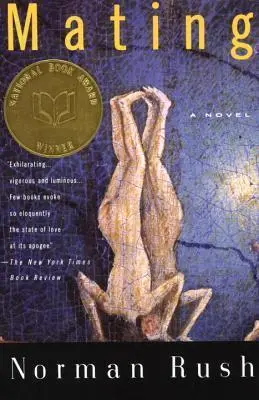
- Название:Mating
- Автор:
- Жанр:
- Год:неизвестен
- ISBN:нет данных
- Рейтинг книги:4 / 5. Голосов: 1
-
Избранное:Добавить в избранное
- Отзывы:
-
Ваша оценка:
Mating: краткое содержание, описание и аннотация
Предлагаем к чтению аннотацию, описание, краткое содержание или предисловие (зависит от того, что написал сам автор книги «Mating»). Если вы не нашли необходимую информацию о книге — напишите в комментариях, мы постараемся отыскать её.
Mating — читать онлайн бесплатно полную книгу (весь текст) целиком
Ниже представлен текст книги, разбитый по страницам. Система сохранения места последней прочитанной страницы, позволяет с удобством читать онлайн бесплатно книгу «Mating», без необходимости каждый раз заново искать на чём Вы остановились. Поставьте закладку, и сможете в любой момент перейти на страницу, на которой закончили чтение.
Интервал:
Закладка:
Not thinking why, I slid my hands down his spine and through the waistbands of his absurd pasha pants and his underpants. I spread his buttocks apart. I broke the embrace. I think he was amused. He asked me something like where I got to be so playful.
Anyway, there we were with Africa sliding into night, bats starting to circulate, the village turning into a brilliant code message as lights came on. It was up to me if we wanted to go further, but I held back. I would have liked to touch his beautiful sternocleidomastoids as thick as backpack straps. I was happy. I was so happy. The feeling I had was that whatever else we could do for each other, we were going to be physical friends, friendly bodies. I determined when it was time for me to be escorted back home. I made some joke about having to get to bed early because I was probably going to be awake all night. I left him to figure out why this might be the case.
Snake Women
Some of the intervening steps to my moving in have to be left out, fascinating as every inch of the process is to me still. When we were looking back and talking about his Achilles-and-the-tortoise approach, I made him laugh when I asked if he didn’t think my narcissism was the most interesting thing there was. I got control of my obsession with not exactly having been rushed off my feet as such as soon as I got to Tsau when Nelson said I was becoming a werewife. That is, for long stretches I was a normal companion, and then voilà when the moon is full I am an echt wife nostalgically fixated on the details of our sluggish courtship.
He claimed that it had been a distraction for us both when I became a snake woman. Being a snake woman was very honorific. This group earned huge extra credits at Sekopololo if it came back from a snake alarm bearing the culprit physically intact or, better yet, still alive. Joining the snake women was purely counterphobic on my part. I hate snakes.
The events the plaza bell was rung for were births, deaths, storm and hail, plenary meetings, snake sightings. Everything was supposed to stop and everyone gather.
I got to be a snake woman with very little ado. I was standing around during the shapeup that took place every morning outside Sekopololo. There was a blackboard propped up advertising the most deserving tasks — and the jacked-up credits you could earn by doing them — and there was a woman acting as a barker, touting particularly urgent tasks in a comic bravura style. I became friendly with her later out of sheer admiration. In action she reminded me of the traffic constables in Bermuda. Her name was Leto Mayekiso and she was the ex-household serf of a Bakwena headman. People acted knowing as to the exact manner of her manumission, which had something to do with the frequency of the unexplained minor fires that had seemed to plague her vicinity, although she was always able to show she was totally innocent. She had been freed but had suffered from some kind of informal blacklisting. There could be raillery from the crowd when she was touting work in the kiln or laundry, which she would never fail to describe as hotter than any woman should be expected to endure. In fact one of her main pieces of shtick was to dwell on how physically unbearable certain tasks were, obviously as a dare. The crowd would ululate appreciatively. I loved it all. She was about my age. She was very canny. If she saw Herero or Kalanga women coming to shape up she would dip into their languages. So far as I could tell she was a genuinely happy and satisfied human being. Anybody who can make the dour Baherero laugh has to be a genius. She was single. Happy people fascinate me.
So on a cold morning the bell rang and the scene around me dissolved madly: there was a snake sighting. Leto dropped the flywhisk she used in her performance and shot into Sekopololo. In the normal villages of Botswana snakes are taken care of by men, who go about it, in my opinion, fairly hysterically, their efforts usually culminating in burning down the perfectly good tree the snake has retired to and then hacking the carcass to bits with mattocks. The snake corps was made up of six trained women and two novices, one of them quite young. There was a fixed routine for dealing with snakes. Whoever spotted the animal was to stand there and blow a police whistle. The snake women would rush to Sekopololo and get into special, rather medieval-looking leather gear: there were greaves that you strapped to your shins under your skirt, a pipelike tube you slid onto your right forearm, heavy gloves, and a skimpy helmet or cloche that not everyone bothered with. Your armaments were like hypertrophied fireplace equipment — staves, tongs, long rods with pitch on the ends that you lit to smoke your quarry out of crevices, plus machetes, weighted nets, sacks, a stick with a wire slip noose attached. Dozens of snakes had been caught since the founding of Tsau. Several snake women had been bitten, none fatally. Beside the great aim of bringing the snake back alive or at least intact, there was an additional bonus for snake eggs. The skins were cured and sold, the skeletons were sunk in polymer and sold to biology departments somewhere, cobras and boomslangs were kept and milked for venom, for which there was also a market. The snake meat ended up grilled and cut into fragments and served as canapés at a celebration in the plaza.
On the spur of the moment, apparently, Leto came out and began pulling at me to come with her. She was inviting me to come fight snakes. There was some supportive ululation around me, so I said yes, hardly knowing what I was agreeing to. Then there was an adventure, at which I was essentially a nerve-wracked observer, ending in our trooping back with an only slightly damaged eight-foot-long rock python bound to a pole carried by our youngest novice and the little girl who had discovered the snake. I had been in terror throughout, but my companions claimed I had done a few helpful things, and they said they wanted me to join the group. I said Yes, you honor me.
Afterward I was extremely elated. There was an impromptu lunch set out for us when we got back. Denoon claimed all this happened on the very day he was going to ask me to think about moving in with him but that seeing me so elevated and involved with the group, he had decided to hold off. I think I do recall him contemplating me avuncularly while we were eating and being told how valiant we were. He even insisted he’d felt an extra attraction occasioned by my amazonesque accessories and general look. Only a fetishist would say that, I said. In any case, it would be a few days more until I was asked, and asked poorly, if you ask me.
I Am Asked
I was enjoying working. For one thing, I was very approved of for working more than I had to and for being goodnatured about volunteering my brawn for some of the heavier jobs. I liked being able to skip work altogether if I felt meditative. I especially liked shifting from one phylum of work to another and also that from time to time spontaneous singing would break out during certain kinds of gang work. These songs were real inventions. They were topical. There used to be something like them in rural Mexico. They were far removed from people robotically lip-synching along with the top forty, which was my closest workplace experience analog. Also work was transparent, unabstract. I was halfway into a state at right angles to my usual American median state of being in which you are in perpetual anxiety about the next thing that’s supposed to transpire in your lifeplan, to the point that you can barely enjoy the thing you’ve just done or the plateau you’ve reached. Can you get pregnant? You do, but then will your child be healthy? Will it be popular, productive, and if it’s a girl will she be assertive but not abrasive? And so on unto whether she is going to abandon you or not when you get old and burdensome. It resembles being a writer and having each book you write being judged essentially on how promising it is, what it augurs about how well you might do next time out. In America there are people who spend all year in agony because they don’t know what quality of New Year’s Eve party they’re going to get invited to. Even in summer camp, which is supposed to be a respite, it was impossible to relax, because the Lutherans who were so charitably giving me a scholarship fixed it so that I was striving the whole time to rise into the next and less humiliating grade of the swimming competence hierarchy or be the object of subtle scorn — not that they realized it. All this was falling away. Partly it was just being with Africans, who are so much the reverse of the American anxiety. And who knows how much of my luxe and calme may have been my romantic reaction to the idea of the experience I was having rather than the result of the experience itself, by which I mean reaction to received ideas about the beauty of communal labor, women being in charge, and so forth. Another perfect fragment from a different imperfect favorite poem of Nelson’s describes pretty well the way I was feeling: Zeno’s arrow in my heart / I float in the plunging year. Basically the reason I don’t know why I felt the way I did is because unfortunately we don’t know what we are, anthropology notwithstanding, even though the reason I clutched anthropology to my bosom was because I believed that academic disciplines did what they said they were doing rather than being hotbeds of dominance behavior where disagreeing on the simplest point gets you into a Götterdämmerung with somebody or his disciples. Another layer of it all was the problem of my knowing that Nelson would no doubt love me more if I loved his system, which Tsau was, tout court. He would be happy if I was happy, he would be seduced if I was seduced, and so on into the night. So it was another bolus.
Читать дальшеИнтервал:
Закладка:
Похожие книги на «Mating»
Представляем Вашему вниманию похожие книги на «Mating» списком для выбора. Мы отобрали схожую по названию и смыслу литературу в надежде предоставить читателям больше вариантов отыскать новые, интересные, ещё непрочитанные произведения.









Обсуждение, отзывы о книге «Mating» и просто собственные мнения читателей. Оставьте ваши комментарии, напишите, что Вы думаете о произведении, его смысле или главных героях. Укажите что конкретно понравилось, а что нет, и почему Вы так считаете.