Norman Rush - Mating
Здесь есть возможность читать онлайн «Norman Rush - Mating» весь текст электронной книги совершенно бесплатно (целиком полную версию без сокращений). В некоторых случаях можно слушать аудио, скачать через торрент в формате fb2 и присутствует краткое содержание. Жанр: Современная проза, на английском языке. Описание произведения, (предисловие) а так же отзывы посетителей доступны на портале библиотеки ЛибКат.
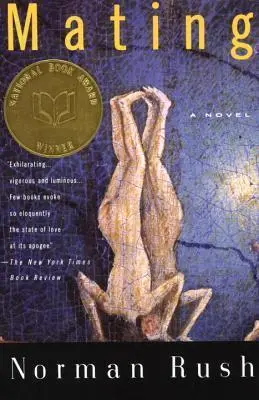
- Название:Mating
- Автор:
- Жанр:
- Год:неизвестен
- ISBN:нет данных
- Рейтинг книги:4 / 5. Голосов: 1
-
Избранное:Добавить в избранное
- Отзывы:
-
Ваша оценка:
Mating: краткое содержание, описание и аннотация
Предлагаем к чтению аннотацию, описание, краткое содержание или предисловие (зависит от того, что написал сам автор книги «Mating»). Если вы не нашли необходимую информацию о книге — напишите в комментариях, мы постараемся отыскать её.
Mating — читать онлайн бесплатно полную книгу (весь текст) целиком
Ниже представлен текст книги, разбитый по страницам. Система сохранения места последней прочитанной страницы, позволяет с удобством читать онлайн бесплатно книгу «Mating», без необходимости каждый раз заново искать на чём Вы остановились. Поставьте закладку, и сможете в любой момент перейти на страницу, на которой закончили чтение.
Интервал:
Закладка:
 He keeps asking me about morale here, which I tell him truthfully seems good overall as far as the women go, but that how happy the men are is? We were out postprandially repairing antigoat fencing around the poplar plot next to the gum tree plantation. Young poplars are to goats as catnip is to cats. When I said morale among the men was a question, he was dismissive. All he would say was Men are only happy in prison or in the army. I am at a point where I suspect him of producing a few too many of these morsels and tidbits re the perfidies of the male race because he’s under the impression I’ll get off on them. So I’m being rather cum grano salis on these throwaway lines, for a change. How would you know men are happy in prison? I asked, and got I know men are happy in prison and the army because of what they fail to do when they get out. Most of them fail to avoid going back to prison. Second, they fail to say anything negative enough about what they’ve experienced to keep their affines and the young from risking going there. And you know men are happy in the army because when they get out they do nothing to keep younger men from joining up, and in fact they themselves join the American Legion to keep their memories of war and killing as fresh as possible and have circle jerks where they call anybody who’s for peace commies, and a deep calm drenches the male soul when it feels the persona it inhabits being firmly screwed into a socket in some iron hierarchy or other, best of all a hierarchy legitimately about killing. His misandry turned out to be a genuine if sporadic thing and continued, although accompanied by hagiographical asides re certain obviously countertypical men. In our exchange at the goat fence he picked up my skepticism about the sincerity of his attitude and abruptly and sternly went into an anecdote about a street performer who had been a fixture in his arrondissement when he was staying in Paris. This was an African guy, a magnificently muscled Senegalese who Nelson assumed at first was doing an escape act since he was bound up in chains and straining mightily against them. He was kneeling. But this wasn’t an escape act, it was art. The guy straining interminably against his bonds was the show itself. What was interesting was the audience, which was made up overwhelmingly of fascinated men. Women would come by, take a look, shudder, be puzzled when there was no escape, and move on. But men were transfixed, and stayed, and kept putting money in the performer’s skullcap. Explain this to me, Denoon said. Another time Nelson was claiming that there are almost no successful complete poems, that perfection should be looked for in fragments of failed larger structures, and I was suggesting he was conflating a human limitation — the tendency to retain only the more vivid fragments of poems — into a perverse cosmic judgment about poetry itself. In passing he quoted some lines he liked from an allegedly otherwise nongreat piece of poetry. An odd thing is that just hearing them that first time was enough to fix them in my memory. I think this is verbatim: The bald accountant back at his desk from vacation / Takes comfort in the president’s angry order / The exile returning from honors in another nation / Feels a thrill seeing the first brutal face at the border. When I suspected disingenuousness on his part the most was when he told tall tales out of school about his gender and himself in particular. As: he was a freshman in college and he read a story by James Agee told from the standpoint of a cow en route to the slaughterhouse, a tour de force that affected him so deeply that his girlfriend gave up meat over the summer vacation — he kept on eating meat himself. So how to read this? As a confession of fundamental tendencies I should be forewarned about? As a demo of how clearly he grasped and disliked the traditional emotional division of labor between women and men? Or as something tendentious and mixed, ostensibly offered as a warning about even him while secretly intended to get me to appreciate him above all for his sterling evolution to the way he was now? I have fear and loathing of liars. I almost wish this were the nineteenth century so I could say something like You lie to me at your peril, to anyone who tried it. I had a glyph to indicate lying that I used in my journals, a circle with a line across it at different levels for probable different degrees of deception, id est an eye winking to different degrees. I see I even put a nota bene in my journal to watch for any reference by Nelson to himself as being a poor liar, which would be evidence that I was dealing with a real liar, in fact. This all makes me seem phobic on the subject. I was simultaneously trying to keep in touch with the fact that the approach of love can make you paranoid. I may lie when my back is against the wall. Obviously. Lies led to my existence in the world. I wasn’t conceived through the association of ideas: somebody said to my mother that he liked her, was attracted, could be trusted. I think my personal utopia would be nobody lying.
We Engage
One evening after dinner chez moi he invited me to accompany him up to his place. There was a reason for it I forget, but it was really to show me the place: so far as he knew I hadn’t seen it previously. It was changed utterly. He was being a bowerbird homolog. There was more furniture. The windows had been washed. Machinery and parts had been consolidated. Candle drippings had been scraped off surfaces where they had been prominent. There was now a significant water storage tank attached to the bathtub setup. I tapped it: it was full. Inside the house it was a wonderland of karosses, not only on the floor but tacked to the walls.
The song I hate most from the sixties begins I will follow him, follow him wherever he may go, and so on, whiningly sung. It epitomizes something humiliating. The prospect of moving in with someone always raises up fears of being the ignominious one, the supplicant, the camp follower, so it was very reassuring to see how delicately Nelson went about showing me his bower.
We held hands during the house tour and when we came out into nightfall both got the idea simultaneously of swinging our clasped hands in a parody of grade school handholding. Then came the embrace. There are ways to embrace a woman that are standard and there are ways that are perfect. This was the latter. If you’re as tall as I am you begin to notice that men about your height always try to arrange for the first embrace-kiss sequence to take place while both of you are seated, so that they can subtly slide you down and deliver the coup de grace of the embrace, the declaratory kiss, from above, with your head bent back, and your throat exposed so you’re like an animal signaling submission to a larger member of the species. The nice thing with Nelson was that no kiss followed. The embrace was not just the scaffolding for the great declaratory kiss. The best standing-up embrace is like that one, slightly off center so that you have his leg and not his actual téméraire up against you, one hand on the base of your spine, and you are brought in against him but not mashingly. His cheek is at your ear but not occluding your actual ear canal. His breath is in your hair. Then you want to feel him sinking against you, slightly, suggesting relief and repose: the embrace from something, not simply stage one in a campaign of possession.
So we hung against each other. I liked his smell. It was positive and faintly like a veal soup my mother made five or so times in my life when for some unknown reason she was elated about something. It was a trace smell subtending the soap, diesel, and smoke amalgam.
Who terminates the embrace is important also. It was up to me.
Читать дальшеИнтервал:
Закладка:
Похожие книги на «Mating»
Представляем Вашему вниманию похожие книги на «Mating» списком для выбора. Мы отобрали схожую по названию и смыслу литературу в надежде предоставить читателям больше вариантов отыскать новые, интересные, ещё непрочитанные произведения.









Обсуждение, отзывы о книге «Mating» и просто собственные мнения читателей. Оставьте ваши комментарии, напишите, что Вы думаете о произведении, его смысле или главных героях. Укажите что конкретно понравилось, а что нет, и почему Вы так считаете.