Juan Pablo Villalobos - Quesadillas
Здесь есть возможность читать онлайн «Juan Pablo Villalobos - Quesadillas» весь текст электронной книги совершенно бесплатно (целиком полную версию без сокращений). В некоторых случаях можно слушать аудио, скачать через торрент в формате fb2 и присутствует краткое содержание. Год выпуска: 2013, Издательство: And Other Stories, Жанр: Современная проза, на английском языке. Описание произведения, (предисловие) а так же отзывы посетителей доступны на портале библиотеки ЛибКат.
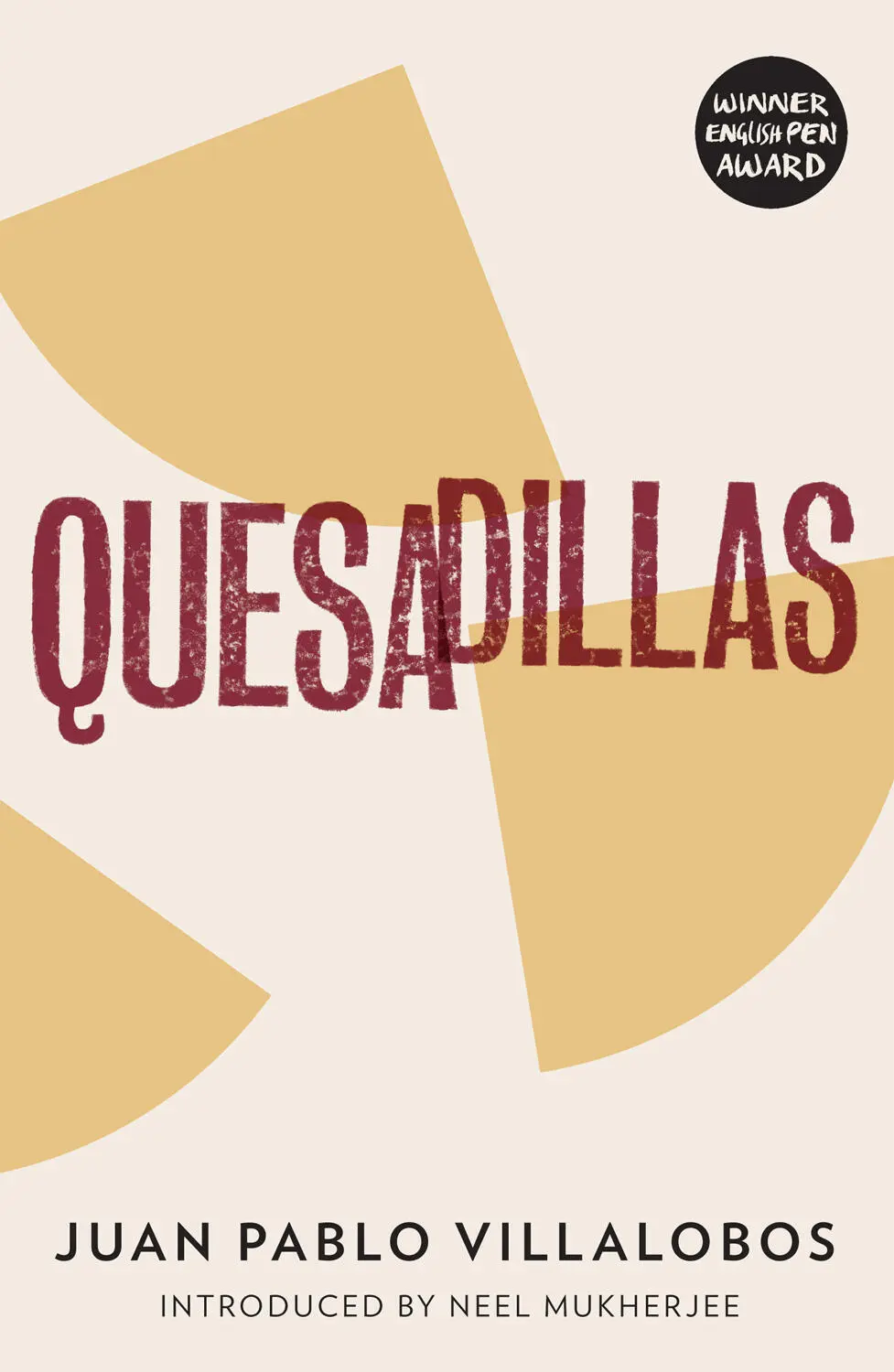
- Название:Quesadillas
- Автор:
- Издательство:And Other Stories
- Жанр:
- Год:2013
- ISBN:нет данных
- Рейтинг книги:5 / 5. Голосов: 1
-
Избранное:Добавить в избранное
- Отзывы:
-
Ваша оценка:
Quesadillas: краткое содержание, описание и аннотация
Предлагаем к чтению аннотацию, описание, краткое содержание или предисловие (зависит от того, что написал сам автор книги «Quesadillas»). Если вы не нашли необходимую информацию о книге — напишите в комментариях, мы постараемся отыскать её.
Orestes meets a procession of pilgrims, a stoner uncle called Pink Floyd and a beguiling politician who teaches him how to lie, and he learns some valuable lessons about families, truth and bovine artificial insemination.
With Quesadillas, Juan Pablo Villalobos serves up a wild banquet. Anything goes in this madcap Mexican satire about politics, big families, and what it means to be middle class.
Quesadillas — читать онлайн бесплатно полную книгу (весь текст) целиком
Ниже представлен текст книги, разбитый по страницам. Система сохранения места последней прочитанной страницы, позволяет с удобством читать онлайн бесплатно книгу «Quesadillas», без необходимости каждый раз заново искать на чём Вы остановились. Поставьте закладку, и сможете в любой момент перейти на страницу, на которой закончили чтение.
Интервал:
Закладка:
Aware that my mother was hovering on the verge of a hysterical outburst, my father had tried to convince his brothers to have Grandfather declared legally unfit due to senile dementia, so as to get access to his material possessions. The problem was that my uncles hadn’t ended up on the street, which meant that, even as poor as they were, they still had plenty of pride and respect for the macabre.
‘Wait until he dies,’ they all kept saying. ‘How long can it be?’
But it could be a long time, the family statistics suggested — our life expectancy was long, extremely long, our great-grandfathers had died at around a hundred years of age; even our great-great-grandfathers lived to over eighty, and they’d had to live through the turbulent and unhygienic nineteenth century!
‘Years and years; we should hope he lives for a great many more,’ my father retorted, testing the rhetorical potential of emotional blackmail, and he was right too: Grandfather would last for ages yet, even making it to the end of the century, just.
‘So go to Pueblo de Moya, there’s lots of land there,’ advised my uncles, who were up to date on the best places to build a house illegally.
However, if our experience on the hill had done anything for us — besides making us suffer — it was to destroy my father’s desire to prove the impossibility of impossible things.
‘We’re not going to steal land. If they screw you over when you’re in the right, imagine what they’ll do when you’re not.’
‘You weren’t in the right.’
‘Nor were they. The land belonged to the council. It wasn’t earmarked for housing.’
‘And who earmarks it? The council!’
‘Exactly!’
‘Yeah, exactly! You weren’t in the right and you never will be. They’re the ones who are always in the right, so what does it matter? Go to Pueblo de Moya. You can hold out for a good few years there.’
‘We’re not going to do any illegal building. I’ll put the house right here on Grandfather’s land.’
The conclusion my father had arrived at, taking advantage of the argument of my grandfather’s madness, was that he would never even notice. The one sign of solidarity my uncles displayed was to agree they would pretend they didn’t know, and that if there was any sort of setback — the return of my grandfather’s lucidity, for example — they would do their utmost to seem as surprised and indignant as possible.
‘It’s your lookout,’ one of them said.
‘You’re stubborn. Do what you like,’ said another.
‘What are you asking us for if you’re going to go and do what you’ve already decided anyway? You’re just wasting your time and making us waste ours,’ moaned his youngest brother, the resentment still throbbing along with the bruise on his forehead.
Grandfather went to the plot every day at around ten in the morning and stayed for a couple of hours, which he spent interrogating his two employees about the health of the watermelons and making an inventory of the materials stored in the storehouse — fertilisers, tools, insecticides — to make sure no one was robbing him. Before he left, without exception, and without a trace of the modesty that had characterised him in his pre-dementia life, he would drop his trousers, ask one of the labourers to help him squat down and position his backside in the open air, and shit in the middle of the watermelons.
‘It’s the best fertiliser there is!’ he would shout happily, still squatting, but now face to face with his most recent, still-steaming production.
He took his leave of his employees with a phrase that proved my father had been wrong about the nature of his madness — in fact he was paranoid-obsessive and highly competitive when it came to covering up secrets.
‘Keep a close eye on this lot for me. They’ve already had a run-in with the law.’
Making the most of the fact that Grandfather’s legs had begun to let him down long ago, condemning him to an exasperating slowness, and mentally calculating the number of days it would take him to cover the 200 metres from the smallholding’s entrance to the bottom of the plot, my father chose the south-eastern corner to build our house, the furthest away from the gate. It was a location at once defiant — at its eastern coordinate, due to the threat of flooding — and resigned — at its southern coordinate, due to the stink from the pigs.
The wild card in my father’s plan was the pair of labourers — two wild cards, in fact. He didn’t know how they would react; we’d not had a chance to get to know them because they were so taciturn. No matter how much my father tried, he hadn’t managed to strike up a conversation with them, so he decided to say nothing to them now, to give them no warning and to find out later exactly how much loyalty they felt towards his father.
The evening following a day in which my mother had not addressed a single syllable to my father, he decided to execute his plan as soon as the labourers had gone home. First we went to the storehouse to find the tools we’d need, which operation called for the use of a screwdriver to break a very flimsy padlock and generated an impressively clandestine atmosphere.
My father measured out the fifty square metres in strides, five by ten, without obsessing about accuracy, and stuck a branch in each corner of the terrain. Archilochus, Callimachus and I took charge of tracing four dotted lines in stones, making the relationship between the branches obvious. Next, Archilochus and Callimachus harvested the watermelons. There weren’t 180 of them, only thirty or so, which meant one of two possibilities: either Grandfather’s agricultural knowledge had been knocked off-kilter too or else we’d been devalued by 83 per cent. Meanwhile, my father and I pulled up the plants with the aid of rakes. We pushed the teeth into the soil and pulled upwards, hard, to see if by doing so we could put an end to so much lousy confusion. The rakes were inanimate objects made of metal, which meant we didn’t have to worry about the thickness of the plants’ stalks and leaves. Just to encourage an increase in slacker culture, it turned out that the roots of the watermelon plants didn’t grow very deeply at all and their desire to stay clinging to the subsoil was weak. Once Archilochus and Callimachus had placed the watermelons safely in my mother’s arms they were assigned the task of using gloves to throw the prickly plants down the riverbank. The light was starting to fade when my father decided our task was finished.
We returned the things to the storehouse, so my father could demonstrate to his children that he wasn’t a total swine. He even took care to respect the original décor: he closed the door and returned the broken padlock to its place. Back in the shack, my mother and Electra had been entertaining themselves by cutting open the watermelons. To one side was a pile of discarded fruits whose pallid interiors betrayed the abortion we had subjected them to. At random, we started to eat the reddest ones we could find.
At least weeding the land had restored my father’s right to be scolded by my mother.
‘Tomorrow the labourers will tell your father and he’ll kick us out. Where will we go then?’
‘They won’t say anything to him, you’ll see.’
‘How can you be so sure?’
‘He makes them smell his excrement. Do you think they have any respect for him?’
‘Respect, I don’t know, but fear …’
‘Fear of what? Have you not seen my dad? He’s a total wreck and he’s a lunatic.’
‘Don’t talk like that in front of the children.’
‘The children have seen their grandfather take a shit and they can hear all the crap he talks. Don’t you think that’s enough?’
They would have carried on arguing if it wasn’t for the fact that suddenly the watermelons started to taste really good: delicious, in fact. Sweet. Juicy. Their sweet juice ran down our chins and we trapped it with our fingers to scoop it back into our mouths, so as not to lose a drop. My father lit a fire so we could gaze at the wondrous pulp we were ingesting.
Читать дальшеИнтервал:
Закладка:
Похожие книги на «Quesadillas»
Представляем Вашему вниманию похожие книги на «Quesadillas» списком для выбора. Мы отобрали схожую по названию и смыслу литературу в надежде предоставить читателям больше вариантов отыскать новые, интересные, ещё непрочитанные произведения.








Обсуждение, отзывы о книге «Quesadillas» и просто собственные мнения читателей. Оставьте ваши комментарии, напишите, что Вы думаете о произведении, его смысле или главных героях. Укажите что конкретно понравилось, а что нет, и почему Вы так считаете.