Denis Johnson - Jesus' Son - Stories
Здесь есть возможность читать онлайн «Denis Johnson - Jesus' Son - Stories» весь текст электронной книги совершенно бесплатно (целиком полную версию без сокращений). В некоторых случаях можно слушать аудио, скачать через торрент в формате fb2 и присутствует краткое содержание. Год выпуска: 2009, ISBN: 2009, Издательство: Picador, Жанр: Современная проза, на английском языке. Описание произведения, (предисловие) а так же отзывы посетителей доступны на портале библиотеки ЛибКат.
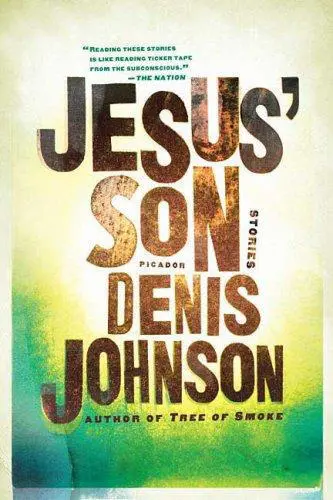
- Название:Jesus' Son: Stories
- Автор:
- Издательство:Picador
- Жанр:
- Год:2009
- ISBN:9780312428747
- Рейтинг книги:5 / 5. Голосов: 1
-
Избранное:Добавить в избранное
- Отзывы:
-
Ваша оценка:
Jesus' Son: Stories: краткое содержание, описание и аннотация
Предлагаем к чтению аннотацию, описание, краткое содержание или предисловие (зависит от того, что написал сам автор книги «Jesus' Son: Stories»). Если вы не нашли необходимую информацию о книге — напишите в комментариях, мы постараемся отыскать её.
Jesus' Son: Stories — читать онлайн бесплатно полную книгу (весь текст) целиком
Ниже представлен текст книги, разбитый по страницам. Система сохранения места последней прочитанной страницы, позволяет с удобством читать онлайн бесплатно книгу «Jesus' Son: Stories», без необходимости каждый раз заново искать на чём Вы остановились. Поставьте закладку, и сможете в любой момент перейти на страницу, на которой закончили чтение.
Интервал:
Закладка:
"Gone, boy. Gone, gone, gone." She laughed like God. I didn't blame her for laughing.
"Any chance of getting some more?"
"How much you want? You got ten?"
"Maybe. Sure."
"I'll take you down here," she said. "I'll take you down over to the Savoy." And after two more stops she led me off the train and down into the streets. A few people stood around trashcans with flames leaping up out of them and that sort of thing, mumbling and singing. The streetlamps and traffic lights had wire mesh screens over them.
I know there are people who believe that wherever you look, all you see is yourself. Episodes like this make me wonder if they aren't right.
The Savoy Hotel was a bad place. The reality of it gave out as it rose higher above First Avenue, so that the upper floors dribbled away into space. Monsters were dragging themselves up the stairs. In the basement was a bar going three sides of a rectangle, as big as an Olympic pool, and a dancing stage with a thick gold curtain hanging down over it that never moved. Everyone knew what to do. People were paying with bills they'd made by tearing a corner off a twenty and pasting it onto a one. There was a man with a tall black hat, a helmet of thick blond hair, and a sharp blond beard. He seemed to want to be here. How did he know what to do? Beautiful women in the corners of my sight disappeared when I looked directly at them. Winter outside. Night by afternoon. Darkly, darkly the Happy Hour. I didn't know the rules. I didn't know what to do.
The last time I'd been in the Savoy, it had been in Omaha. I hadn't been anywhere near it in over a year, but I was just getting sicker. When I coughed I saw fireflies.
Everything down there but the curtain was red. It was like a movie of something that was actually happening. Black pimps in fur coats. The women were blank, shining areas with photographs of sad girls floating in them. "I'll just take your money and go upstairs," somebody said to me.
Michelle left me permanently for a man called John Smith, or shall I say that during one of the times we were parted she took up with a man and shortly after that had some bad luck and died? Anyway, she never came back to me.
I knew him, this John Smith. Once at a party he tried to sell me a gun, and later at the same party he made everyone quiet down for a few minutes because I was singing along with the radio, and he liked my voice. Michelle went to Kansas City with him and one night when he was out she took a lot of pills, leaving a note beside her on his pillow where he'd be sure to find it and rescue her. But he was so drunk when he got home that night that he just laid his cheek down on the paper she'd written on, and went to sleep. When he woke up the next morning my beautiful Michelle was cold and dead.
She was a woman, a traitor, and a killer. Males and females wanted her. But I was the only one who ever could have loved her.
For many weeks after she died, John Smith confided to people that Michelle was calling to him from the other side of life. She wooed him. She made herself seem more real than any of the visible people around him, the people who were still breathing, who were supposed to be alive. When I heard, shortly after that, that John Smith was dead, I wasn't surprised.
When we were arguing on my twenty-fourth birthday, she left the kitchen, came back with a pistol, and fired it at me five times from right across the table. But she missed. It wasn't my life she was after. It was more. She wanted to eat my heart and be lost in the desert with what she'd done, she wanted to fall on her knees and give birth from it, she wanted to hurt me as only a child can be hurt by its mother.
I know they argue about whether or not it's right, whether or not the baby is alive at this point or that point in its growth inside the womb. This wasn't about that. It wasn't what the lawyers did. It wasn't what the doctors did, it wasn't what the woman did. It was what the mother and father did together.
The Other Man
But I never finished telling you about the two men. I never even started describing the second one, whom I met more or less in the middle of Puget Sound, travelling from Bremerton, Washington, to Seattle.
This man was just basically one of those people on a boat, leaning on the rail like the others, his hands dangling over like bait. The day was sunny, unusual for the Northwest Coast. I'm sure we were all feeling blessed on this ferryboat among the humps of very green-in the sunlight almost coolly burning, like phosphorus-islands, and the water of inlets winking in the sincere light of day, under a sky as blue and brainless as the love of God, despite the smell, the slight, dreamy suffocation, of some kind of petroleum-based compound used to seal the deck's seams.
This guy wore horn-rimmed glasses and had a shy smile, by which I think is generally meant a smile that occurs while the eyes look away.
It was his foreignness, inability to make himself accepted, essential loserness, that made him look away.
"Do you like some beers?"
"Okay," I said.
He bought me a beer and explained that he was from Poland, over here on business. I stayed and talked with him about the obvious things. "It's a beautiful day"-by which we meant that the weather was good. But we never say, "The weather's good," "The weather's pleasant." We say, "It's a beautiful day," "What a beautiful day."
He was a sad case. His jacket was lightweight and yellow. He might have been wearing it for the first time. It was the kind of jacket a foreigner would buy in a store while saying to himself, "I am buying an American jacket." "Are you having," he asked of me, "a family? Any father, mother, brother, sister?"
"I have a brother, one brother, and my parents are both living."
He was driving around in a rented car, with an expense account: a youthful international person doing all right. A certain yearning attached itself between us. I wanted to participate in what was happening to him. It was just a careless, instinctive thing. There was nothing of his I wanted in particular. I wanted it all. We went downstairs and got in his new-smelling rented car. We waited for the boat to dock and then we drove down the ramp and just a very short ways to a restaurant and tavern on the waterfront, a loud place dappled with sunshine and full of the deep tones of thick beer ware.
I didn't ask him if he had a wife or was father to a family. And he didn't ask me about those things. "Do you ride the motorcycle? I do," he said. "I ride the small, the one, we say, ah, yes, motorscooter, you call it. The big Hell's Angels have the motorcycles, no, I ride the small motorscooter, excuse me. In Warsaw, my city, we drive in the park after twelve in the night, but the rules are saying ho, you must not go to the park after this time, 12 p.m. middle-night, yes, ah, midnight, exact, precisely, it's against the rule, the law. It is a law, the park is clawsded. Closed, yes, thank you, it is a law for one months in jail if you try it. Oh, we have a lot fun! I put it on my helmet, and if the polices are catching, they will-bung! bung! — with their sticks! But it doesn't hurt. But we always get away, because they walk, the polices, they have no transportation for that park. We always win! After the middle-night, it is always dark there."
He excused himself and went to find a bathroom and order one more pitcher of beer.
We hadn't yet mentioned our names. We probably wouldn't. In barrooms I lived this over and over.
He came back with the pitcher and poured my glass full and sat down. "Ah hell," he said. "I'm not Polish. I'm from Cleveland."
I was shocked, surprised. Really. Not for one second had I thought of something like this. "Well, tell me some stories about Cleveland, then," I said.
"The Cuyahoga River caught on fire one time," he said. "It was burning in the middle of the night. The fire was just floating along down it. That was interesting to see, because you'd almost expect the fire to stay in the same place, while the water travelled along beneath it. The pollutants caught on fire. Flammable chemicals and waste products from the factories."
Читать дальшеИнтервал:
Закладка:
Похожие книги на «Jesus' Son: Stories»
Представляем Вашему вниманию похожие книги на «Jesus' Son: Stories» списком для выбора. Мы отобрали схожую по названию и смыслу литературу в надежде предоставить читателям больше вариантов отыскать новые, интересные, ещё непрочитанные произведения.






Обсуждение, отзывы о книге «Jesus' Son: Stories» и просто собственные мнения читателей. Оставьте ваши комментарии, напишите, что Вы думаете о произведении, его смысле или главных героях. Укажите что конкретно понравилось, а что нет, и почему Вы так считаете.