Zoe Wicomb - October
Здесь есть возможность читать онлайн «Zoe Wicomb - October» весь текст электронной книги совершенно бесплатно (целиком полную версию без сокращений). В некоторых случаях можно слушать аудио, скачать через торрент в формате fb2 и присутствует краткое содержание. Жанр: Современная проза, на английском языке. Описание произведения, (предисловие) а так же отзывы посетителей доступны на портале библиотеки ЛибКат.
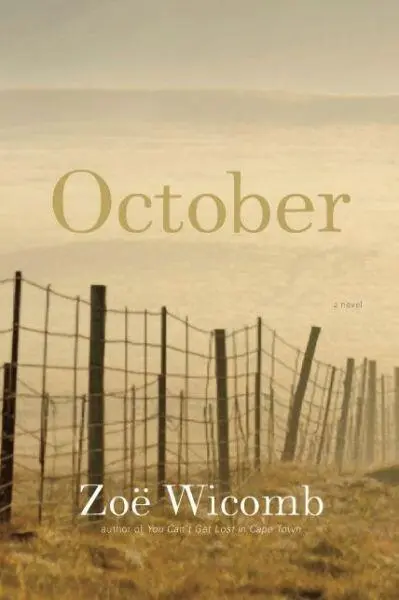
- Название:October
- Автор:
- Жанр:
- Год:неизвестен
- ISBN:нет данных
- Рейтинг книги:4 / 5. Голосов: 1
-
Избранное:Добавить в избранное
- Отзывы:
-
Ваша оценка:
October: краткое содержание, описание и аннотация
Предлагаем к чтению аннотацию, описание, краткое содержание или предисловие (зависит от того, что написал сам автор книги «October»). Если вы не нашли необходимую информацию о книге — напишите в комментариях, мы постараемся отыскать её.
With this pitch-perfect story, the “writer of rare brilliance” (The Scotsman) Zoë Wicomb — who received one of the first Donald Windham — Sandy M. Campbell Literature Prizes for lifetime achievement — stands to claim her rightful place as one of the preeminent contemporary voices in international fiction.
October — читать онлайн бесплатно полную книгу (весь текст) целиком
Ниже представлен текст книги, разбитый по страницам. Система сохранения места последней прочитанной страницы, позволяет с удобством читать онлайн бесплатно книгу «October», без необходимости каждый раз заново искать на чём Вы остановились. Поставьте закладку, и сможете в любой момент перейти на страницу, на которой закончили чтение.
Интервал:
Закладка:
Sylvie wept for weeks. She could not eat. She grew listless and frail, and failed her standard five exams. Her menses that had started only the previous month now would not stop. AntieMa said she was pure evil, that there was no question of her staying on at school. How lucky they were that old Lodewyk was prepared to employ her.
Until the day she started in the butcher’s shop Sylvie believed that Meester would rescue her. For all God’s warning he was surely still her friend who had promised to protect her, but no word, not even a sign, came from him.
What kind of God was he who interfered so cruelly?
The answer: a cruel God. So that Sylvie owed him no allegiance. With her arms plunged into the alchemy of sausage meat, she stopped crying; she bought lipstick and cigarettes, took up her hems, and in tight jeans went dancing with boys from the high school. Her mothers shook their heads sadly. Why had they expected anything else? The sins of the fathers must after all be visited upon the children to the third and fourth generations. But Sylvie would hear nothing of fathers. It was all too late, she said. Having three mothers suited her just fine; she had always appreciated their delicacy, so she hoped they would not now burden her with dreary stories, with fathers. AntieMa was outraged. How right they were to send her to the butchery. If it were not for her pride she would ask Lodewyk to thrash the girl, but Ousie said no, pride was also a good thing, and the girl would grow out of this rude phase.
One night Sylvie drank a whole can of beer and allowed herself to be dragged off to the dipkraal by one of the Dirkse boys, who later boasted about his conquest. The truth was that although she had cast off all thoughts of Meester and God, by now a composite, her body would not obey. Much as Sylvie wanted to lose herself in the embraces of perfectly nice young men, her flesh revolted at the final act; she simply could not, not even after a second can of brave beer. Fortunately for her, none of the young men were prepared to say that he had failed, and so her reputation as a loose goose grew. She reveled in the role. A loose goose had privileges. A loose goose was allowed to hang out, smoking and drinking with men, slapping her tightly denimed thighs, and tilting her head back to crow with loud laughter. And if they went on a jaunt to Rooikrans, she leapt nimbly onto the back of a bakkie, standing all the way with her thumbs hooked in her jeans pockets, keeping a posed balance as the vehicle juddered over corrugated roads.
Old Lodewyk too must have got wind of Sylvie’s looseness, for he lurched at her one day as she was preparing chops, a hand already groping at her shirt before she realized what he was doing. How thrilling it was, the idea of raising the axe, of severing a hand cleanly, and watching warm red blood rush from the cut veins, watching it spill down the wooden block. Entranced she was, Sylvie the wild one, Sylvie the butcher, who would wrap the old, liver-spotted hand in newspaper that they kept for cheap cuts, and hand it to him. Then frightened by the vision she took the axe, held it aloft, and with her left fist shoved the old man away. There now, she said quietly, we wouldn’t want that bad old hand chopped off and parceled up as soup bones, would we?
There was no question of old Lodewyk trying anything on with her again, but how that hand, those fingers seem to point at her, mocking the girl stuck in a butcher’s shop with an axe. That image of herself flickered on a rough wall; the Kool Kat talk with which she inflated herself echoed as if she were trapped in a cave; it was as the apostle said, all noisy gongs and clanging cymbals. At school, Sylvie had learned by heart the text in Corinthians, but where, she wondered, was the love the apostle spoke of? He might as well have spoken in the tongues he raged against, for she knew that there was no escape. Overhead the sun bludgeoned its way as it did every day across the unwavering blue of the sky. At three o’clock the easterly wind rose to sweep stinging sand across the dry plains. There was no escape.
Ousie, sliding down heavily in her chair, held out a hairbrush at Sylvie, who brushed and plaited the thinning gray hair. Ousie carried a small shriveled potato in each pocket, but the arthritis in her arms and hands would not desist. As her mothers declined, Sylvie grew more tolerant of them. She choked on a lump in her throat when she caught herself humming along to Ousie’s hymn: Jesus sal a-al jou so-onde weg was, jou so-onde weg was. . Was her life to be mapped out in the manner of her mothers? If there was no escape, the Kool Kat would at least resist for as long as she could.
For a while she thought that escape had arrived in the shape of Fanus, with whom Sylvie became friends. Much older, more sophisticated than the milksops she had been seeing, the young men who sat hungover in church on Sundays, Fanus was wry and cynical and did not go to church. Which appealed to her.
What a brilliant life of boerewors you’re managing here for yourself, he mocked, as she wrapped the sausage in greaseproof paper.
Sylvie laughed; she knew they would be friends. She could talk to him about the dreariness of being trapped, of her fears of taking up the baton in the manner of a relay race from her mothers. But her mothers were content; they didn’t complain.
No, Fanus said, they have God.
So, should we try to find God? she asked. The sound of clanging cymbals rang an ominous note of God.
Too late, he said. It’s no longer possible to get mixed up with superstition when there is a real world crying out for radical change. Fanus explained to her the work he was doing for the ANC, got her to help with distributing leaflets and organizing tea at meetings. For all his gravity, he understood her wildness, laughed at her loose-goose posturing, appreciated her need to dazzle on the dance floor, so that it seemed inevitable that they would drift into each other’s arms. But Fanus said she was too young; he spoke of his ambition to go to university one day. Which Sylvie understood as an excuse. He would go away and leave her behind in a butchery, so that she listened quietly, nodded respectfully, and sealed her heart. She should go to night school, he said, but Sylvie was fearful, skeptical of the benefits of schooling. She would rather not know things; knowing, she feared, was not all it was made out to be. We see but in a glass darkly, Sylvie quoted.
Fanus said, nonsense, that she should put all that nonsense from the Bible behind her. Sylvie knew that he did not love her, would never love her. Once Fanus left she stopped leafleting and making tea for firebrands who failed to see the hands that served them.
Sylvie thought of Ousie, who must have felt trapped, who had left, and then returned. Ousie, the mother, with a real live baby in her arms, refusing motherhood.
Chapter 15
Mercia puts the mobile in her handbag, looks about the room, and slinging the bag onto her shoulder, knows that she cannot stay there. Not in that house. Not in Kliprand. She does not have the courage or the strength to face Sylvie, but above all she cannot bear to be in that place. She has to get away. Grabbing her keys and computer she locks up and drives off. She should be in Cape Town before bedtime.
At the petrol station she sends Sylvie a clipped text to say that Jake has been admitted to the clinic and that she, Mercia, is on her way to town. That she’ll be in touch. It may be shameful but she has to keep moving, get away from this place called home. She must not think of her father, will not be destroyed by him. He too is departed, is dead, thank God. Mercia need not brood over him and his actions. No need to go over their last days together. There can be no point in pondering over what it means to love, to have loved a man, a father who is capable of abusing another child. She has in any case no language for such an exercise, no escape route via metaphor. This crime — and the word brings a sharp pain — has to be fully faced, but she does not know how.
Читать дальшеИнтервал:
Закладка:
Похожие книги на «October»
Представляем Вашему вниманию похожие книги на «October» списком для выбора. Мы отобрали схожую по названию и смыслу литературу в надежде предоставить читателям больше вариантов отыскать новые, интересные, ещё непрочитанные произведения.











Обсуждение, отзывы о книге «October» и просто собственные мнения читателей. Оставьте ваши комментарии, напишите, что Вы думаете о произведении, его смысле или главных героях. Укажите что конкретно понравилось, а что нет, и почему Вы так считаете.