Zoe Wicomb - October
Здесь есть возможность читать онлайн «Zoe Wicomb - October» весь текст электронной книги совершенно бесплатно (целиком полную версию без сокращений). В некоторых случаях можно слушать аудио, скачать через торрент в формате fb2 и присутствует краткое содержание. Жанр: Современная проза, на английском языке. Описание произведения, (предисловие) а так же отзывы посетителей доступны на портале библиотеки ЛибКат.
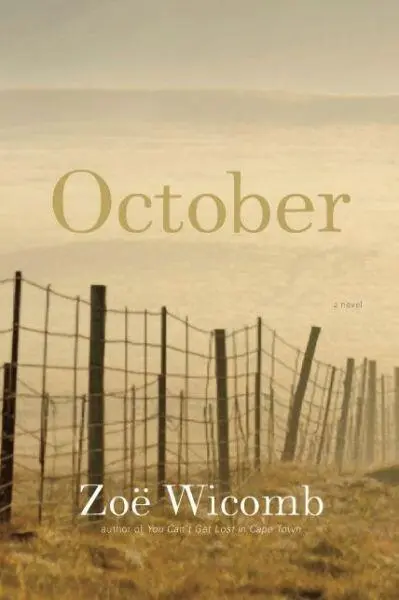
- Название:October
- Автор:
- Жанр:
- Год:неизвестен
- ISBN:нет данных
- Рейтинг книги:4 / 5. Голосов: 1
-
Избранное:Добавить в избранное
- Отзывы:
-
Ваша оценка:
October: краткое содержание, описание и аннотация
Предлагаем к чтению аннотацию, описание, краткое содержание или предисловие (зависит от того, что написал сам автор книги «October»). Если вы не нашли необходимую информацию о книге — напишите в комментариях, мы постараемся отыскать её.
With this pitch-perfect story, the “writer of rare brilliance” (The Scotsman) Zoë Wicomb — who received one of the first Donald Windham — Sandy M. Campbell Literature Prizes for lifetime achievement — stands to claim her rightful place as one of the preeminent contemporary voices in international fiction.
October — читать онлайн бесплатно полную книгу (весь текст) целиком
Ниже представлен текст книги, разбитый по страницам. Система сохранения места последней прочитанной страницы, позволяет с удобством читать онлайн бесплатно книгу «October», без необходимости каждый раз заново искать на чём Вы остановились. Поставьте закладку, и сможете в любой момент перейти на страницу, на которой закончили чтение.
Интервал:
Закладка:
Hokaai! her father said, raising his hand into a stop sign. He suspected the boy of political involvement; he would not be surprised if Fanus had chosen this route in order to further his seditious plans, and if that were not the case, the boy, if he had any backbone, would later, through his own efforts, put himself through university. That, after all, was what he, Nicholas, had to do. Had to work as a delivery boy whilst attending night school, and as an adult paid for his own teacher training. Terrible, he tutted, that the poor go on having so many children.
Mercia felt a second stab of blinding hatred for her father.
There was no question of speaking to Fanus, who avoided being alone with her. Only once, when in her presence he said that he might not bother with the Matric exams, Mercia interrupted, Ah, but if you were to decide on the day to take them after all, you’d still run off with the prize. Fanus was scornful. A silver trophy! Who cares about that? There’s a fascist regime to be overthrown, work to be done, he said, without looking at her.
That was, of course, not what she had meant. They would all have refused the silver cup that Dr. Groenewald had bequeathed to the new Colored High School, and she burned with shame. She thought of refusing to go to university until her father paid Fanus’s fees, but what after all would that bring? Fanus would certainly not have accepted, so that all she could wish for was to leave Kliprand, to put behind her the guilt and shame. And she did. In the heady days of political struggle at the-home-of-the-left university, of falling in and out of love, Fanus and Kliprand faded and merged into a place left behind, a place to which she would never return.
And it turned out, said her father a few years later, that Fanus, just as he suspected, had no backbone after all. Having passed the Matric exam with flying colors, he failed to pull himself up by his own bootstraps. By the time he had helped to get the younger ones through school, and was a leading figure in the seditious UDF, he was working as a manager of sorts in a builders’ yard in Kliprand. Some intellectual! Meester snorted.
So Fanus did not manage to get to university, and Mercia, whose heart was fully mended, assumed that he had like most young men in the village succumbed to drink. In the years that followed, it was not difficult to avoid him during the vacations. Still, she wondered about him, and the trace of guilt persisted for years. Now she cannot help feeling that Fanus has got his revenge. How he must have hated them, the Murrays, who took for granted their privilege.
She must have said it aloud, for Jake sits up and says, Look, this isn’t about Fanus; it’s about me, about us, our family, and the vark who fathered us. And you shouldn’t hold anything against Fanus. He always asks after you, always wants to know how you’re doing at that university of yours; he thinks you’re dead smart.
Mercia groans. Oh no, he doesn’t. He knows only too well that he was much cleverer than I, that it’s a world in which I had an unfair advantage. Too late now for the Fanuses of South Africa, too late for a generation lost to drink. For all the shit in this New South Africa, for all the complaints that the country is going to the dogs, at least for the likes of the Lategans their children have free schooling. At least Fanus’s children will have more of a chance, won’t be ground down with crap work and drink.
Oh yeh? His child is dead, Jake all but shouts. Look, Fanus has more reason to despise me, he says, for having made nothing of my so-called advantage. But I’m glad, do you hear me, I’m glad I left, that I didn’t take the money that the old bastard — and he puts on a solemn, sanctimonious voice — scrimped and saved and sacrificed himself for. Control freak — obedience and gratitude weren’t enough, we had to be his clones. Siss! Puffed up with his own pathetic achievement, with the bloody old bootstraps ballad. Siss! What a pity he didn’t just support Fanus instead, but no, he was fixed on the idea of family that he could mold in his own form, the filthy old hypocrite. Dirty vark. May he squirm in his grave. May the worms gorge themselves and puke in disgust.
Mercia hangs her head. She cannot bear it. She shuts her eyes against the image of their father’s face that drifts up into her vision. The dead old man’s disgrace, like a swarm of blowflies, has invaded her body, so that every organ buzzes with shame. She hears again his voice, the ardent prayer to be a good God-fearing father, and the words he so often quoted: Solomon loved the Lord, walking in the statutes of David his father. Holy, filial love, that was what he set store by. She feels a rush of pity, which she knows to keep to herself. How Nicholas has let himself down.
As if he senses her pity, Jake says, Listen to me: he was evil. When he brought me back here to Kliprand — I was in bad shape then — he might as well have put that bitch on a platter for me. Oh yes, he said we’d have to get someone in to help. Sylvie this and Sylvie that, and she was wonderful. My legs were swollen; I couldn’t walk, but oh Sylvie was the one with healing hands. So she nursed me back to health with her massages and her chicken soup and thereafter her boerefuckingwors and homemade ginger beer. All his doing. What kind of father is that, passing to me his leftovers when I’m on my knees? Dirty bastards.
Jake turns away in disgust, gropes for the bottle, from which he takes a draining swig, and announces that he is off to bed, that she should go, far away from him and his dirty mess. Drained as Mercia feels, she reminds him of his word. She’ll drive him to Dr. Swemmers; he can have a sleep while they wait to be seen, and she says nothing of the rehabilitation clinic where she hopes he’ll be able to go that night. Jake nods. He is too tired to resist; he’ll do anything. He does not question her fumbling in a drawer for clean pajamas, tossing his things into a shopping bag.
Mercy, he says, I’m sorry. I shouldn’t have written. I wanted to keep all this from you.
Jake is shaking; his bleary eyes are awash. Mercia knows what it has taken for him to tell. She puts her arms around him and his head drops on her shoulder. Sweetheart, my poor sweetheart, she says, and is alarmed to hear in her own voice that of the woman on the bus ride to Edinburgh. Poor Jake, she revises, over and over as she leads him to the car, bundles him into the seat.

Mercia swithers about Fanus. Should she speak to him, perhaps even meet up with him? The awkwardness of their teens is still there, a ghostly guilt, but there is always the possibility that he has invented it all, for reasons so base that she knows it to be a foolish hope. Still, she would prefer to hear for herself the story, find out his source (has Sylvie told him?), and check for herself how Fanus has, as one does, translated it through his own history. So that she in turn can retranslate it through her cloud of shame and pity? Oh, she doesn’t know; she is tired of speculations.
There is no question of speaking to Sylvie directly, and that is that. She has not rung the girl, and Sylvie would not expect to hear from her until later that day. But it is her responsibility to ascertain as best she can what really happened. The sins of the father have to be borne, but Mercia cannot bear the girl to know that she knows.
Fanus, though, will have nothing to do with that responsibility. When she looks up his number in the directory and calls to ask whether she could meet with him, he is clipped, firm. He does not beat about the bush. If it’s about Sylvie, he says, yes, he knows he has spoken out of turn; he is sorry, he should not have said anything to Jake.
Читать дальшеИнтервал:
Закладка:
Похожие книги на «October»
Представляем Вашему вниманию похожие книги на «October» списком для выбора. Мы отобрали схожую по названию и смыслу литературу в надежде предоставить читателям больше вариантов отыскать новые, интересные, ещё непрочитанные произведения.









Обсуждение, отзывы о книге «October» и просто собственные мнения читателей. Оставьте ваши комментарии, напишите, что Вы думаете о произведении, его смысле или главных героях. Укажите что конкретно понравилось, а что нет, и почему Вы так считаете.