Ferenc Karinthy - Metropole
Здесь есть возможность читать онлайн «Ferenc Karinthy - Metropole» весь текст электронной книги совершенно бесплатно (целиком полную версию без сокращений). В некоторых случаях можно слушать аудио, скачать через торрент в формате fb2 и присутствует краткое содержание. Год выпуска: 2008, Издательство: Telegram Books, Жанр: Современная проза, на английском языке. Описание произведения, (предисловие) а так же отзывы посетителей доступны на портале библиотеки ЛибКат.
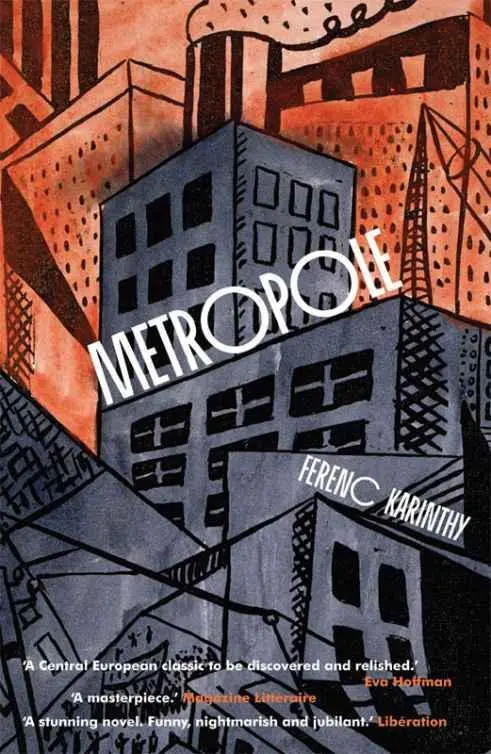
- Название:Metropole
- Автор:
- Издательство:Telegram Books
- Жанр:
- Год:2008
- ISBN:нет данных
- Рейтинг книги:4 / 5. Голосов: 1
-
Избранное:Добавить в избранное
- Отзывы:
-
Ваша оценка:
Metropole: краткое содержание, описание и аннотация
Предлагаем к чтению аннотацию, описание, краткое содержание или предисловие (зависит от того, что написал сам автор книги «Metropole»). Если вы не нашли необходимую информацию о книге — напишите в комментариях, мы постараемся отыскать её.
“A stunning novel. Funny, nightmarish and jubilant.”— "Although it took almost 40 years for
to be translated into English, the book holds up well. In the same way that Kafka becomes relevant again every time you renew your driver's license, Karinthy captures that enduring, horrifying and exhilarating state of being at the mercy of an unfamiliar land." — Jessa Crispin for NPR
“I don’t know when I’ve read a more perfect novel-a dynamically helpless hero (in the line of Kafka), and a gorgeous spiral of action, nothing spare, nothing wrong, inventive and without artifice.”—Michael Hoffman in Budai finds himself in a strange city where he can’t understand a word anyone says. One claustrophobic day blurs into another as he desperately struggles to survive in this vastly overpopulated metropolis where there are as many languages as there are people.
Metropole Ferenc Karinthy
Metropole — читать онлайн бесплатно полную книгу (весь текст) целиком
Ниже представлен текст книги, разбитый по страницам. Система сохранения места последней прочитанной страницы, позволяет с удобством читать онлайн бесплатно книгу «Metropole», без необходимости каждый раз заново искать на чём Вы остановились. Поставьте закладку, и сможете в любой момент перейти на страницу, на которой закончили чтение.
Интервал:
Закладка:
Strangely enough, not for a moment did she question the role Budai had allotted her. Indeed she was clearly ready and willing to act as his language tutor as though this were her responsibility, something she was positively aching to do. As soon as they got to the top floor she lit a cigarette, blew out the smoke and stood ready to help, prepared to answer any question he might have, though it would not have been a simple task for her either, trying to make sense of his scribbles and gestures. Surely she must be wondering what this guest was wanting with his impenetrable foreign words and phrases, what it was he was really after. Maybe she felt it was up to her to look after him, that she alone was capable of helping — or was it some other instinct that drove her?
However he tried Budai could not work out the precise terms of her employment or whether she had a fixed routine. There were times he could not find her when his life seemed empty, barren and pointless: it frightened him to think how vague his own place in the world was. He made no effort to experiment with other people, thinking it would only confuse him now and cast into doubt the tiny amount he thought he might have learned. And after all Dédé’s kindness and patience it would have felt a little like infidelity.
He didn’t flatter himself that he could stop the first person in the street and simply ask them to teach him the language: he already knew that was out of the question. There were a lot of drunks out there, especially after dark, not only in the street but in the metro, as well as in the hotel lobby: men and women, reeling about, singing, shouting, arguing, swearing and fighting — not much point asking them. It was chiefly the evenings he feared when his hotel room felt like a prison. If only he had something to read in whatever language as long as he understood it!
He couldn’t really spend all his time trying to solve the obscure wherewithal of texts of which he did not recognise a single letter. He lacked the determination, he lacked the detachment: he feared going mad. In any case, to go out was to risk missing the girl: there were times when she worked both mornings and nights. But he couldn’t just sit around in his room doing nothing: he was constantly restless, anxious to carry on researching and sniffing out the truth, to come and go, fearing that if he simply stood still no one would look for him.
So he spent most of his time in the lobby keeping track of the movements of the lift. The vast hall was always full, even at night, people sitting in armchairs, dozing or teetering sleepily to and fro. The queue at reception was always long with ever more guests carrying ever more luggage. What was strange was that he had only seen luggage enter the hotel: nothing seemed to leave it. Guests must be departing all the time, their luggage must be somewhere. Perhaps if he were to investigate that… Might the luggage be carried out through another door? And where would that door be? Surely it could not be that people arrived here never to leave?
He glanced up and spotted the delegation of exotic hierarchs he had seen that first morning, that motley crew of bearded, brilliantly dark-skinned, caftan-and-chain-wearing elders in high fur caps, who were once more proceeding in silent and dignified manner past respectful crowds that opened before them. Nothing they wore hinted at what part of the world they came from or indeed which religion they represented.
He took a short walk in the street, passing the fat doorman who always greeted him by raising his hand to his cap. He only went as far as the skyscraper-in-construction to see how far they had got. They were still working away at great pace, armies of builders swarming over the structure, welders sparkling, mobile platforms rising and sinking under floodlights. It was odd that the building had only grown by an extra floor since he had last seen it and counted the floors — they had got to seventy — though he had been here longer.
There was just as much bustle at night as at any other time. People were constantly pouring in and out of the metro, great ranks of exhausted workers, their faces puffy with sleep, heading towards industrial estates on the outskirts to their dawn occupations. Others were merely dawdling, drifting along aimlessly, bumping into each other on corners or in squares, getting involved in arguments, discussing sporting events or waiting for the morning papers. There were syrupy alcoholic drinks on sale, the kind that had made him drunk before. He would have welcomed a little alcohol, the tipsy light-headedness it offered, the lack of responsibility it conferred, but he stood by his resolution and was thrifty with his money, what remained of it.
Far in the distance he noticed the same neon lights alternating between red and blue. What might they be advertising? From a basement room nearby there rose something he had thus far missed: the sound of drums and music, waves of general noise. Out of curiosity he looked in. It was a large room, a kind of dance hall packed to the rafters, though owing to the smoke, the racket and the crowds that filled every nook and cranny, he couldn’t make out where the floor was. People were dancing between the tables, at the bar, by the wall and on the steps leading down. Of course it was mainly the young wearing the brightly fashionable or ostentatiously ragged universal uniform of youth. It wasn’t just boys dancing with girls, but girls with girls and boys with boys too. They weren’t really in pairs: it was more everyone with everyone, all higgledy-piggledy yet each alone, each an island unto himself or herself in the general movement. The sexes were hard to distinguish in any case, many of the boys sporting long feminine hairstyles, a lot of the girls in trousers. Apart from that, it seemed the whole world was there, each part of it, every human race represented by someone, all mixed up topsy-turvy, tugging and shrugging, kicking up heels, waving arms to the rhythm of the music.
There was no trace of musicians though: it must have been a record-player or some similar equipment. It was unbearably loud, non-stop, one piece exactly like another, consisting entirely of beat with practically no trace of melody, the whole thing broken, syncopated, aggressive, shameless, rhythmic. But it was the volume above all that hurt Budai, his head almost exploding with it: he couldn’t understand how people could bear the constant pounding.
He was about to leave when there was a kind of disturbance or panic by the far wall. At first he couldn’t tell what precisely it was, it was just that the movement was different, no longer to the rhythm of the music. After a few seconds he realised the cause of it: a fight had broken out, and, as the space cleared, he could see it was between blacks and whites. He had no idea what it was about and could only guess, for no very good reason, that the slim, straw-blonde girl who appeared for a moment between the groups of brawlers, the one with the indifferent, mocking expression on her face, had something to do with it.
By the time Budai noticed it it was practically over, the groups having been separated from each other. Officials appeared as if from nowhere, uniformed men wearing those ubiquitous brown boiler suits. They blew whistles and formed a line that served as a living barrier between the two camps. Despite this, the groups continued threatening each other with unchecked fury, trying to break the line, pulling faces and screaming. Budai was curious as to what they were saying, it might well help him in his quest for understanding. As far as he could make out under the music — for that had gone on uninterrupted — the imprecations and challenges consisted of raising one’s fists and shouting something like:
‘Gyurumba!… Ugyurumbungya!’
This could mean any number of things, like: Filth! Dickhead! Bastard! You just wait! Come on then! I’ll smash your face in! Oh yeh?! All the same, Budai noted them down in his book phonetically along with the range of possible meanings.
Читать дальшеИнтервал:
Закладка:
Похожие книги на «Metropole»
Представляем Вашему вниманию похожие книги на «Metropole» списком для выбора. Мы отобрали схожую по названию и смыслу литературу в надежде предоставить читателям больше вариантов отыскать новые, интересные, ещё непрочитанные произведения.









Обсуждение, отзывы о книге «Metropole» и просто собственные мнения читателей. Оставьте ваши комментарии, напишите, что Вы думаете о произведении, его смысле или главных героях. Укажите что конкретно понравилось, а что нет, и почему Вы так считаете.