Paul Theroux - Blinding Light
Здесь есть возможность читать онлайн «Paul Theroux - Blinding Light» весь текст электронной книги совершенно бесплатно (целиком полную версию без сокращений). В некоторых случаях можно слушать аудио, скачать через торрент в формате fb2 и присутствует краткое содержание. Год выпуска: 2006, Издательство: Mariner Books, Жанр: Современная проза, на английском языке. Описание произведения, (предисловие) а так же отзывы посетителей доступны на портале библиотеки ЛибКат.
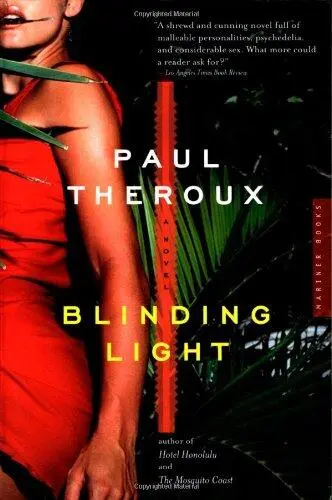
- Название:Blinding Light
- Автор:
- Издательство:Mariner Books
- Жанр:
- Год:2006
- ISBN:нет данных
- Рейтинг книги:5 / 5. Голосов: 1
-
Избранное:Добавить в избранное
- Отзывы:
-
Ваша оценка:
Blinding Light: краткое содержание, описание и аннотация
Предлагаем к чтению аннотацию, описание, краткое содержание или предисловие (зависит от того, что написал сам автор книги «Blinding Light»). Если вы не нашли необходимую информацию о книге — напишите в комментариях, мы постараемся отыскать её.
Blinding Light — читать онлайн бесплатно полную книгу (весь текст) целиком
Ниже представлен текст книги, разбитый по страницам. Система сохранения места последней прочитанной страницы, позволяет с удобством читать онлайн бесплатно книгу «Blinding Light», без необходимости каждый раз заново искать на чём Вы остановились. Поставьте закладку, и сможете в любой момент перейти на страницу, на которой закончили чтение.
Интервал:
Закладка:
She challenged him to go further. “Deeper, deeper, deeper,” she would say. He had never known a woman to be so explicit in daring him. Theirs was nothing like the sort of courtship or love affair in which by degrees trust was gained and plans were made for a future together. Next month, next year, a vacation, children, a mortgage — none of that. They had no future; tonight was enough. They wrecked themselves on each other, and yet the following day they met again, like insatiable conspirators, for more.
She was able to surprise him as no other woman had ever done. One night she said, “I’ve got something for you,” and he expected exotic lingerie or Polaroids, as in the past. But if she promised something new, it was original, all hers, and certainly new to him. She did not disappoint.
That night she met him at the Dockside bar wearing a dark tailored suit and slacks, a wide tie, a felt fedora. He smiled — he had never seen this suit on her before. She looked like a decadent schoolboy. On the way home she told him to pull into a side road and park. “I want to make out with you,” she said, and kissed him, let him grope her, fondle her breasts, and she opened her knees and held his hand against her. He felt something hard, like a rubber truncheon, between her legs.
“A strap-on,” she said. “That’s for both of us.”
And when they set off again, Steadman became sweaty, anxious, eager, and fearful, as she described how she was going to use it on him. But in the house she would not go into the bedroom. She lazed on his sofa and pulled the thing out and played with it and refused to take any clothes off. “On your knees,” she said, “get me in the mood,” and forced his head down. Seeing how he was making her happy — she screeched with pleasure as she gagged him — he became aroused by the madness of her voluptuous laughter.
Again and again he had to remind himself that she was a physician, respected in the hospital and on the island. Yet how was it possible, knowing the most delicate surgery and all the anatomy — the name of every tissue, every muscle, every organ — that she could lose herself in the darkness of the body in which nothing had a name? A doctor was trained to see the body as something coherent, namable, dissectible, like a symmetrical cabinet of flesh and blood. But that was her daytime preoccupation; at night she stripped him naked and operated on him with her mouth and her fingers, devouring him, nameless part by nameless part, as though they were hardly human.
“You are my meat,” she said.
That summer passed. People saw them together, the writer and the doctor, but as Steadman and Ava always looked semidetached and distracted, like friends, never a couple, the people observing did not speculate unduly. They were glad to see Steadman at last out of his selfimposed captivity. His good mood seemed to indicate that he who had published nothing in years might have freed himself from his seclusion by finishing a book and would be publishing it soon.
There was no book, and now his silence was a virtue, for he was spending time with Ava and glorying in her paradoxes — the medical doctor who was a debauched sensualist. Summer faded into fall, and fall declined into winter, and the cold weather made them more companionable, allowing them to possess the darker, emptier island. Winter was perfect, their solitude complete. The Vineyard seemed to belong to them. The hospital was less busy, there were no parties, hardly any social events, no “Taking another trip?” no “How’s the book coming along?”
And there was nothing more exciting to him than Ava’s phoning him in midafternoon: “Tonight — a house call,” then click, and his anticipating her arrival in the early dark of winter, frost gleaming on the grass, and the approach of her car, the fat tires announcing her on the gravel driveway, and her kiss, her warm breath, her open mouth, “I want you,” and her taking off her laboratory smock or her ER scrubs and revealing herself in a pretty dress or lingerie. The great room of his house was so warm they were comfortable lying half naked on the sofa; the candle flames, the mirrors, her sighs, which became low howls of pleasure. Out here, in the winter, she could scream — and sometimes did, foulmouthed in uncontrollable desire, shocking him with men’s words — and no one would hear, for they were in the middle of a dark ice-bound island.
When they were done, drenched in sweat, panting for breath, they lay in each other’s arms.
“I hadn’t expected you to call.”
“I had to see you,” she might say. “We lost someone today, a nice old man. I needed to do something life-affirming.”
He smiled, he held her.
“Something human. Something perverted.”
But he would sometimes stare, seeing only the elderly blood-drained face of a patient yellowing on a pillow, open-mouthed, as though having died screaming.
“Now I’m better. You cured me. Gotta go.” Abrupt, all business, like a man on a mission, she was out the door and in her car, and at last two receding red lights.
Spring came, full of equivocating winds and low temperatures, dawdling promises, daffodils in April, drizzle and mud in May, reminders of the previous spring and their first meeting, and somehow giving a sense of repetition to their days and weeks. They had been together for a full year. In the second summer Ava was busier at the hospital, in greater demand, and he was the one who was made to wait. Waiting was hard for him, because he had no work. He wondered if there was someone else; he couldn’t ask — that was their agreement, proposed by her. “When we’re together we should possess each other. When we’re alone we have no claims.” Steadman had thought that was a good, enlightened idea, but as the summer passed and he saw less of her, he became insecure, suspicious, jealous.
“I think I have a rival,” he said one day, hating himself for even raising the subject.
“Two rivals,” she said. “A man with emphysema, on a ventilator, with pneumonia, whose family wants to pull the plug. And a man in constant pain, in a head and neck brace, who fell from a roof he was fixing and cracked three cervical vertebrae, whose heart is too weak to let us operate. Who just wants to die.”
She was the strong one, and understanding this he was ashamed of himself. He felt more like one of her patients than her lover, but a fatuous and fussing patient, whining for her attention. He sometimes wished that there really had been something wrong with him, so he could justify seeing her more often. She had a busy life that was determined by the urgencies of medical procedures. She was sometimes so reflective that she fell silent when she was with him, and he knew she was thinking of a critical case, someone at the hospital.
Her work was full of life and death — rescue and cure, real flesh, real blood. What had he to offer in return? Blank pages and complaints, the insubstantial fictions of someone who had forgotten how to write, who might have nothing to write. By the end of the summer she was polite but preoccupied, and though they remained sex partners — the blunt, unsentimental expression was hers; she often described previous lovers that way — the passion was gone, and with it the sexual innovation. She was a good doctor; he did not feel let down, but he knew she was caring for him.
“I’m still very fond of you,” she said, and he laughed, because the expression was empty of desire. It was like a way of saying goodbye.
He knew it was over. “Fond” said it all. “Fond” was the opposite of her teeth and lips, her torn panties, her stabbing finger, his flogging her smeared face with his cock as she teased him with her tongue.
They made a ritual one night of burning their Polaroids. In their solemnity they were so reproached by what they saw, they hardly recognized their own bodies. They spoke of needing to find a way to end the affair, to formally seal it somehow.
Читать дальшеИнтервал:
Закладка:
Похожие книги на «Blinding Light»
Представляем Вашему вниманию похожие книги на «Blinding Light» списком для выбора. Мы отобрали схожую по названию и смыслу литературу в надежде предоставить читателям больше вариантов отыскать новые, интересные, ещё непрочитанные произведения.











Обсуждение, отзывы о книге «Blinding Light» и просто собственные мнения читателей. Оставьте ваши комментарии, напишите, что Вы думаете о произведении, его смысле или главных героях. Укажите что конкретно понравилось, а что нет, и почему Вы так считаете.