Paul Theroux - Hotel Honolulu
Здесь есть возможность читать онлайн «Paul Theroux - Hotel Honolulu» весь текст электронной книги совершенно бесплатно (целиком полную версию без сокращений). В некоторых случаях можно слушать аудио, скачать через торрент в формате fb2 и присутствует краткое содержание. Год выпуска: 2002, Издательство: Mariner Books, Жанр: Современная проза, на английском языке. Описание произведения, (предисловие) а так же отзывы посетителей доступны на портале библиотеки ЛибКат.
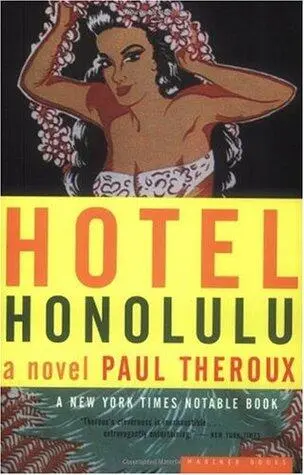
- Название:Hotel Honolulu
- Автор:
- Издательство:Mariner Books
- Жанр:
- Год:2002
- ISBN:нет данных
- Рейтинг книги:4 / 5. Голосов: 1
-
Избранное:Добавить в избранное
- Отзывы:
-
Ваша оценка:
Hotel Honolulu: краткое содержание, описание и аннотация
Предлагаем к чтению аннотацию, описание, краткое содержание или предисловие (зависит от того, что написал сам автор книги «Hotel Honolulu»). Если вы не нашли необходимую информацию о книге — напишите в комментариях, мы постараемся отыскать её.
Hotel Honolulu — читать онлайн бесплатно полную книгу (весь текст) целиком
Ниже представлен текст книги, разбитый по страницам. Система сохранения места последней прочитанной страницы, позволяет с удобством читать онлайн бесплатно книгу «Hotel Honolulu», без необходимости каждый раз заново искать на чём Вы остановились. Поставьте закладку, и сможете в любой момент перейти на страницу, на которой закончили чтение.
Интервал:
Закладка:
Lionberg felt insecure and outwitted, but the girl was looking around once again.
"What do you call those trees?"
They were tall and weedy-looking, with slender trunks that popped up everywhere, and especially flourished in the gully that lay between the hedge around Lionberg's garden and the perimeter fence.
He said, "To tell you the truth, they're a nuisance. Christmasberry. Brazilian pepper. Schefflera. Gunpowder trees."
"They're so green."
He was holding a newly washed gardenia bough in his hands, but she said nothing about that.
"I've put your bag in the guest house. I think you'll be comfortable there."
"Hey, thanks." She started away.
She was graceful-looking yet had no grace. The young could be so abrupt.
"Dinner's at eight."
"That's okay, I won't be eating," she said. "I got some bananas at Foodland and ate them coming up the hill."
Lionberg said, "We were expecting you to have dinner, I'm afraid. I think the chef made something special for you."
Had she seen a look of disappointment on his face? He hoped not, because he knew that he was not disappointed. It was simply that the guest, like the host, had certain obligations.
"Okay, I'll come. Hey, that's real sweet of the chef."
He repeated the time. He said there was no dress code. But he thought: Why did I insist on her coming? Why did I mention the chef? He had never done that before. He had always been happiest eating alone. And by the time dinner was ready, he had stopped being annoyed with himself and begun to resent the girl for making him feel so ill at ease in his own house.
51 Dinnertime
"Here I am again," Rain Conroy said, sounding so willing, though he knew she was there because he had insisted. Yet she seemed convincingly enthusiastic, and as always her voice sounded cheery. There was something wholehearted and uncomplaining about her, and even the way she looked tonight reassured him. She wore a simple black dress that showed off her long legs, which were beautiful. The dress was so small and insubstantial Lionberg imagined plucking it off her by its spaghetti straps and cramming it into his pocket.
The skirt was riding up her thigh — she was leaning, peering into the side room, Lionberg's study. "Calla lilies," she said eagerly, and looking closer, she walked into the room.
Who had ever before entered Lionberg's study? The maid, a carpet layer, a cable installer. They had no idea where they were. It was a source of pride to Lionberg that no one other than a handful of employees or laborers had ever seen the room in which he worked, had ever seen the place in which he used his mind, had ever seen his desk, his scattered papers, the books that mattered most to him, his favorite paintings, everything he regarded as revelation. Even his handwriting, which he was sensitive, even a bit vain, about — he wanted no one to see it, no one to know him through it, did not want to hear any comments about it. He
sensed that if someone saw it, he would be exposed and would lose something of himself.
And here was Rain Conroy with her hands on his desk, smiling at the painting.
"Georgia O'Keeffe. An amazingly introspective image, I always think."
"I used to grow them," she said. She wasn't listening.
"I can't tell you the number of museums that have pestered me for it. I wouldn't part with it. I never get tired of looking at it."
"They love fish fertilizer, nitrogen especially," she said. "You can tell when they're happy. They get very white. And when they're not looked after, they get all limp and sort of rot."
"Lilies that fester smell far worse than weeds," Lionberg said.
"That's really true, you know."
"Shakespeare. Sonnet Ninety-four." She didn't hear that, either.
Lionberg turned some papers over. Not that the girl was looking at them, but seeing his handwriting made him self-conscious.
"This is my study," he said. "I do my work here."
"What kind of thing do you do?"
"I am a man of leisure," Lionberg said. "A little writing. Some gardening. Some beekeeping."
She was in his room; he had revealed what he did there. She could see his papers, the pictures — not just the O'Keeffe but the Matisse sketch of a footbridge and the photograph of himself at age ten, posed on the porch of his parents' house. Anyone could see that he had been a deeply unhappy child; he had sorrowful eyes. Lionberg pitied the child when he looked at it. She was unimpressed by everything except the flower — not the painting but the species.
"Isn't this sketch incredible?" He decided not to say it was Matisse. "Pencil."
"Anyone could erase it," she said.
He decided to surprise her by switching on the old jukebox, which had been in shadow in a corner of the room. She laughed at the red and blue and yellow lights, the flashing lights inside its fishbowl top, where the black plastic records shimmered. The light was on her face.
"We've got one just like that at the diner where I work," she said.
Lion berg switched off the lights.
Rain was still smiling, moving forward. The study led to a lanai, which was attached to his bedroom. She commented on the palms in the colorful Sicilian vases, the plants — strawberries in terra-cotta pots, herbs in a planter. At the edge of the lanai sat several large Chinese water jars, glazed red, that held fish and water lilies and greens mats of hyacinth.
"Those are nice."
"When I can't sleep, which is often, I come out here and shine a flashlight in and look at the fish."
"I have the opposite problem. I have trouble waking up."
He realized that she had seen nearly everything on this floor of the house. Walking back to the dining room, she glanced to the side and said, "That's the second-biggest TV screen I've ever seen."
She meant the television set in his bedroom, which she had glimpsed through the lanai window. It was his secret that he often lay in bed and watched old movies on the screen that took up most of one wall. No one had seen it because no one had been on his private lanai, which was accessible only from his study.
Lionberg asked, "I'm curious. Which TV screen was the biggest?"
"Pigskin Lounge in Sweetwater," she said. "It's a sports bar. Buddy's cousin owns it. You never want to go there alone if you're a woman, my father used to say."
Lionberg's only thought was that he had never been in such a place.
"This is great," Rain said, seating herself at the elaborately set table -
— all the silver, four glasses each, the stacked plates, the napkin rings. "My father was always so big on mealtimes."
"And you're not?"
"I don't think about it much."
"One of the pleasures of life."
"I usually eat standing up," Rain said.
Lionberg said, "If I had a daughter, I would never say, 'Don't go there, don't do this or that.' I'd tell her to go anywhere she wanted. Complete freedom."
"Excuse me, but if you lived in Sweetwater, you sure as heck wouldn't. You'd be warning her and worrying, just like my daddy did."
Lionberg realized that in trying to please her by seeming openminded, he had made himself look naive. He even wondered whether he believed what he had just said to her. But then, what did it matter? He had never been in such a bar. He was bored by sports, by the noise and the frantic spectacle. The sight of big men competing seemed to him gladiatorial and frightening and sometimes sissified.
"Bars like that are dangerous," she was saying, sure of herself, seeming to know how ignorant he was of such places. "If a single woman goes in, the men figure she's looking for trouble. And she usually is, or why else would she be there? It's a man's place."
He was smiling, as though she were not being logical.
"Just a joint," she said.
Читать дальшеИнтервал:
Закладка:
Похожие книги на «Hotel Honolulu»
Представляем Вашему вниманию похожие книги на «Hotel Honolulu» списком для выбора. Мы отобрали схожую по названию и смыслу литературу в надежде предоставить читателям больше вариантов отыскать новые, интересные, ещё непрочитанные произведения.










Обсуждение, отзывы о книге «Hotel Honolulu» и просто собственные мнения читателей. Оставьте ваши комментарии, напишите, что Вы думаете о произведении, его смысле или главных героях. Укажите что конкретно понравилось, а что нет, и почему Вы так считаете.