Christopher Beha - Arts & Entertainments - A Novel
Здесь есть возможность читать онлайн «Christopher Beha - Arts & Entertainments - A Novel» весь текст электронной книги совершенно бесплатно (целиком полную версию без сокращений). В некоторых случаях можно слушать аудио, скачать через торрент в формате fb2 и присутствует краткое содержание. Год выпуска: 2014, Издательство: Ecco, Жанр: Современная проза, на английском языке. Описание произведения, (предисловие) а так же отзывы посетителей доступны на портале библиотеки ЛибКат.
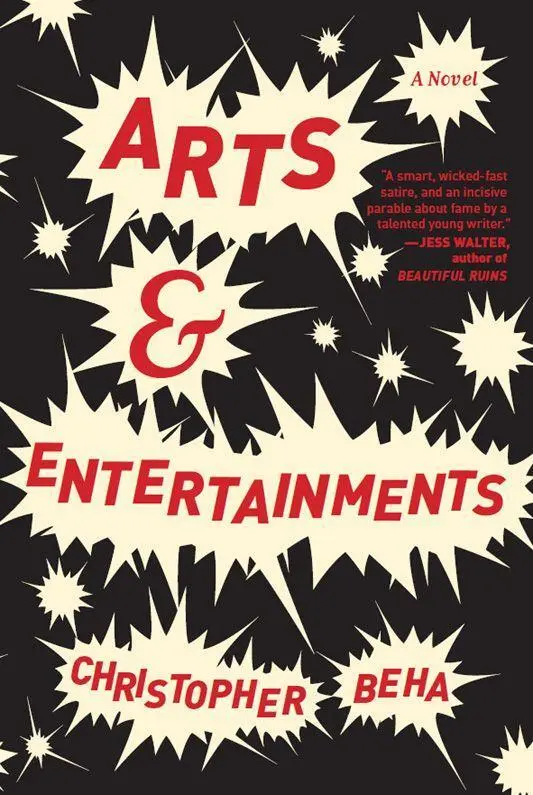
- Название:Arts & Entertainments: A Novel
- Автор:
- Издательство:Ecco
- Жанр:
- Год:2014
- ISBN:нет данных
- Рейтинг книги:4 / 5. Голосов: 1
-
Избранное:Добавить в избранное
- Отзывы:
-
Ваша оценка:
Arts & Entertainments: A Novel: краткое содержание, описание и аннотация
Предлагаем к чтению аннотацию, описание, краткое содержание или предисловие (зависит от того, что написал сам автор книги «Arts & Entertainments: A Novel»). Если вы не нашли необходимую информацию о книге — напишите в комментариях, мы постараемся отыскать её.
Weighted down with debt, Susan's mounting unhappiness, and his own deepening sense of failure, Eddie is confronted with an alluring solution when an old friend-turned-Web-impresario suggests Eddie sell a sex tape he made with an ex-girlfriend, now a wildly popular television star. In an era when any publicity is good publicity, Eddie imagines that the tape won't cause any harm — a mistake that will have disastrous consequences and propel him straight into the glaring spotlight he once thought he craved.
A hilariously biting and incisive takedown of our culture's monstrous obsession with fame,
is also a poignant and humane portrait of a young man's belated coming-of-age, the complications of love, and the surprising ways in which the most meaningful lives often turn out to be the ones we least expected to lead.
Arts & Entertainments: A Novel — читать онлайн бесплатно полную книгу (весь текст) целиком
Ниже представлен текст книги, разбитый по страницам. Система сохранения места последней прочитанной страницы, позволяет с удобством читать онлайн бесплатно книгу «Arts & Entertainments: A Novel», без необходимости каждый раз заново искать на чём Вы остановились. Поставьте закладку, и сможете в любой момент перейти на страницу, на которой закончили чтение.
Интервал:
Закладка:
“Anyone who watched Sandra in the roller derby challenge of Scavenger Detroit, ” Marian assured her viewers, “knows she’s not a quitter.”
“Burt Wyman got a DUI,” Eddie told Susan one morning while flipping through a copy of CelebNation that he’d found in the Hope Springs waiting room.
“Who on earth is that?”
“He was the runner-up in the last season of We Drink Too Much.”
“You watch that show?”
“It’s very popular.”
“Put that thing down.”
She laughed as she said it, but Eddie followed her command. More and more she addressed him in this imperative mode. Clean up the kitchen. Turn off the TV. Be gentle with that needle. They moved from Lupron to Menopur and Follistim, which was a good sign, except that the drugs made her angry and manic. She needed constant reminders of why they were doing all this. Eddie considered it a good day when she was too tired to be mad at him.
Otherwise everything seemed to be working out. On the morning that Eddie told Susan about Burt’s relapse, Regnant announced that they had a good number of suitable eggs. They needed to get ready for retrieval.
Two days later the nurses brought Susan to the room where her follicles would be removed. She was put under general anesthesia for the procedure. For once Eddie had his own job to do. This time he didn’t have to go off site, to the farthest reaches of the West Side. It amazed him how much nicer a room you were given for this business once you paid five figures. The array of auxiliary materials provided was astonishing. A few months from now, he imagined, the Martha Martin tape would be included in the Hope Springs library.
Regnant called the next week to say that things looked good, though it didn’t sound that great.
“It’s not the ideal scenario,” he admitted. “But I’m honestly pretty happy with where we are. We’ve got three fertilized embryos, which is a lower number than I’d hoped. None of them have developed into blastocysts yet, but that’s not necessarily a problem. I’d like to go ahead and implant all three of them. I think that’s our best bet.”
This mixed news already put them further along than they’d gotten the first time around, and Susan seemed entirely encouraged. The next morning, they went back to Hope Springs. Given all they’d been through and the importance of this next step, it was a remarkably simple procedure. Susan was put into stirrups in the surgical room. Eddie held her hand, but he looked away as Regnant brought the catheter between her legs. There was a sloppy, squishing sound while it entered her, and Susan squeezed Eddie’s hand. After it was over, she smiled. There were embryos inside of her, little babies waiting to be born. They would have to wait about two weeks for a test to tell them if any had implanted themselves.
In the recovery room, Susan was punchy from excitement. She looked at Eddie with a silly, loving smile. Once she had regained some strength, he stood her up and helped her to get dressed. Halfway to the elevator, she pointed at a magazine on the coffee table.
“Look, honey,” she said.
Eddie picked up the copy of CelebNation, a new issue he’d somehow missed. “Dr. Drake Baby Bump?” the cover headline asked. There was a photo of Martha and Turner walking hand in hand. Martha’s midsection had been magnified within a red circle in the middle of the page. It might have just been the loose shirt she was wearing, but it did look like her belly was bigger than usual. Eddie looked over at Susan, waiting for her reaction. She laughed and put her arms around him.
“I guess we’re not the only ones having a baby.”
PART TWO
SEVEN
INTRODUCTION TO DRAMATIC ACTING was Eddie’s first class of the year, second period in the theater. Nearly a third of the sophomore class — about twenty students — had signed up, making it the most popular elective. Eddie was under no illusion about this popularity. The creative impulse was meant to be encouraged and critical judgment understood as finally subjective, so any student who showed up in Eddie’s classes and gave some sign of having done the work could expect an A- or, at worst, a B+. The same was true of some of the other electives — fiction writing and art studio — but there were additional advantages to “DramAct,” as the boys called it. Eddie was a lousy disciplinarian, and he was easily led into digressions that took up much of the fifty-minute period. At some point word had spread that you could get away with attending his classes while stoned. He didn’t believe in his own authority, which made it impossible to project it to the boys. At heart, he didn’t care whether they learned anything. His first goal was keeping himself out of trouble by avoiding any student complaints. His second was making sure he didn’t accidentally inspire one of them to a vocation, which could only end badly. With the exception of Patrick Hendricks, he seemed to have succeeded so far.
“If you’ve ever smiled in appreciation after opening a present you didn’t want, you’ve been an actor,” Eddie announced to the boys by way of introduction. “If you’ve ever told your mother you were cleaning your room when you were really watching the game, you’ve been an actor. If you’ve ever made up an excuse to get out of going out with a girl whose feelings you didn’t want to hurt, you’ve been an actor.”
This was the speech his predecessor, Mr. Carlton, had made at the beginning of this class, and Eddie performed it more or less verbatim, though the examples were hopelessly stale. These boys were not required to put on a smile when they didn’t like something they were given. They told their mothers what they actually wanted and got it the next day. As for cleaning up their rooms, the best of them were minimally polite to the household help. Nor did they care about sparing feelings, based on what Eddie heard in the hall. The attitude seemed to be that the less attractive you made a girl feel, the more accommodating she would be.
But the examples hardly mattered, since the entire speech was wrong. Eddie didn’t know whether Carlton had ever believed it, but Eddie himself certainly did not. He remembered Martha telling him how she had learned to act by being encaged in her beauty, holding herself apart from the world. This conceit had appealed to him so long as he thought he was in on the act, not just another member of the crowd. But what she’d done wasn’t acting. You weren’t actually supposed to lie to the audience. It wasn’t acting when you told a stranger that you were a Russian aristocrat. Acting was when you told a stranger, “Tonight, I will be playing the role of a Russian aristocrat,” and proceeded to make that stranger believe you in the role anyway. Lying credibly, Eddie had learned, took no talent at all if you were telling a lie that the other person wanted to believe.
He repeated the speech nonetheless, because nothing else he thought to say seemed any better. If he told them that acting wasn’t the same as lying, without telling them what it might be instead, that only confused matters, which wasn’t supposed to be a teacher’s job. Most of what people said about acting was wrong. There was a truth to be learned, but it could only be experienced, not named. You arrived at it through trial and error, and that process couldn’t be taught. This obviously wasn’t a great attitude for an acting instructor to have, which was why Eddie kept it to himself.
When he’d finished, he took a moment to measure the class’s reaction. The boys looked blankly at him, except for a pair talking in the back of the theater, who made no effort to lower their voices.
“Why don’t we go around the room and introduce ourselves. You all know each other, of course, but I don’t know everyone. Say your name, and tell us your favorite actor.”
Читать дальшеИнтервал:
Закладка:
Похожие книги на «Arts & Entertainments: A Novel»
Представляем Вашему вниманию похожие книги на «Arts & Entertainments: A Novel» списком для выбора. Мы отобрали схожую по названию и смыслу литературу в надежде предоставить читателям больше вариантов отыскать новые, интересные, ещё непрочитанные произведения.



Обсуждение, отзывы о книге «Arts & Entertainments: A Novel» и просто собственные мнения читателей. Оставьте ваши комментарии, напишите, что Вы думаете о произведении, его смысле или главных героях. Укажите что конкретно понравилось, а что нет, и почему Вы так считаете.