Richard Ford - Independence Day
Здесь есть возможность читать онлайн «Richard Ford - Independence Day» весь текст электронной книги совершенно бесплатно (целиком полную версию без сокращений). В некоторых случаях можно слушать аудио, скачать через торрент в формате fb2 и присутствует краткое содержание. Год выпуска: 1996, Издательство: Vintage, Жанр: Современная проза, на английском языке. Описание произведения, (предисловие) а так же отзывы посетителей доступны на портале библиотеки ЛибКат.
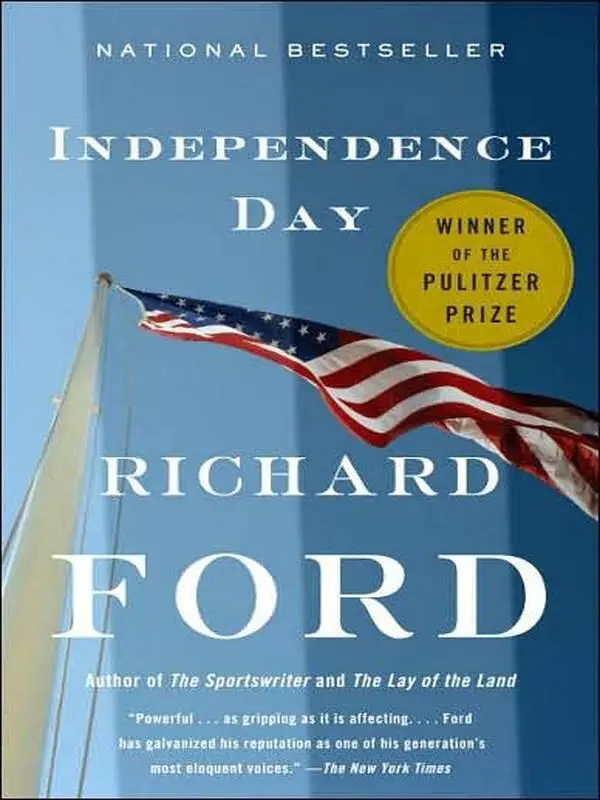
- Название:Independence Day
- Автор:
- Издательство:Vintage
- Жанр:
- Год:1996
- ISBN:нет данных
- Рейтинг книги:3 / 5. Голосов: 1
-
Избранное:Добавить в избранное
- Отзывы:
-
Ваша оценка:
Independence Day: краткое содержание, описание и аннотация
Предлагаем к чтению аннотацию, описание, краткое содержание или предисловие (зависит от того, что написал сам автор книги «Independence Day»). Если вы не нашли необходимую информацию о книге — напишите в комментариях, мы постараемся отыскать её.
, Richard Ford deepens his portrait of one of the most unforgettable characters in American fiction, and in so doing gives us an indelible portrait of America. Frank Bascombe, in the aftermath of his divorce and the ruin of his career, has entered an "Existence Period," selling real estate in Haddam, New Jersey, and mastering the high-wire act of normalcy. But over one Fourth of July weekend, Frank is called into sudden, bewildering engagement with life.
is a moving, peerlessly funny odyssey through America and through the layered consciousness of one of its most compelling literary incarnations, conducted by a novelist of astonishing empathy and perception.
Independence Day — читать онлайн бесплатно полную книгу (весь текст) целиком
Ниже представлен текст книги, разбитый по страницам. Система сохранения места последней прочитанной страницы, позволяет с удобством читать онлайн бесплатно книгу «Independence Day», без необходимости каждый раз заново искать на чём Вы остановились. Поставьте закладку, и сможете в любой момент перейти на страницу, на которой закончили чтение.
Интервал:
Закладка:
The McLeods’ house looks as it did at 8:30, though someone in the last three hours has removed my FOR RENT sign from in front of the Harrises’, and I pull to a halt there, careful not to stop in front of the McLeods’ and alert them. I climb out into the clammy heat, ditch my windbreaker and hike up onto the dry lawn and take a look around. I check down both sides of the house, behind the hydrangeas and the rose of Sharon bush and up on the tiny porch as if the sign stealers had just uprooted the thing and tossed it, which according to Everick and Wardell is what usually happens. Only it’s not here now.
I step back out to my car, open the trunk for another sign from the several (FOR SALE, OPEN HOUSE, REDUCED, CONTRACT PENDING) that’re stacked there with my box of offer sheets, along with my suitbag and fishing rods, three Frisbees, two ball mitts, baseballs and the fireworks I’ve ordered special from relatives in Florida — all important paraphernalia for my trip with Paul.
I bring the new FOR RENT up onto the lawn, find the two holes the previous sign occupied, waggle the stiff metal legs in until they stop, and with my toe mash some grassy ground around so that everything looks as it did. Then I close up the trunk, wipe the sweat off my arms and brow, using my handkerchief, and walk straight to the McLeods’ front door, where, though I mean to ring the bell, I like a criminal step to the side and peer through the front window into the living room, where it’s murky as twilight. I can make out both McLeod kids huddled on a couch, eyes glued like zombies to the TV (little Winnie is clutching a stuffed bunny in her tiny hands). Neither one of them seems to see me, though suddenly the older one, Nelson, jerks his curly head around and stares at the window as if it were just another TV screen, and I was in the picture.
I wave a little friendly wave and grin. I would like to get this over with and get going to Franks and on to Sally’s.
Nelson continues staring at me out of the dark room’s dreamy light as though he expects me to disappear in a few more seconds. He and his sister are watching Wimbledon, and I suddenly realize that I have no business whatsoever gawking in the window and am actually running a serious risk hothead Larry will blow my head off.
Little Nelson gazes at me until I wave again, step away from the window, move back to the door and ring the bell. Like a shot, his bare feet hit the floor and pound out of the room, heading I hope to get his lazy parents up out of bed. An interior door slams, and far, far away I hear a voice below the a/c hum, a voice I can’t make out, saying what, I’m not sure, though it’s certainly about me. I look out at the street of white, green, blue and pink frame houses with green and red roofs and neat little cemetery-plot yards — some with overgrown tomato plants along the foundation walls, others with sweet-pea vines running up side lattices and porch poles. It could be a neighborhood in the Mississippi Delta, though the local cars at the curb are all snazzy van conversions and late-model Fords and Chevys (Negroes are among the most loyal advocates of “Buy American”).
A large elderly black woman, pushing an aluminum walker over which a yellow tea towel is draped, stumps out the screen door of the house directly across the street. When she sees me on the McLeods’ porch she stops and stares. This is Myrlene Beavers, who waved at me hospitably the first two times I cruised the block, back in 1986, when I was deciding to buy into her neighborhood. Her husband, Tom, has died within the year, and Myrlene — the Harrises tell me by letter — has gone into a decline.
“Who you lookin’ fo’?” Myrlene shouts out at me across the street.
“I’m just looking for Larry, Myrlene,” I shout back and wave amiably. She and Mr. Beavers were both diabetics, and Myrlene is losing the rest of her sight to milky cataracts. “It’s me, Myrlene,” I call out. “It’s Frank Bascombe.”
“Sho’ better not be,” Myrlene says, her steely hair all tufted out in crazy stalks. “I’m tellin’ you right now.” She’s wearing a brightorange Hawaiian-print muumuu, and her ankles are swollen and bound up in bandages. I am aware she may fall slap over dead if she gets excited.
“It’s all right, Myrlene,” I call out. “I’m just visiting Larry. Don’t worry. Everything’s all right.”
“I’m callin’ the po-lice,” Mrs. Beavers says, and goes stumping around so she can get back through her front door, the walker scraping the porch boards ahead of her.
“No, don’t call the police,” I shout. I should jog across and let her see it’s me, that I’m not a burglar or a process server, only a rent collector — more or less the way Joe Markham said. Myrlene and I had several cordial conversations when the Harrises were still here — she from her porch, me going to and from my car. But something has happened now.
Though just as I’m about to hustle across and stop her from calling the cops, more bare feet come thundering toward the door, which suddenly quakes with locks and bolts being keyed and thrown, then opens to reveal Nelson in the crack, sandy-curly headed and light tan skin, a little mulatto Jackie Cooper. His face is below the nail latch on the screen, and staring down on him I feel like a giant. He says nothing, just peers up at me with his small, brown, skeptical eyes. He is six, bare-chested and wearing only a pair of purple-and-gold Lakers shorts. A draft of air-conditioned air slips past my face, which again is sweating. “Advantage, Miss Navratilova,” an English woman’s bland voice says, after which spectators applaud. (It’s a replay from yesterday.)
“Nelson, how you doin’?” I say enthusiastically. We have never spoken, and Nelson just stares up at me and blinks as if I were speaking Swahili. “Your folks home today?”
He takes a look over his shoulder, then back at me. “Nelson, why don’t you tell your folks Mr. Bascombe’s at the front door, okay? Tell ‘em I’m just here for the rent, not to murder anybody.” This may be the wrong brand of humor for Nelson.
I would like not to peek in farther. It’s, after all, my house, and I have a right to see in under extraordinary circumstances. But Nelson and Winnie may be home by themselves, and I wouldn’t want to be inside alone with them. I have the sensation from behind me of Myrlene Beavers yelling inside her house: an unidentified white man is trying to break into Larry McLeod’s private home in broad daylight. “Nelson,” I say, sweating through my shirt and feeling unexpectedly trapped, “why don’t you let me lean inside and call your Dad? Okay?” I offer him a big persuasive nod, then pull back the screen door, which surprisingly isn’t latched, and push my face into the cool, swimming air. “Larry,” I say fairly loudly into the dark room. “I’m just here for the rent.” Winnie, clutching her stuffed rabbit, seems asleep. The TV’s showing the deep greens of the All England Club.
Nelson looks straight up at me still (I’m leaning directly over him), then turns and goes and reseats himself on the couch by his sister, whose eyes open slowly, then close.
“Larry!” I call in again. “Are you in here?” Larry’s big pistol is absent from the table, which may mean, of course, he has it in his possession.
I hear what sounds like a drawer opening and shutting in a back room; then a door slams. What would a panel of eight blacks and four whites — a jury of my peers — say if because of wishing to collect my rent I turned out to be a pre-holiday homicide statistic? I’m sure I’d be found at fault.
I step back from the door and turn a wary look over at the Beavers’ house. Myrlene’s orange muumuu is swimming like a mirage behind the screen, where she’s watching me.
Читать дальшеИнтервал:
Закладка:
Похожие книги на «Independence Day»
Представляем Вашему вниманию похожие книги на «Independence Day» списком для выбора. Мы отобрали схожую по названию и смыслу литературу в надежде предоставить читателям больше вариантов отыскать новые, интересные, ещё непрочитанные произведения.



Обсуждение, отзывы о книге «Independence Day» и просто собственные мнения читателей. Оставьте ваши комментарии, напишите, что Вы думаете о произведении, его смысле или главных героях. Укажите что конкретно понравилось, а что нет, и почему Вы так считаете.