Richard Ford - Independence Day
Здесь есть возможность читать онлайн «Richard Ford - Independence Day» весь текст электронной книги совершенно бесплатно (целиком полную версию без сокращений). В некоторых случаях можно слушать аудио, скачать через торрент в формате fb2 и присутствует краткое содержание. Год выпуска: 1996, Издательство: Vintage, Жанр: Современная проза, на английском языке. Описание произведения, (предисловие) а так же отзывы посетителей доступны на портале библиотеки ЛибКат.
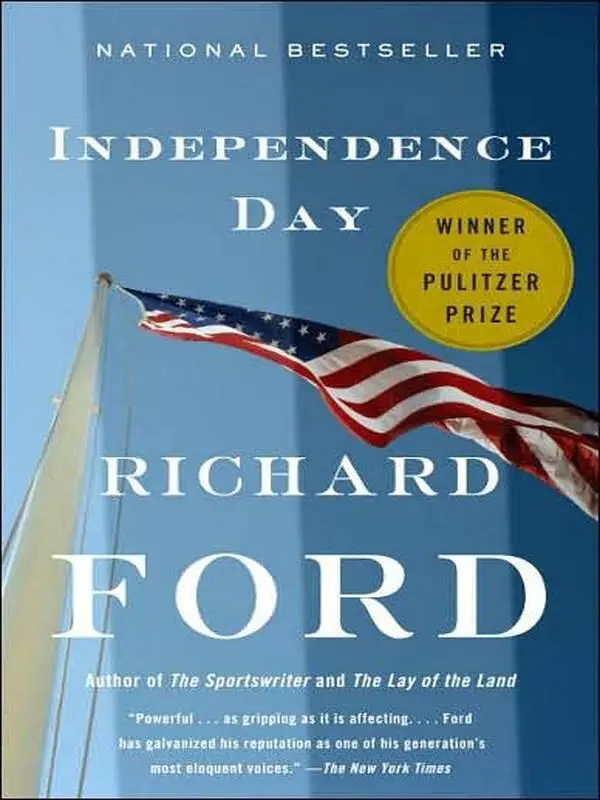
- Название:Independence Day
- Автор:
- Издательство:Vintage
- Жанр:
- Год:1996
- ISBN:нет данных
- Рейтинг книги:3 / 5. Голосов: 1
-
Избранное:Добавить в избранное
- Отзывы:
-
Ваша оценка:
Independence Day: краткое содержание, описание и аннотация
Предлагаем к чтению аннотацию, описание, краткое содержание или предисловие (зависит от того, что написал сам автор книги «Independence Day»). Если вы не нашли необходимую информацию о книге — напишите в комментариях, мы постараемся отыскать её.
, Richard Ford deepens his portrait of one of the most unforgettable characters in American fiction, and in so doing gives us an indelible portrait of America. Frank Bascombe, in the aftermath of his divorce and the ruin of his career, has entered an "Existence Period," selling real estate in Haddam, New Jersey, and mastering the high-wire act of normalcy. But over one Fourth of July weekend, Frank is called into sudden, bewildering engagement with life.
is a moving, peerlessly funny odyssey through America and through the layered consciousness of one of its most compelling literary incarnations, conducted by a novelist of astonishing empathy and perception.
Independence Day — читать онлайн бесплатно полную книгу (весь текст) целиком
Ниже представлен текст книги, разбитый по страницам. Система сохранения места последней прочитанной страницы, позволяет с удобством читать онлайн бесплатно книгу «Independence Day», без необходимости каждый раз заново искать на чём Вы остановились. Поставьте закладку, и сможете в любой момент перейти на страницу, на которой закончили чтение.
Интервал:
Закладка:
G etting going in the realty business followed as a natural offspring of selling my house and buying Ann’s. Once all was settled and I was “at home” on Cleveland Street, I started thinking again about new enterprises, about diversification and stashing my new money someplace smart. A ministorage in New Sharon, a train-station lobster house rehab, a chain of low-maintenance self-serv car washes — all rose as possibles. Though none did I immediately bite for, since I still somehow felt frozen in place, unable or unwilling or just uninspired to move into action. Without Ann and my kids nearby, I, in fact, felt as lonely and inessential and exposed as a lighthouse keeper in broad daylight.
Unmarried men in their forties, if we don’t subside entirely into the landscape, often lose important credibility and can even attract unwholesome attention in a small, conservative community. And in Haddam, in my new circumstances, I felt I was perhaps becoming the personage I least wanted to be and, in the years since my divorce, had feared being: the suspicious bachelor, the man whose life has no mystery, the graying, slightly jowly, slightly too tanned and trim middle-ager, driving around town in a cheesy ’58 Chevy ragtop polished to a squeak, always alone on balmy summer nights, wearing a faded yellow polo shirt and green suntans, elbow over the window top, listening to progressive jazz, while smiling and pretending to have everything under control, when in fact there was nothing to control.
One morning in November, though, Roily Mounger, one of the broker-agents at Lauren-Schwindell, and the one who had walked me through my buyout with the Institute and who is a big ex-Fair-leigh Dickinson nose-tackle out of Piano, Texas, called up to advise me about some tax forms I needed to get hold of after New Year’s and to fill me in on some “investment entities” dealing with government refinance grants for a bankrupt apartment complex in Kendall Park that he was putting together with “other principals”—just in case I wanted a first crack (I didn’t). He said, however, as if in passing, that he himself was just before pulling up stakes and heading to Seattle to get involved with some lucrative commercial concepts he didn’t want to get particular about; and would I like to come over and talk to some people about coming on there as a residential specialist. My name, he said, had come up “seriously” any number of times from several different sources (why, and who, I couldn’t guess and never found out and I’m sure now it was a total lie). It was generally thought, he said, I had strong natural credentials “per se” for their line of work: which was to say I was looking to get into a new situation; I wasn’t hurting for dough (a big plus in any line of work); I knew the area, was single and had a pleasant personality. Plus, I was mature — meaning over forty — and I didn’t seem to have a lot of attachments in the community, a factor that made selling houses one hell of a lot easier.
What did I think?
Training, paperwork and “all that good boool dukie,” Roily said, could be plowed under right on the job while I went nights to a three-month course up at the Weiboldt Realty Training Institute in New Brunswick, after which I could take the state boards and start printing money like the rest of them.
And the truth was, having parted with or been departed from by most everything, until I was left almost devoid of all expectation, I thought it was a reasonable idea. In those last three months I’d begun to feel that living through the consequences of my various rash acts and bad decisions had had its downsides as well as its purported rewards, and if it was possible to be at a complete loss without being miserable about it, that’s what I was. I’d started going fishing alone at the Red Man Club three afternoons a week, sometimes staying overnight in the little beaverboard cabin meant for keeping elderly members out of the rain, taking a book up with me but ultimately just lying there in the dark listening to big fish kerplunking and mosquitoes bopping the screen, while not very far away the bangety-bang of I-80 soothed the night and, out east, Gotham shone like a temple set to fire by infidels. I still registered a faint tingle of the synchronicity I’d felt when I got back from France. I was still dead set on taking the kids to Mississippi and the Pine Barrens once they were settled, and had even joined AAA and gotten color-coded maps with sidebars to various attractions down side roads (Cooperstown and the Hall of Fame was in fact one of them).
But tiny things — things I’d never even noticed when Ann lived in Haddam and we shared responsibilities and I held down my sportswriting job — had begun to get the better of me. Some little worry, some little anything, would settle into my thinking — for instance, how was I going to get my car serviced on Tuesday but also get to the airport to sign for a Greek rug I’d ordered from Thessaloníki and had been waiting on for months and was sure some thieving airport worker would steal if I wasn’t there to lay hands on it the instant it came down the conveyer? Should I rent a car? Should I send someone? Who? And would that person even be willing to go if I could think of who he or she was, or would that person think I was an idiot? Should I call the broker in Greece and tell him to delay the shipping? Should I call the freight company and say I’d be a day late getting up there and would they please see to it the rug was kept in a safe place until my car was ready? I’d wake up right in the Red Man Club cabin, my heart booming, or in my own new house, brooding about such things, sweating, clenching my fists, scheming how to get this plus a hundred other simple, ordinary things done, as if everything were a crisis as big as my health. Later I’d start to think about how stupid it was to carry such things around all day. I’d decide then to trust fate, go up and get it when I could or maybe never, or to forget the fucking rug and just go fishing. Though then I’d start to fear I was letting everything go, that my life was spinning crazy-out-of-azimuth, proportion and common sense flying out the window like pie plates. Then I’d realize that years later I’d look back on this period as a “bad time,” when I was “waaaay out there at the edge,” my everyday conduct as erratic and zany as a roomful of chimps, only I was the last to notice (again, one’s neighbors would be the first: “He really sort of stayed to himself a lot, though he seemed like a pretty nice guy. I wouldn’t have expected anything like this!”) .
Now, of course, in 1988, driving into sunny Haddam with better hopes for the day squirreling around my belly, I know the source of that devilment. I’d paid handsome dues to the brotherhood of consolidated mistake-makers, and having survived as well as I had, I wanted my goddamned benefits: I wanted everything to go my way and to be happy all the time , and I was wild it wouldn’t work out like that. I wanted the Greek rug delivery not to interfere with getting my windshield washer pump replaced. I wanted the fact that I had left France and Catherine Flaherty and come home in the best spirit of enterprise and good works to still somehow reward me in big numbers. I wanted the fact that my wife had managed to divorce me again and worse , and even divorce my kids from me, to become a fact of life I got smoothly used to and made the most of. I wanted a lot of things, in other words (these are just samples). And I’m not in fact sure all this didn’t constitute another “kind of major crisis,” though it may also be how you feel when you survive one.
But what I wanted more than anything was to quit being deviled so I could have a chance for the rest, and it occurred to me once I’d listened to Roily Mounger’s idea that I might try out a new thought (since I wasn’t making any other headway): I might just take seriously his list of my “qualifications” and let them lead me toward the unexpected — instead of going on worrying about how happy I was all the time — after which worries and contingencies might glide away like leaves on a slack tide, and I might find myself, if not in the warp of many highly dramatic events, reckless furies and rocketing joie de vivre, still as close to day-to-day happy as I could be. This code of conduct, of course, is the most self-preserving and salubrious tenet of the Existence Period and makes real estate its ideal occupation.
Читать дальшеИнтервал:
Закладка:
Похожие книги на «Independence Day»
Представляем Вашему вниманию похожие книги на «Independence Day» списком для выбора. Мы отобрали схожую по названию и смыслу литературу в надежде предоставить читателям больше вариантов отыскать новые, интересные, ещё непрочитанные произведения.








Обсуждение, отзывы о книге «Independence Day» и просто собственные мнения читателей. Оставьте ваши комментарии, напишите, что Вы думаете о произведении, его смысле или главных героях. Укажите что конкретно понравилось, а что нет, и почему Вы так считаете.