Richard Ford - Independence Day
Здесь есть возможность читать онлайн «Richard Ford - Independence Day» весь текст электронной книги совершенно бесплатно (целиком полную версию без сокращений). В некоторых случаях можно слушать аудио, скачать через торрент в формате fb2 и присутствует краткое содержание. Год выпуска: 1996, Издательство: Vintage, Жанр: Современная проза, на английском языке. Описание произведения, (предисловие) а так же отзывы посетителей доступны на портале библиотеки ЛибКат.
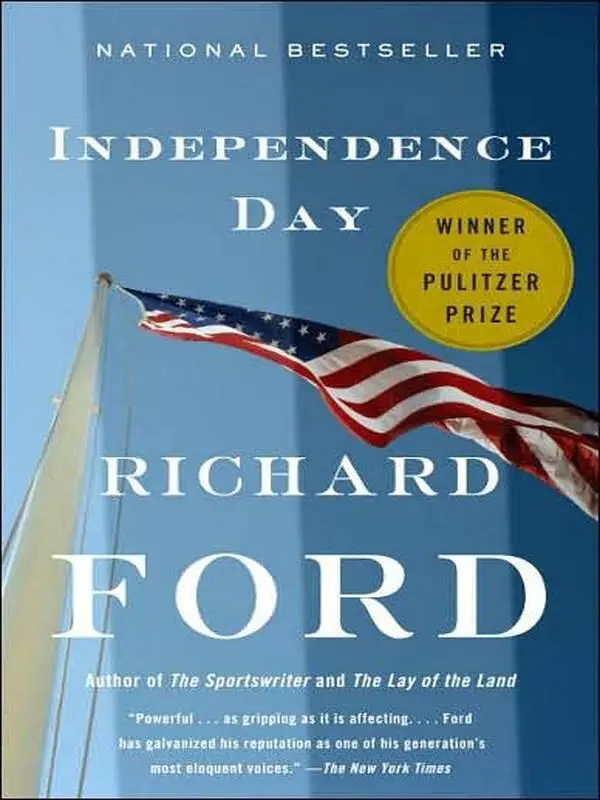
- Название:Independence Day
- Автор:
- Издательство:Vintage
- Жанр:
- Год:1996
- ISBN:нет данных
- Рейтинг книги:3 / 5. Голосов: 1
-
Избранное:Добавить в избранное
- Отзывы:
-
Ваша оценка:
Independence Day: краткое содержание, описание и аннотация
Предлагаем к чтению аннотацию, описание, краткое содержание или предисловие (зависит от того, что написал сам автор книги «Independence Day»). Если вы не нашли необходимую информацию о книге — напишите в комментариях, мы постараемся отыскать её.
, Richard Ford deepens his portrait of one of the most unforgettable characters in American fiction, and in so doing gives us an indelible portrait of America. Frank Bascombe, in the aftermath of his divorce and the ruin of his career, has entered an "Existence Period," selling real estate in Haddam, New Jersey, and mastering the high-wire act of normalcy. But over one Fourth of July weekend, Frank is called into sudden, bewildering engagement with life.
is a moving, peerlessly funny odyssey through America and through the layered consciousness of one of its most compelling literary incarnations, conducted by a novelist of astonishing empathy and perception.
Independence Day — читать онлайн бесплатно полную книгу (весь текст) целиком
Ниже представлен текст книги, разбитый по страницам. Система сохранения места последней прочитанной страницы, позволяет с удобством читать онлайн бесплатно книгу «Independence Day», без необходимости каждый раз заново искать на чём Вы остановились. Поставьте закладку, и сможете в любой момент перейти на страницу, на которой закончили чтение.
Интервал:
Закладка:
Eventually, after a long recovery during which one or the other would have had to relearn some basic human life functions up to now taken for granted (walking, breathing, pissing), certain key conversations would’ve taken place, certain dour admissions been offered if not already offered in moments of extremis, and important truths reconciled so that a new and (this time) binding union could be forged.
Or maybe not. Maybe we would simply have parted again, though with new strengths and insights and respects achieved through the fragile life experiences of the other.
But all of that was gone like a fart in a skillet. And jeez Louise! If I’d thought back in ’81 that Ann would get remarried, I’d have fought it like a Viking instead of giving in to divorce like a queasy, uninspired saint. And I’d have fought it for a damn good reason: because no matter where she held the mortgage papers, she completely supposed my existence. My life was (and to some vague extent still is) played out on a stage in which she’s continually in the audience (whether she’s paying attention or not). All my decent, reasonable, patient, loving components were developed in the experimental theater of our old life together, and I realized that by moving house up to Deep River she was striking most of the components, dismembering the entire illusion, intending to hook up with another, leaving me with only faint, worn-out costumes to play myself with.
Naturally enough, I fell into a deep, sulfurous, unsynchronous gloom, stayed at home, called no one for days, drank a lot more gin, reconsidered heavy-equipment-operator’s class and becoming an unwieldy embarrassment to people who knew me, and overall felt myself becoming significantly less substantial.
I spoke once or twice to my children, who seemed to calculate their mother’s marriage to Charley O’Dell with the alacrity with which a small investor notices a gain in a stock he feels certain he’ll eventually lose money on. Though he’d later change his mind, Paul uncomfortably declared Charley to be an “okay” guy and admitted having gone to a Giants game with him in November (something I hadn’t heard about because I was in Florida and contemplating going to France). Clarissa seemed more interested in the wedding itself than in the conception of remarriage, which didn’t seem to worry her much. She was concerned with what she was going to wear, where everyone would stay (the Griswold Inn in Essex) and if I could be invited (“No”), plus whether she could be a bridesmaid if I got married in the future (which she said she hoped I would). All three of us talked about all these matters for a while via extension phones. I tried to calm fears, sweeten prospects and simplify growing confusions about my own and their possible unhappiness, until there was nothing left to say, after which we parted company, never to speak under those exact circumstances or in those same innocent voices again. Gone. Poof.
T he wedding itself was an intimate though elegant “on the grounds” affair at Charley’s house—“The Knoll” (pretentious hand-hewn post-and-beam Nantucket cottage adaptation: giant windows, wood from Norway and Mongolia, everything built-in flush, rabbeted, solar panels, heated floors, Finnish sauna, on and on and on). Ann’s mother flew in from Mission Viejo, Charley’s aged parents somehow motored down from Blue Hill or Northeast Harbor or some such magnate’s enclave, with the happy couple flying off to the Huron Mountain Club, where Ann’s father had left her his membership.
But no sooner had Ann solemnized her retreaded vows than I plunged forward with my own plans (founded on my previously explained sense of practicality, since high-spirited synchronicity hadn’t fared well) to purchase her house on Cleveland Street for four ninety-five, and to get rid of my big old soffit-sagging half-timber on Hoving Road, where I’d lived nearly every minute of my life in Haddam and where I mistakenly thought I could live forever, but which now seemed to be one more commitment holding me back. Houses can have this almost authorial power over us, seeming to ruin or make perfect our lives just by persisting in one place longer than we can. (In either case it’s a power worth defeating.)
Ann’s house was a crisp, well-kept freestanding Greek Revival town house of a style and 1920s vintage typical of the succinct, Nice-but-not-finicky central Jersey architectural temper — a place she’d bought on the cheap (with my help) after our divorce and done some modernizing work on (“opening out” the back, adding skylights and crown moldings, repointing some basement piers, finishing off the third floor to be Paul’s lair, then giving the clapboards a new white paint job and new green shutters).
In truth, the house was a natural for me, since I’d already spent a three-years collection of sleepless nights there when a child was sick or when, in the early days of our sad divorced limbo, I’d sometimes gotten the jimjams so bad Ann would take pity on me and let me slip in and sleep on the couch.
It felt like home, in other words; and if not my home, at least my kids’ home, someone’s home. Whereas since Ann’s announcement, my old place had begun to feel barny and murky, murmurous and queer, and myself strangely outdistanced as its owner — in the yard cranking away on the Lawn-Boy, or standing in my driveway, hands on hips, supervising from below the patching of a new squirrel hole under the chimney flashing. I was no longer, I felt, preserving anything for anything, even for myself, but was just going through the motions, joining life’s rough timbers end to end.
Consequently, I got promptly over to Lauren-Schwindell and threw my hat in both rings at once: hers to buy, mine to sell. My thinking was, if lightning struck and Charley and his new bride came unglued during week one, Ann and I could forge our new beginning in her house (then later move to Maine more or less as newlyweds).
So, before the O’Dells returned home (no annulment was pending), I’d entered a full-price cash offer on 116 Cleveland and, through a savvy intercession by old man Otto Schwindell himself, reached an extremely advantageous deal with the Theological Institute to take over my house for the purpose of converting it into the Ecumenical Center where guests like Bishop Tutu, the Dalai Lama and the head of the Icelandic Federation of Churches could hold high-level confabs about the fate of the world’s soul, and still find accommodations homey enough to slip down after midnight for a snack.
The Institute’s Board of Overseers was, in fact, highly sensitive to my tax situation, since my house appraised out at an eye-popping million two, near the peak of the boom. Their lawyers were able to set up a healthy annuity which earns interest for me and later passes on to Paul and Clarissa, and by whose terms I in essence donated my house as an outright gift, claimed a whopper deduction and afterward received a generous “consultant’s” fee in what I think of as temporal affairs. (This tax loophole has since been closed, but too late, since what’s done’s done.)
One bright and green August day, I simply walked out the door and down the steps of my house, leaving all my furniture except for books and nostalgic attachments (my map of Block Island, a hatch-cover table, a leather chair I liked, my marriage bed), drove over to Ann’s house on Cleveland, with all her old-new furniture sitting exactly where she’d left it, and took up residence. I was allowed to keep my old phone number.
And truth to tell I hardly noticed the difference, so often had I lain awake nights in my old place or roamed the rooms and halls of hers when all were sleeping — searching, I suppose, for where I fit in, or where I’d gone wrong, or how I could breathe air into my ghostly self and become a recognizable if changed-for-the-better figure in their sweet lives or my own. One house is as good as another for this kind of private enterprise. And the poet was right again: “Let the wingèd Fancy roam, / Pleasure never is at home.”
Читать дальшеИнтервал:
Закладка:
Похожие книги на «Independence Day»
Представляем Вашему вниманию похожие книги на «Independence Day» списком для выбора. Мы отобрали схожую по названию и смыслу литературу в надежде предоставить читателям больше вариантов отыскать новые, интересные, ещё непрочитанные произведения.



Обсуждение, отзывы о книге «Independence Day» и просто собственные мнения читателей. Оставьте ваши комментарии, напишите, что Вы думаете о произведении, его смысле или главных героях. Укажите что конкретно понравилось, а что нет, и почему Вы так считаете.